VI.15.1 Pompeii. House of the
Vettii or Casa dei Vettii or Domus Vettiorum.
Excavated 1894-1895. Linked to VI.15.27.
Peristyle
Part 3 Part 4 Part 1 Part 2 VI.15.1 Plan
In Notizie degli Scavi, prior to January 1897, this house was described as being in Insula 12 of Reg. VI, afterwards it was changed to Insula 15 of Reg. VI.
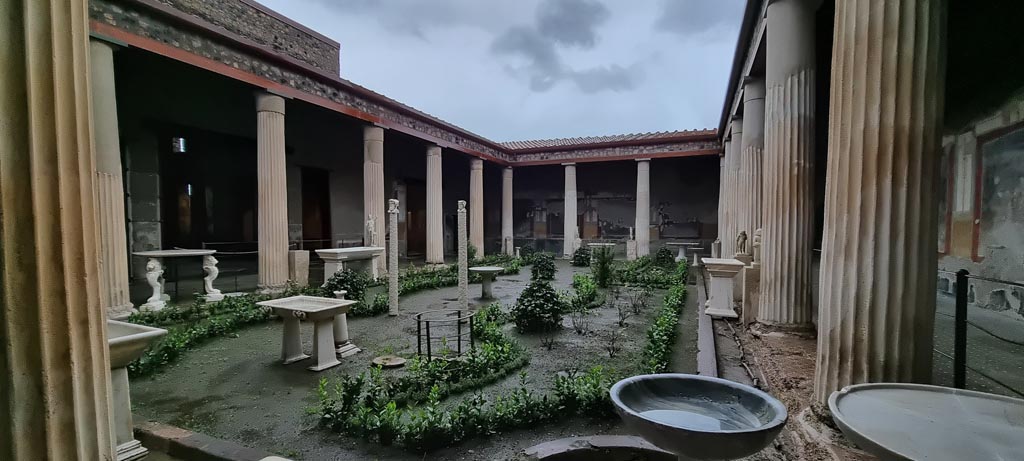
VI.15.1 Pompeii. January 2023.
Looking south-east across peristyle garden from north-west corner. Photo courtesy of Miriam Colomer.
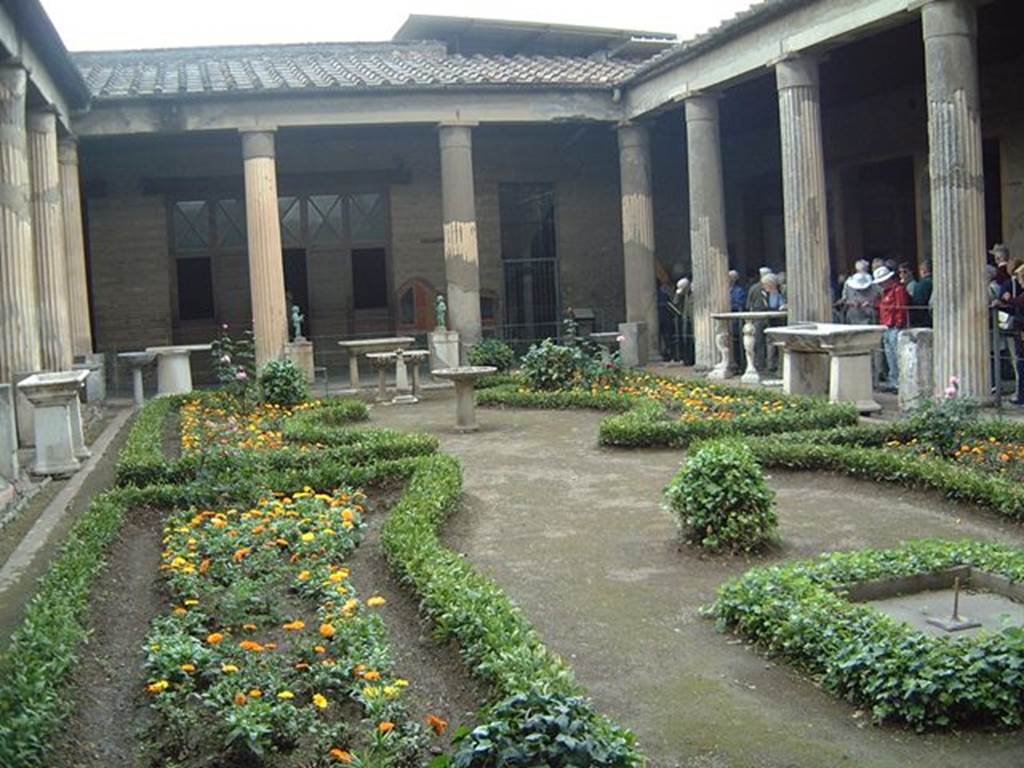
VI.15.1 Pompeii. Peristyle. View of garden looking north in May 2001. Photograph courtesy of Current Archaeology.
According to Jashemski,
“Water from 12 fountain statuettes (2 bronze and 10 marble) on bases placed between the columns of the portico, jetted into 8 marble basins which stood in the water channel at the edge of the garden. 9 of the fountain statuettes were preserved and used to be on display in the garden.
In 1978, the 4 fountain statuettes from the north end of the garden were stolen, eventually being recovered, but in pieces.
The remaining statuettes were removed for safe keeping.”
See Jashemski, W. F., 1993. The Gardens of Pompeii, Volume II: Appendices. New York: Caratzas. (p.153-54).
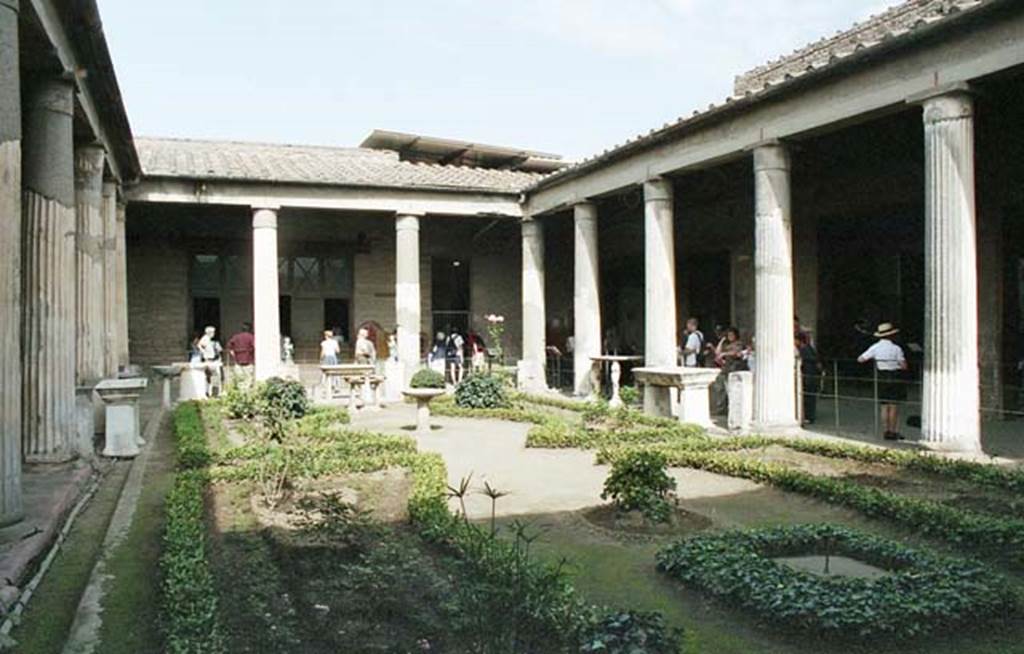
VI.15.1 Pompeii. October 2001. Peristyle. View of garden looking north. Photo courtesy of Peter Woods.
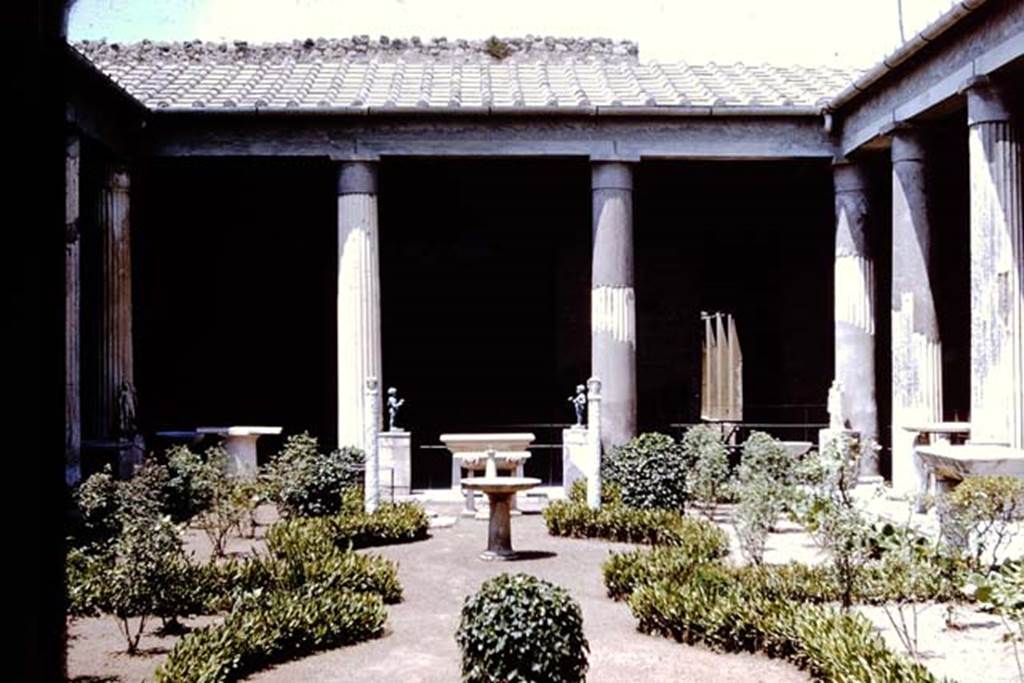
VI.15.1 Pompeii. 1964. Looking towards north end of garden area. Photo by Stanley A. Jashemski.
Source: The Wilhelmina and Stanley A. Jashemski archive in the University of Maryland Library, Special Collections (See collection page) and made available under the Creative Commons Attribution-Non-Commercial License v.4. See Licence and use details.
J64f1866
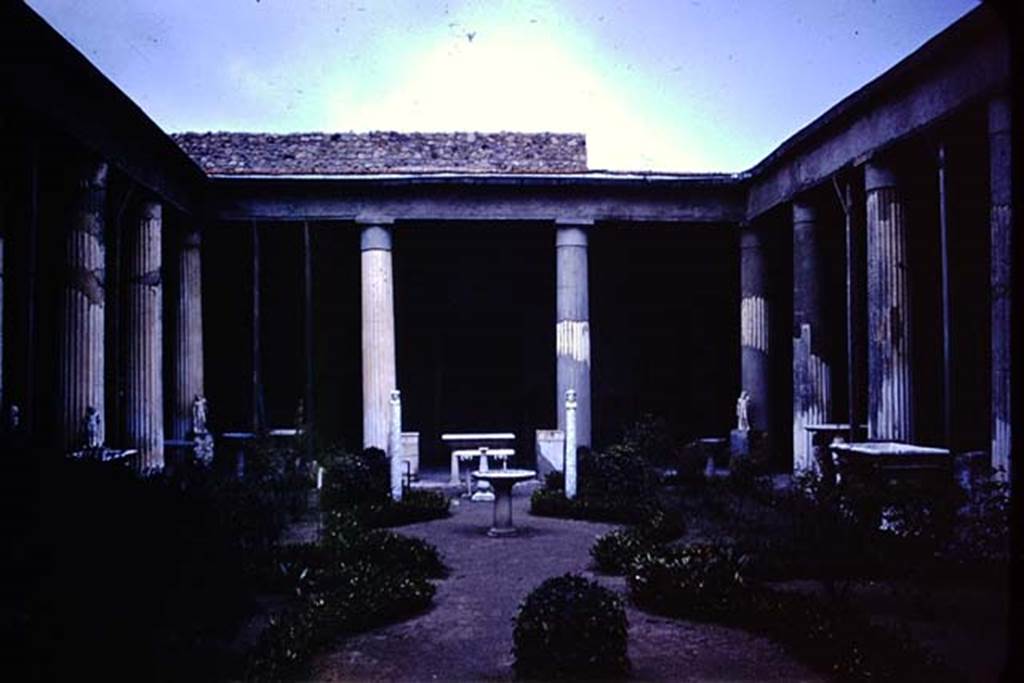
VI.15.1 Pompeii. 1955. Looking towards north end of garden area. Photo by Stanley A. Jashemski.
Source: The Wilhelmina and Stanley A. Jashemski archive in the University of Maryland Library, Special Collections (See collection page) and made available under the Creative Commons Attribution-Non-Commercial License v.4. See Licence and use details.
J55f0480 and 497
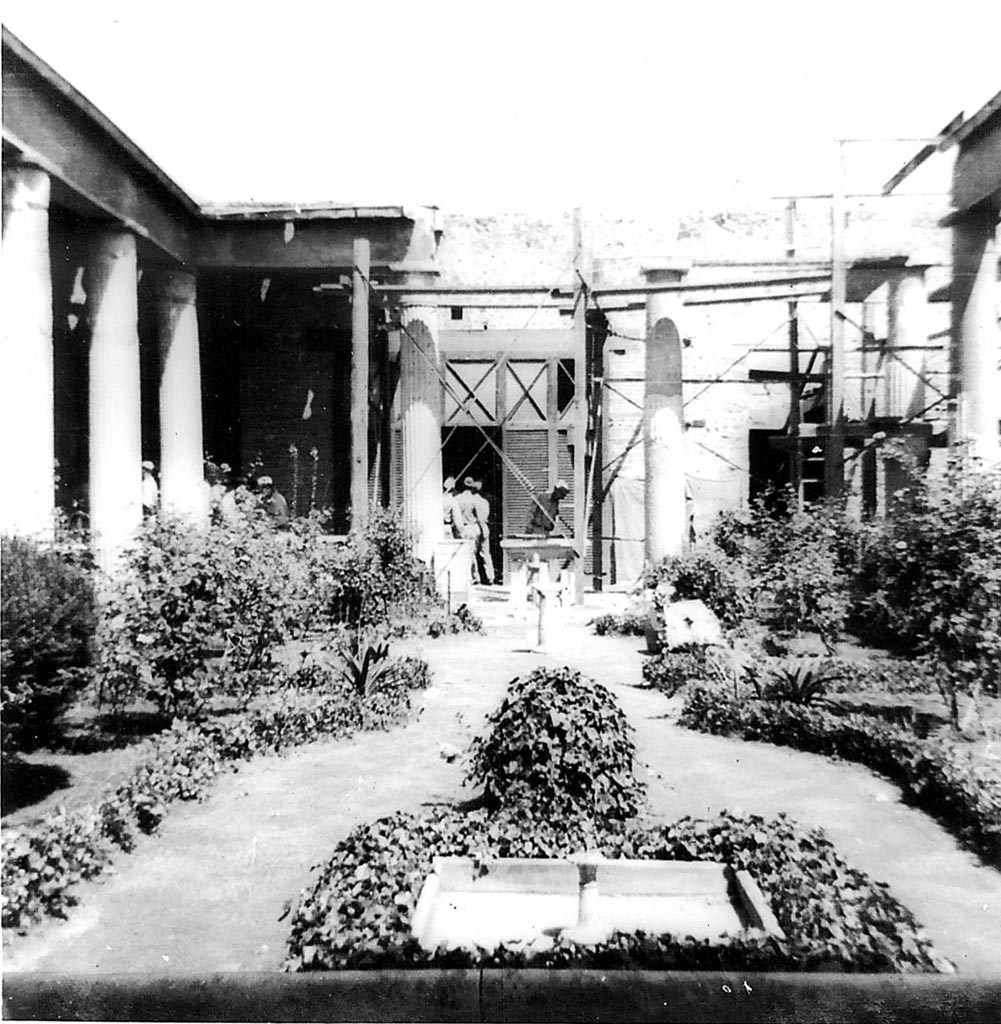
VI.15.1 Pompeii. 1944. Peristyle garden, looking north. Photo courtesy of Rick Bauer.
According to Garcia y Garcia, not even the most famous house in Pompeii was saved from the 1943 bombardment.
The troops of tourists that have visited there each day, are mostly ignorant of the reality of the events.
On the night of 16th September 1943, a bomb fell and destroyed the north-east corner of the peristyle causing the subsidence of the floor of the peristyle.
This also caused the destruction of a part of the north perimeter wall, the ruin of three columns in the peristyle, and the partial loss of the IV style painted wall from the north portico, and the west wall of the peristyle.
Damage was also suffered in the south-west part of the triclinium and the north wall of the oecus of Pasiphae, to the north-east of the peristyle.
The south corner of the women’s gynaeceum to the north of the peristyle was also partially ruined.
In the south-east corner of this area was the triclinium decorated with the painting of Hercules and Auge on the south wall.
This was damaged in its lower parts, without the possibility of restoration.
Partially damaged was the roof of the walkways around the peristyle, and that of the oecus of Pasiphae, and in the cubiculum to the north of the atrium.
The other paintings in the house were saved by a miracle.
See Garcia y
Garcia, L., 2006. Danni di guerra a Pompei. Rome: L’Erma di Bretschneider. (p.93-96,
including photos).
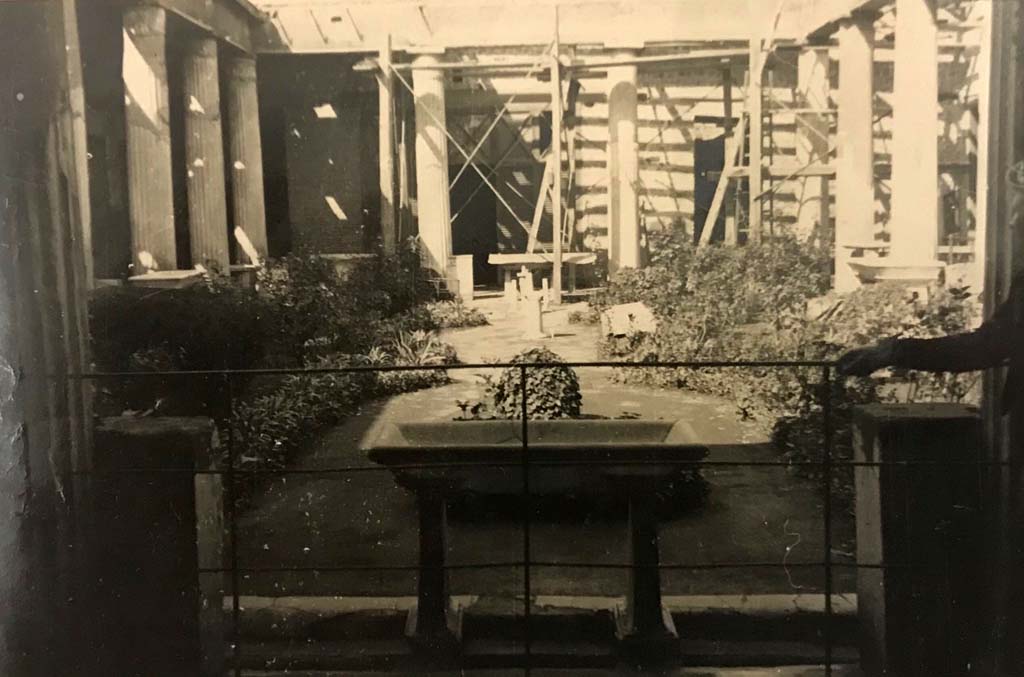
VI.15.1 Pompeii. 1944. Peristyle garden, looking north towards bomb-damaged area. Photo courtesy of Rick Bauer.
(This photo was in an album belonging to a sailor assigned to
Patrol Squadron 63 (VP-63).)
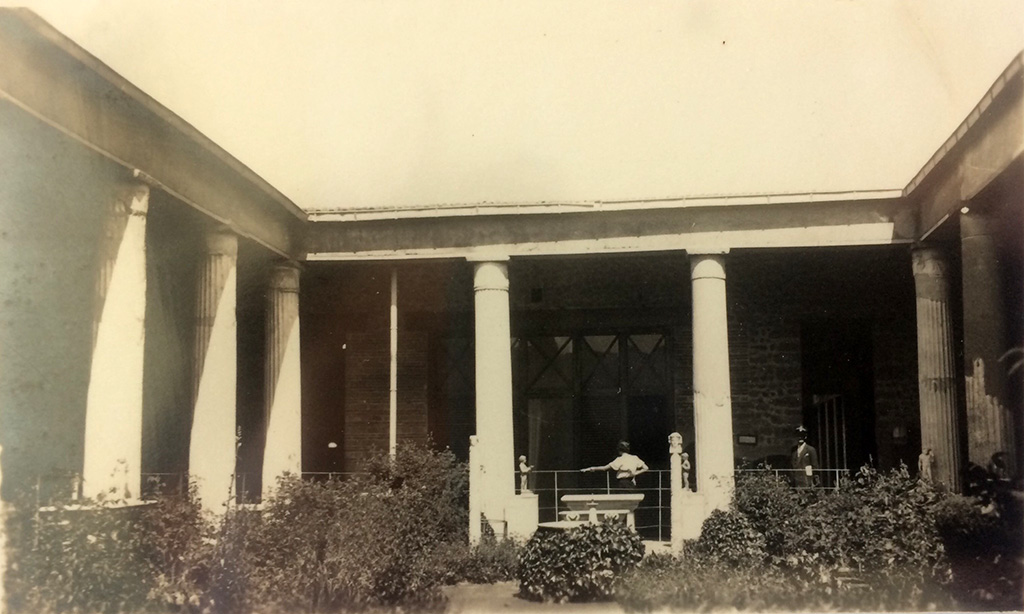
VI.15.1 Pompeii. 1933. Looking north across garden area. Photo
courtesy of Rick Bauer.
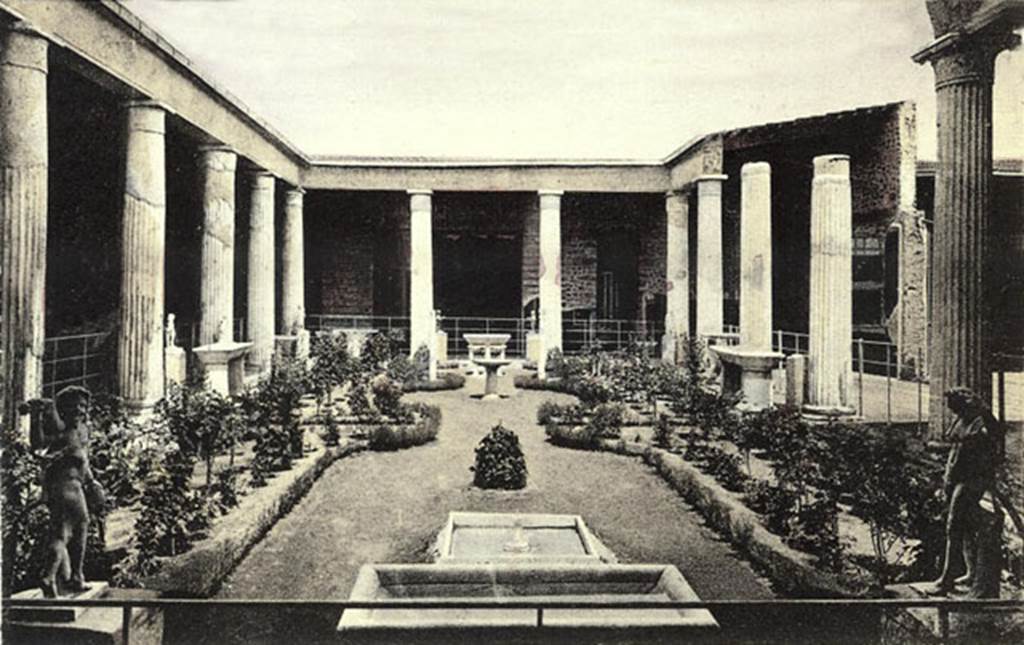
VI.15.1 Pompeii. Old postcard. Peristyle garden looking north. Photo courtesy of Rick Bauer.
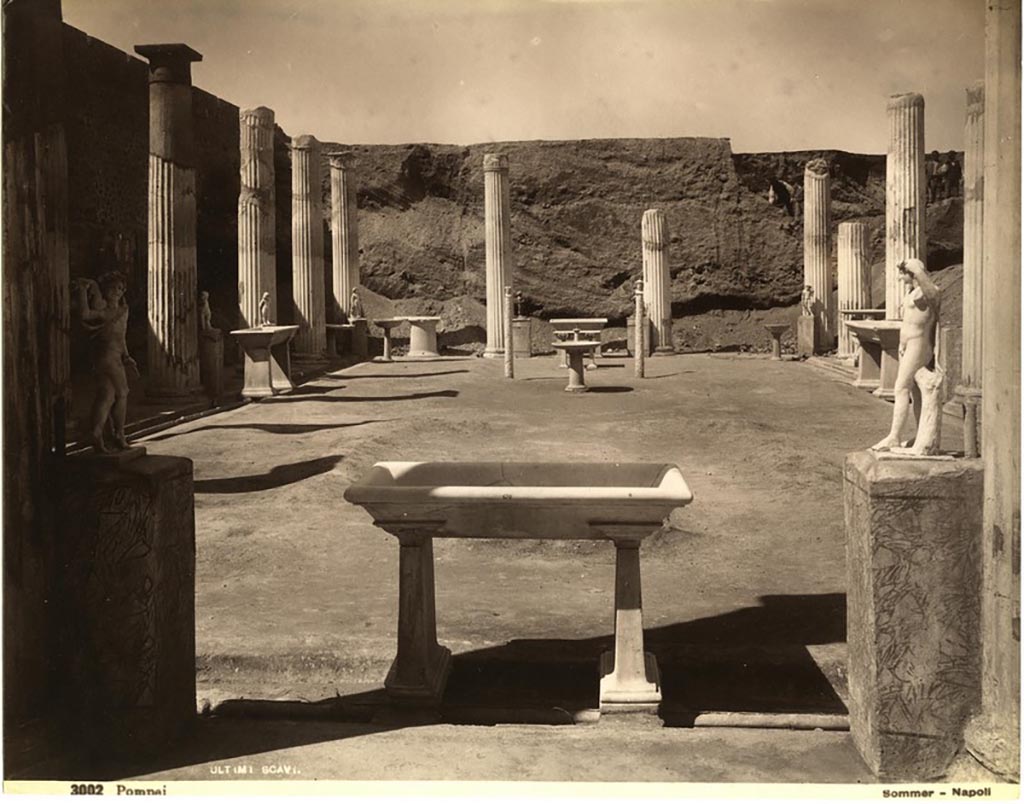
VI.15.1 Pompeii. Looking north across peristyle during excavation.
Photograph No.
3002, by Giorgio Sommer, (1834-1914), described as “Ultimi scavi”. Public domain, via Wikimedia Commons.
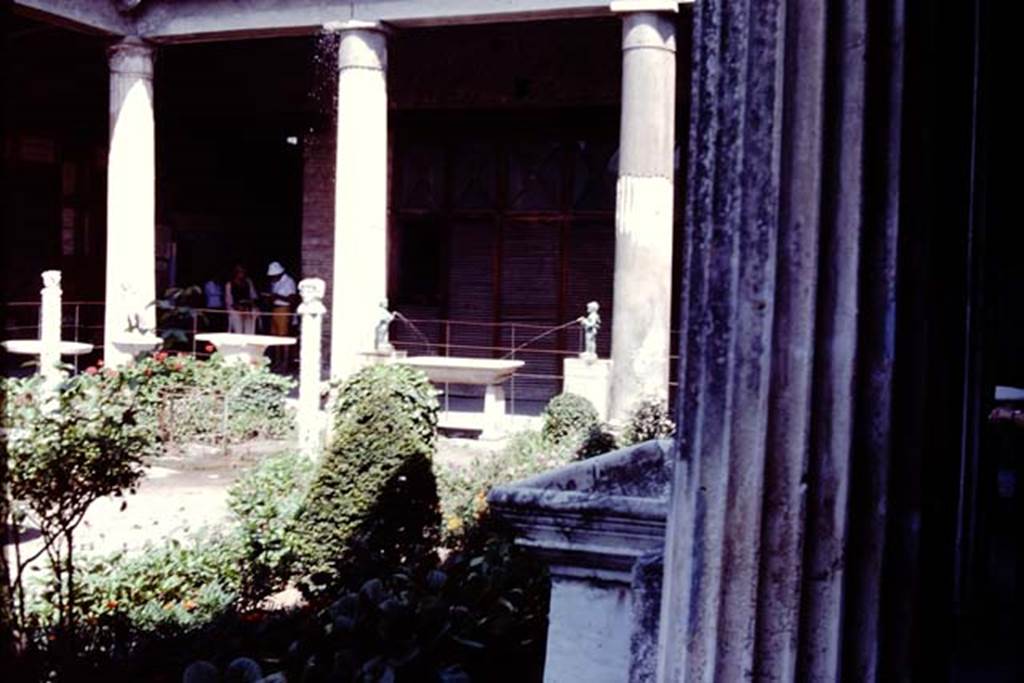
VI.15.1 Pompeii. 1977. Looking towards north side, with working statuette fountains. Photo by Stanley A. Jashemski.
Source: The Wilhelmina and Stanley A. Jashemski archive in the University of Maryland Library, Special Collections (See collection page) and made available under the Creative Commons Attribution-Non-Commercial License v.4. See Licence and use details.
J77f0283
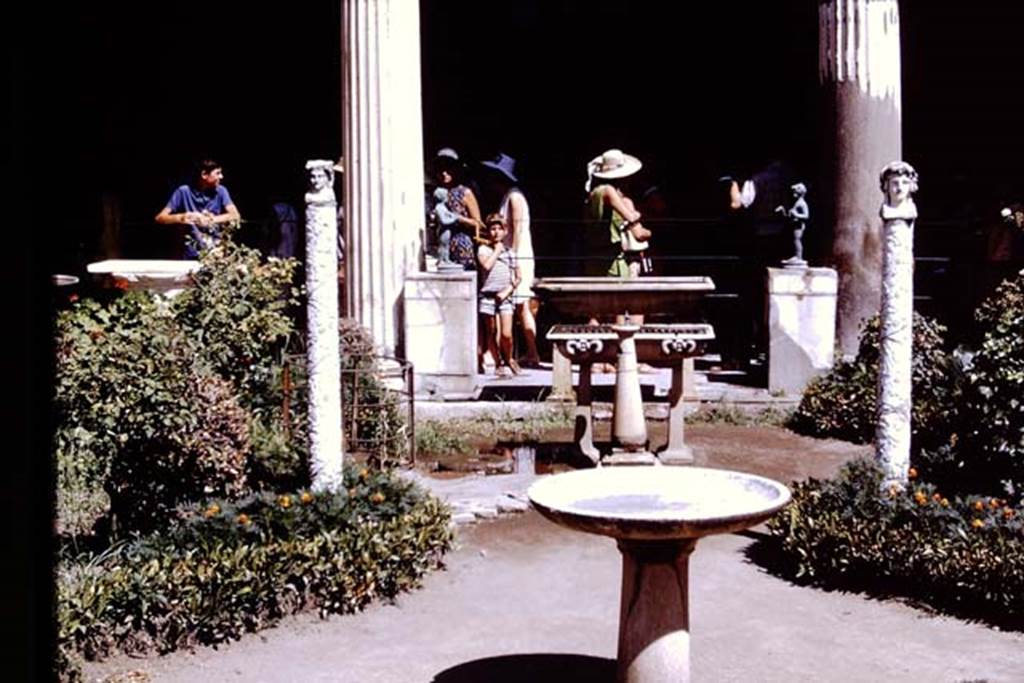
VI.15.1 Pompeii, 1968. North side of peristyle with statuettes in situ. Photo by Stanley A. Jashemski.
Source: The Wilhelmina and Stanley A. Jashemski archive in the University of Maryland Library, Special Collections (See collection page) and made available under the Creative Commons Attribution-Non-Commercial License v.4. See Licence and use details.
J68f0690
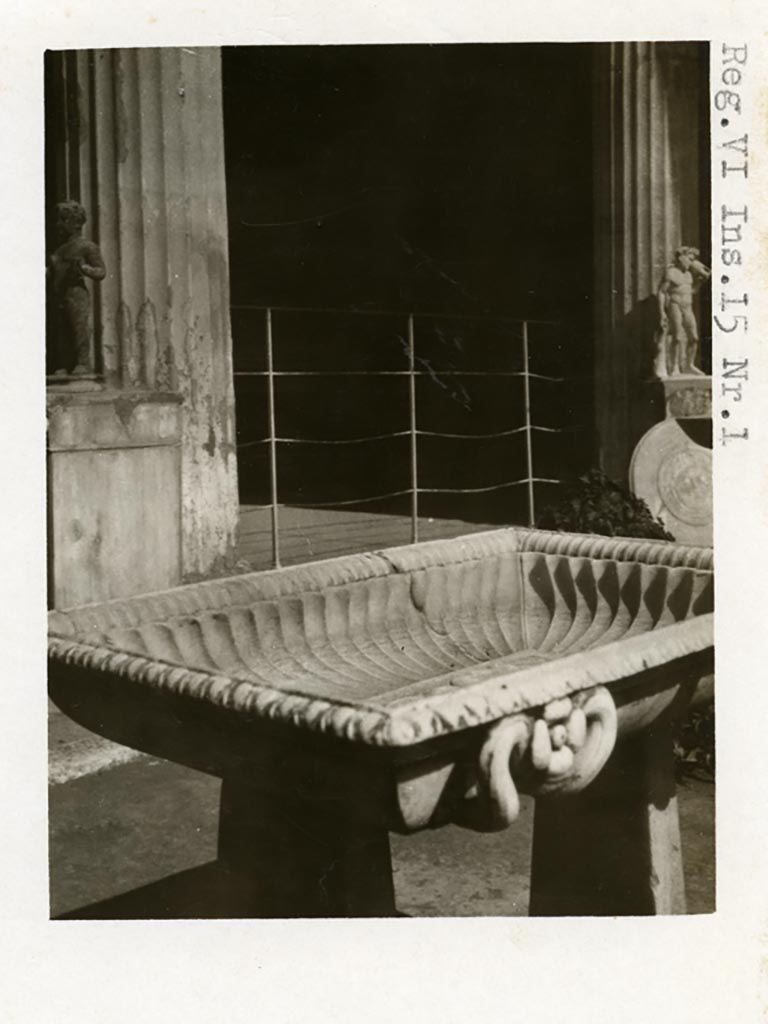
VI.15.1 Pompeii. Pre-1937-39. Detail of basin at north end.
Photo courtesy of American Academy in Rome, Photographic Archive. Warsher collection no. 1386.
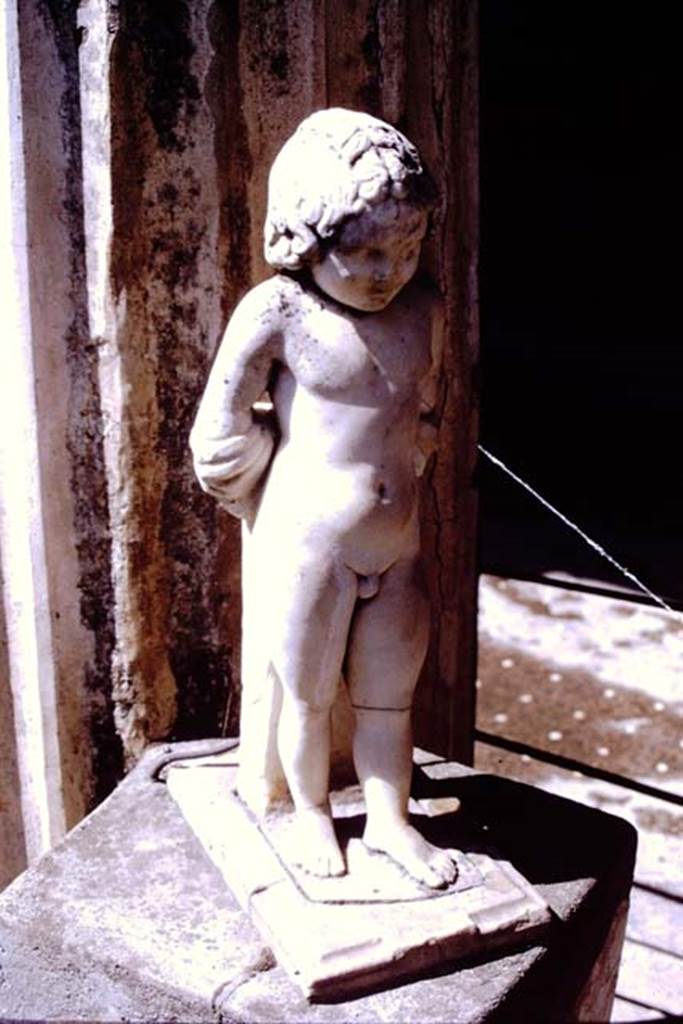
VI.15.1 Pompeii, 1968. Marble statuette of a boy. Photo by Stanley A. Jashemski.
Source: The Wilhelmina and Stanley A. Jashemski archive in the University of Maryland Library, Special Collections (See collection page) and made available under the Creative Commons Attribution-Non-Commercial License v.4. See Licence and use details.
J68f0687
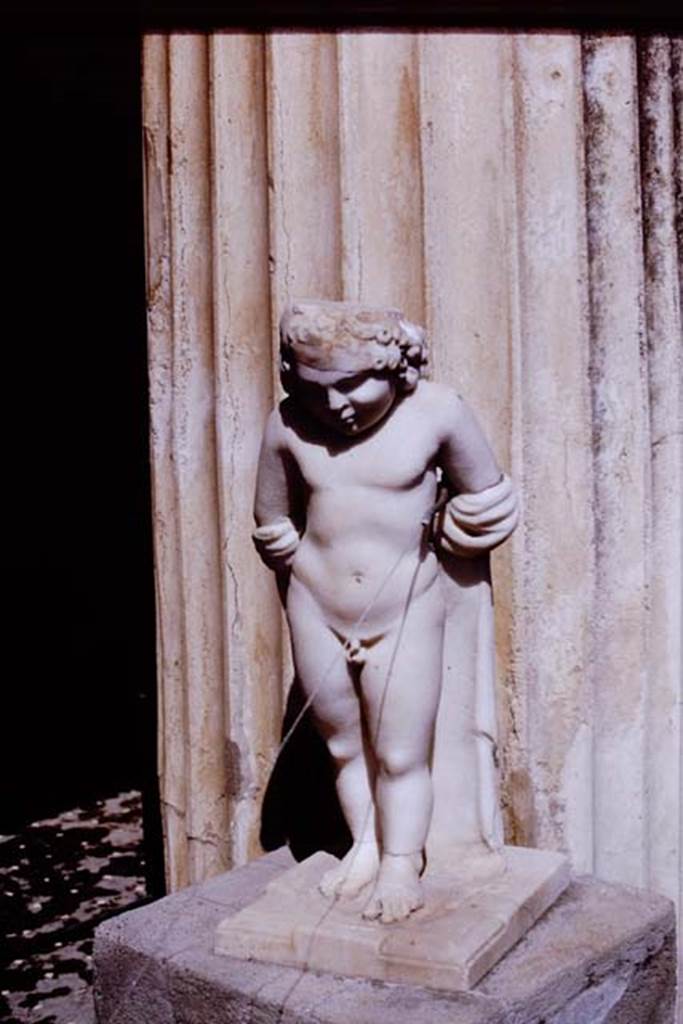
VI.15.1 Pompeii, 1968. Marble statuette of a boy. Photo by Stanley A. Jashemski.
Source: The Wilhelmina and Stanley A. Jashemski archive in the University of Maryland Library, Special Collections (See collection page) and made available under the Creative Commons Attribution-Non-Commercial License v.4. See Licence and use details.
J68f0683
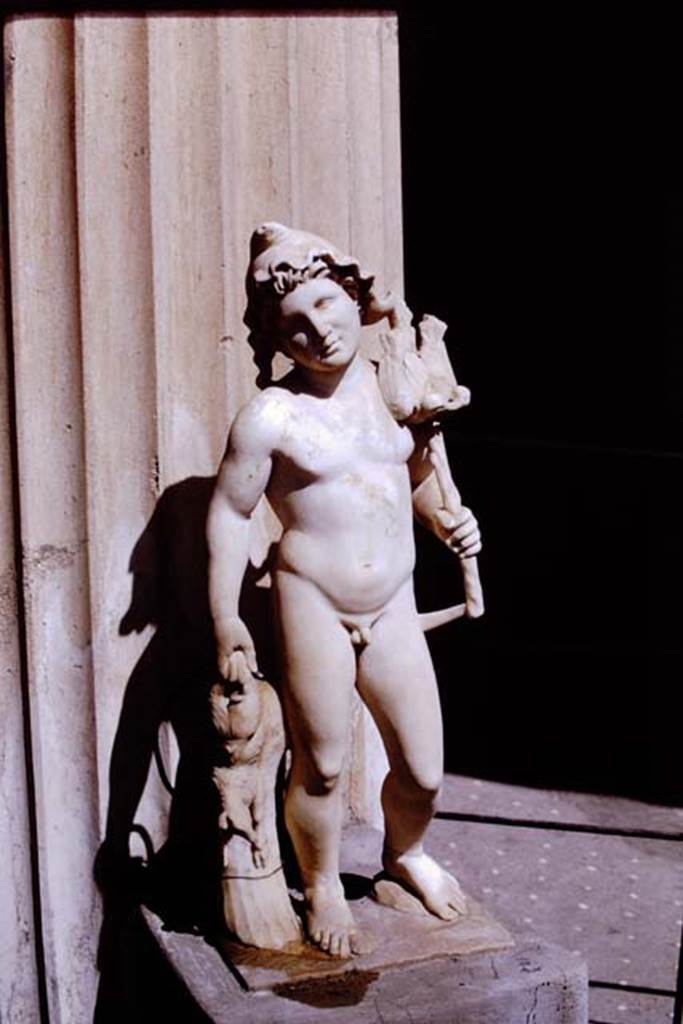
VI.15.1 Pompeii, 1968. Marble statuette in north-west corner. Photo by Stanley A. Jashemski.
Source: The Wilhelmina and Stanley A. Jashemski archive in the University of Maryland Library, Special Collections (See collection page) and made available under the Creative Commons Attribution-Non-Commercial License v.4. See Licence and use details.
J68f0684
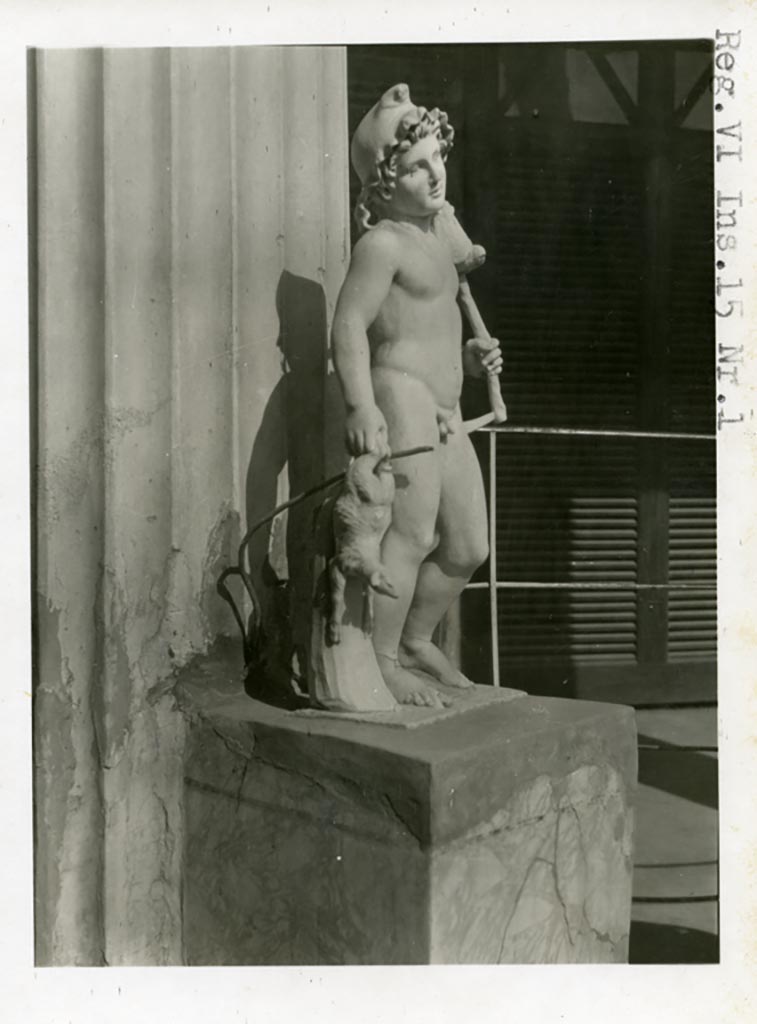
VI.15.1 Pompeii. Pre-1937-39. Marble statuette in north-west corner.
Photo courtesy of American Academy in Rome, Photographic Archive. Warsher collection no. 1387.
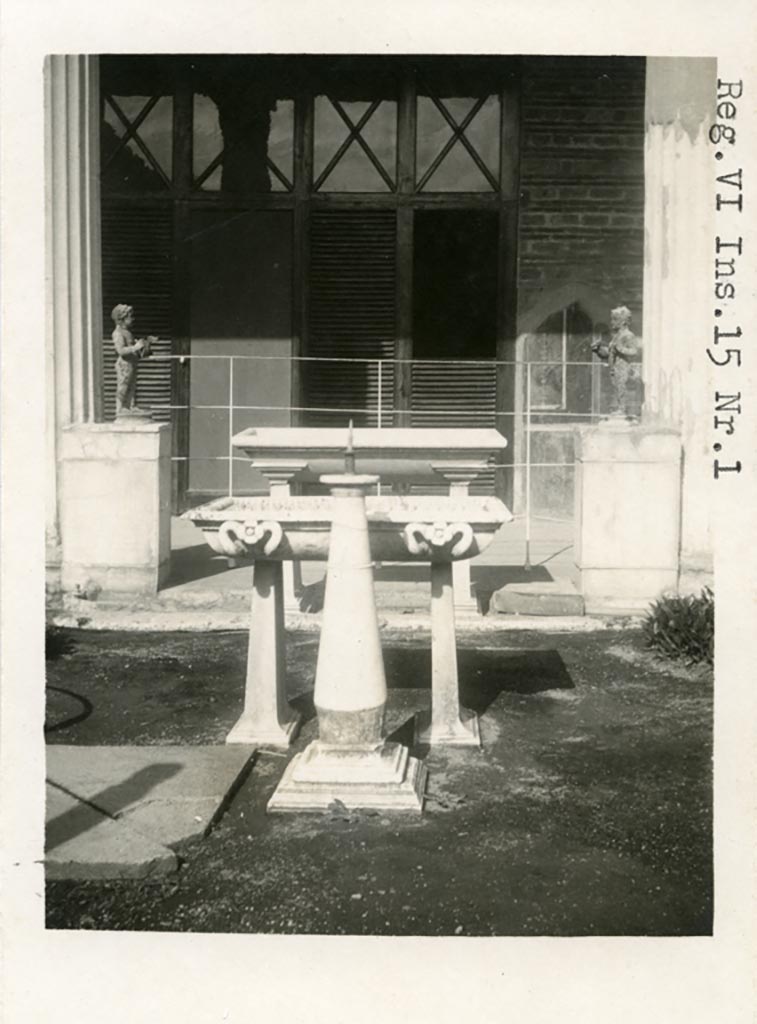
VI.15.1 Pompeii. Pre-1937-39.
North side of peristyle with statuettes in situ, looking towards doorway to Cupid’s room.
Photo courtesy of American Academy in Rome, Photographic Archive. Warsher collection no. 507.
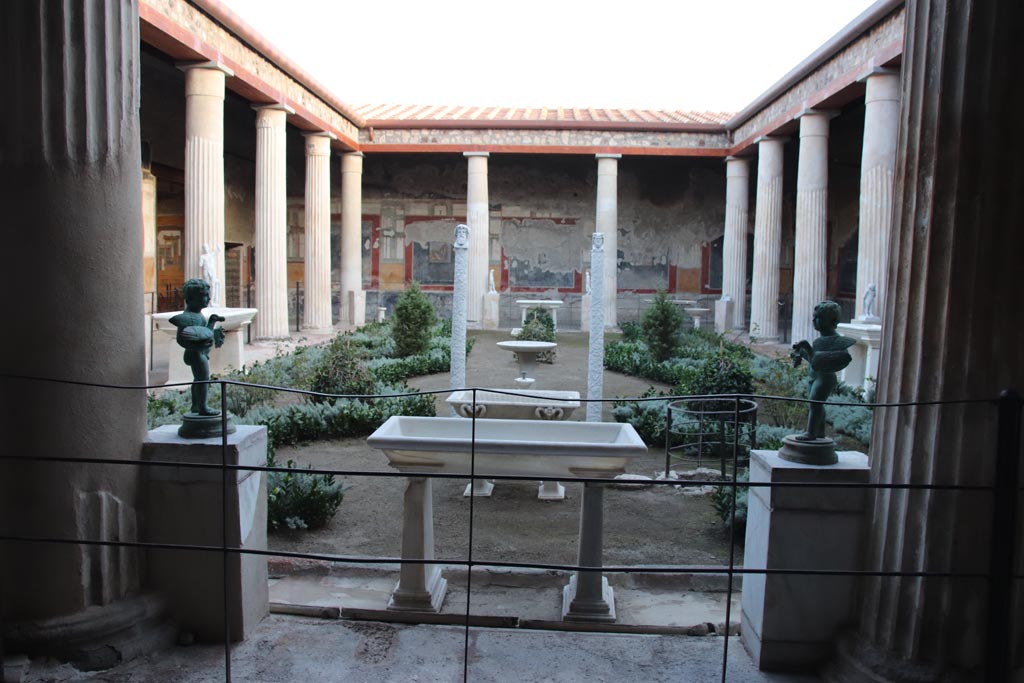
VI.15.1 Pompeii. October 2023.
Looking south across peristyle garden from north portico outside of the “Cupid’s room”. Photo courtesy of Klaus Heese.
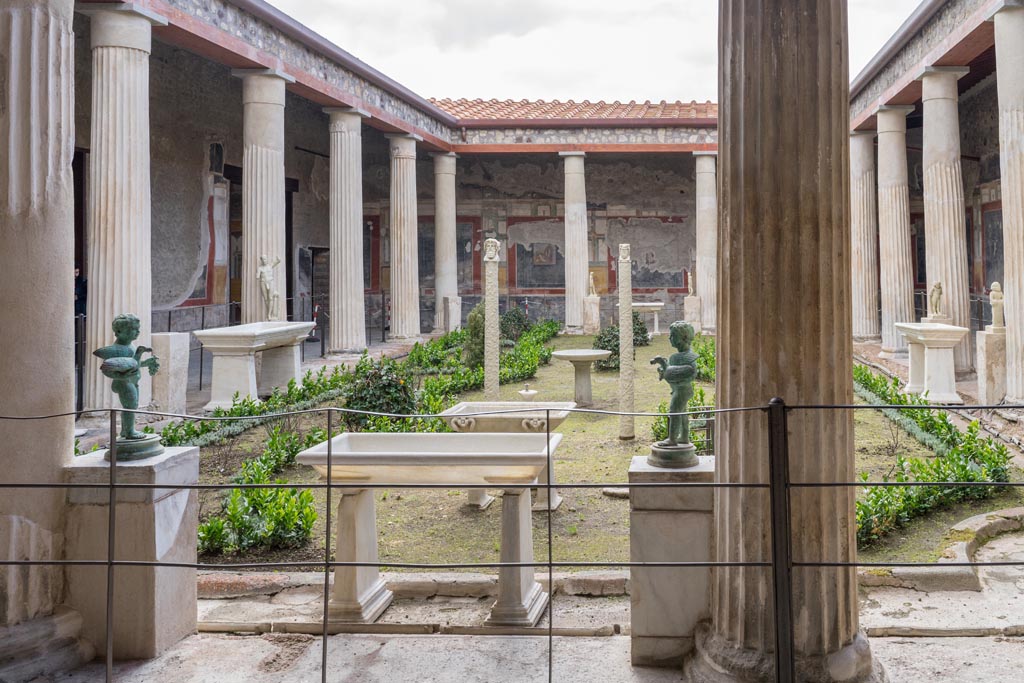
VI.15.1 Pompeii. March 2023.
Looking south-east across peristyle garden from north portico outside of the “Cupid’s room”. Photo courtesy of Johannes Eber.
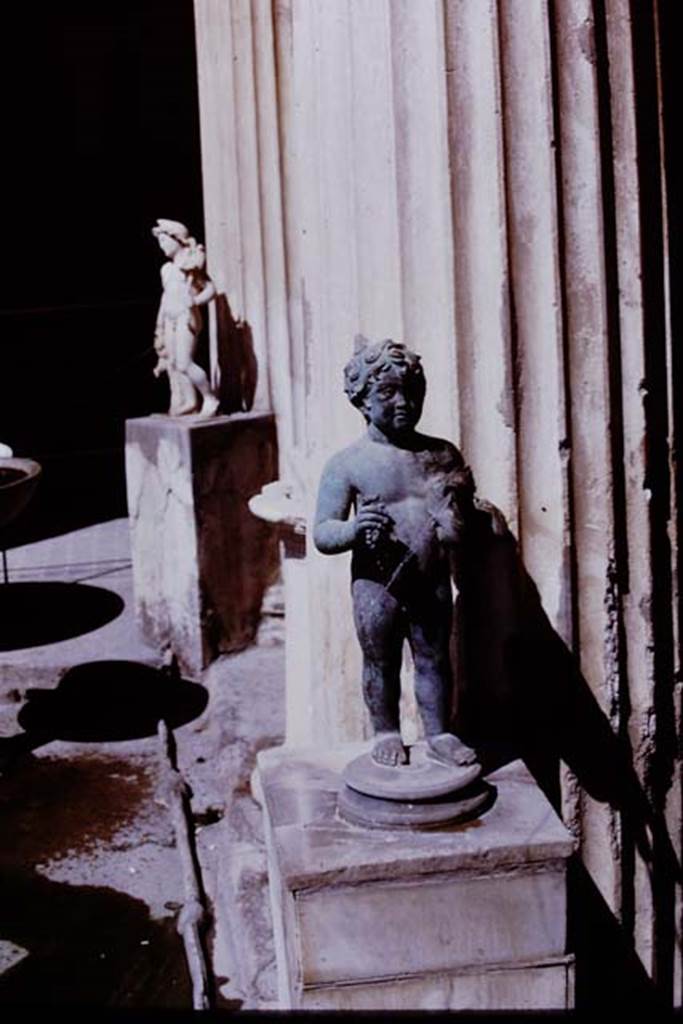
VI.15.1 Pompeii, 1968. Looking towards the north-west corner.
The lead pipe that was laid in the gutter to provide water to the fountains can be seen.
Photo by Stanley A. Jashemski.
Source: The Wilhelmina and Stanley A. Jashemski archive in the University of Maryland Library, Special Collections (See collection page) and made available under the Creative Commons Attribution-Non-Commercial License v.4. See Licence and use details.
J68f0686
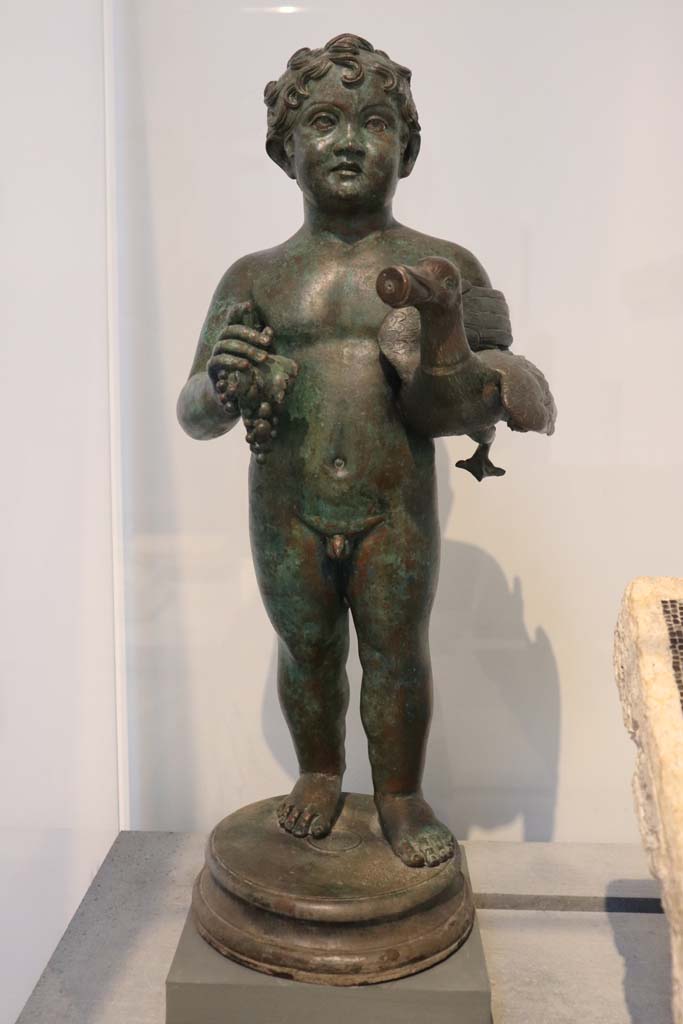
VI.15.1
Pompeii. February 2021.
Bronze statuette of
young boy holding a goose, on display in Antiquarium.
Photo courtesy of
Fabien Bièvre-Perrin (CC BY-NC-SA).
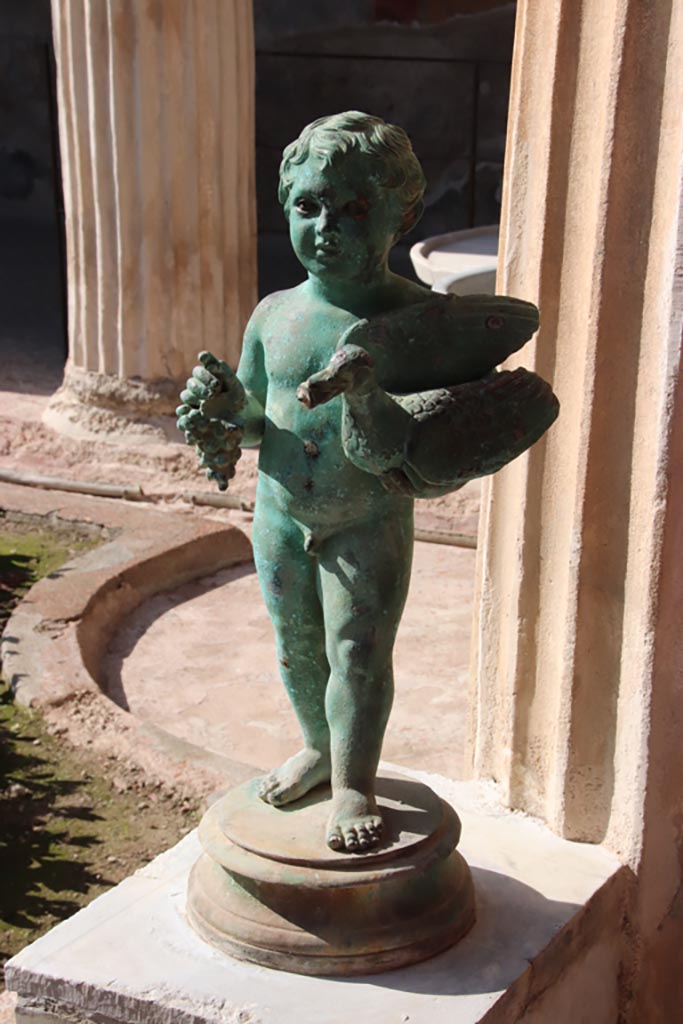
VI.15.1 Pompeii.
October 2023.
Bronze statuette of boy with grapes and a goose/duck.
Photo courtesy of Klaus Heese.
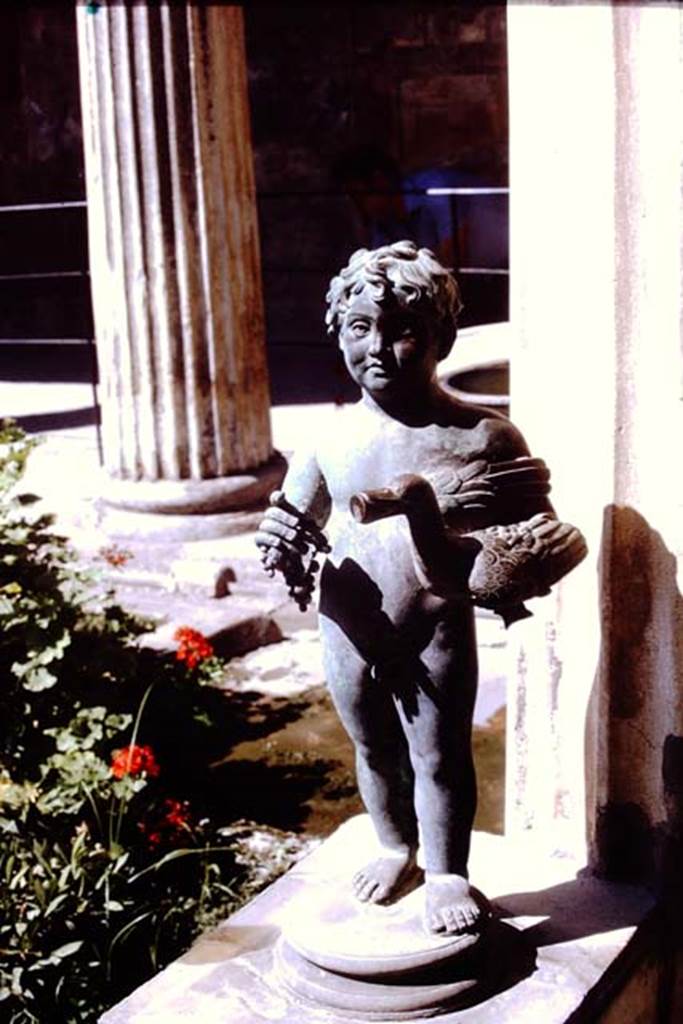
VI.15.1 Pompeii, 1968.
Bronze statuette of boy with grapes and a goose/duck. Photo by Stanley A. Jashemski.
Source: The Wilhelmina and Stanley A. Jashemski archive in the University of Maryland Library, Special Collections (See collection page) and made available under the Creative Commons Attribution-Non-Commercial License v.4. See Licence and use details.
J68f0679
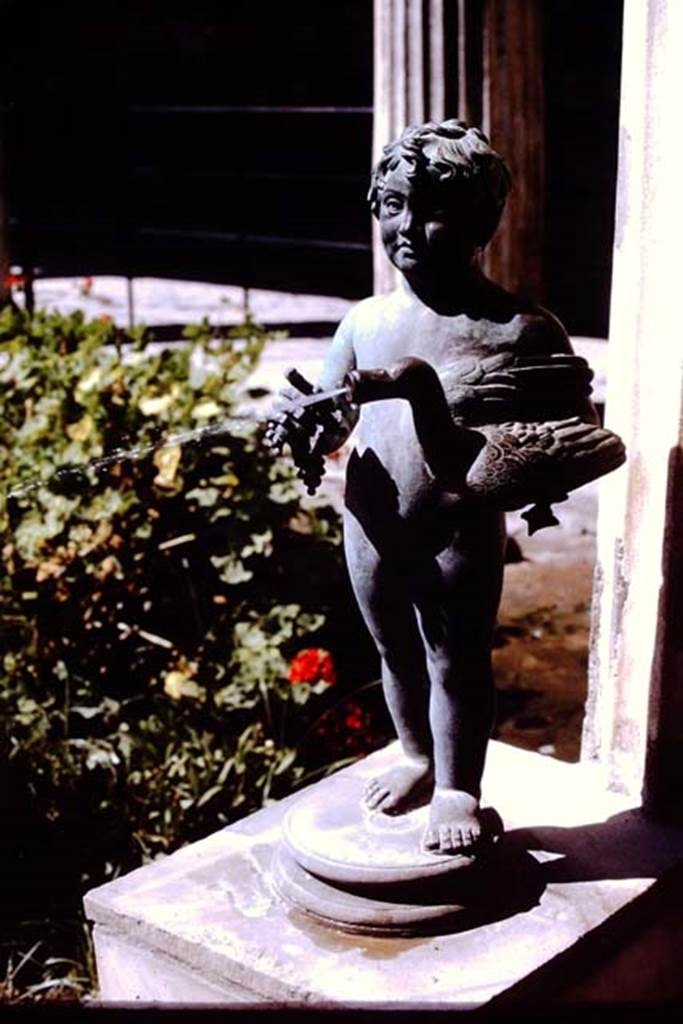
VI.15.1 Pompeii, 1968. Bronze statuette working as a fountain. Photo by Stanley A. Jashemski.
Source: The Wilhelmina and Stanley A. Jashemski archive in the University of Maryland Library, Special Collections (See collection page) and made available under the Creative Commons Attribution-Non-Commercial License v.4. See Licence and use details.
J68f0688
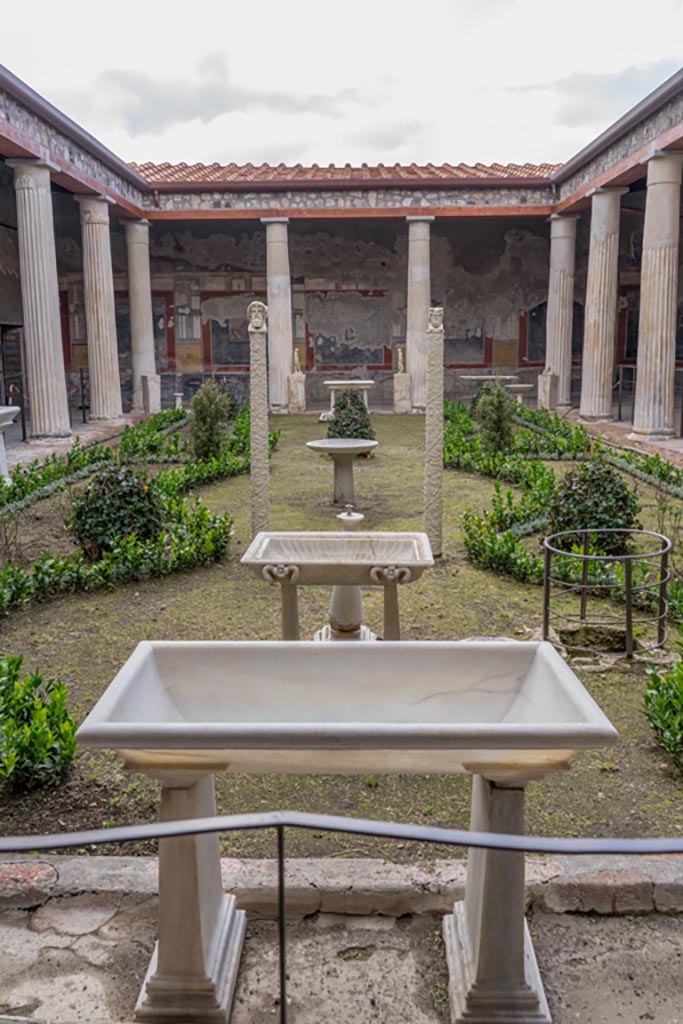
VI.15.1 Pompeii. March 2023.
Looking south across basin at north end. Photo courtesy of Johannes Eber.
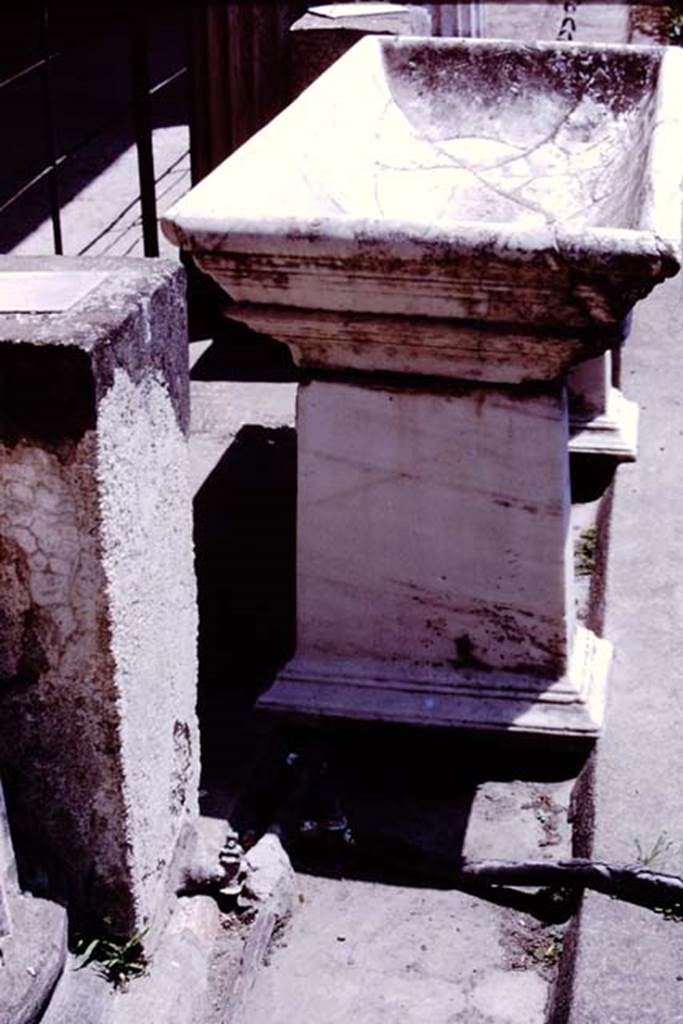
VI.15.1 Pompeii. 1977. Looking east at basin at north end. Photo by Stanley A. Jashemski.
Source: The Wilhelmina and Stanley A. Jashemski archive in the University of Maryland Library, Special Collections (See collection page) and made available under the Creative Commons Attribution-Non-Commercial License v.4. See Licence and use details.
J77f0555
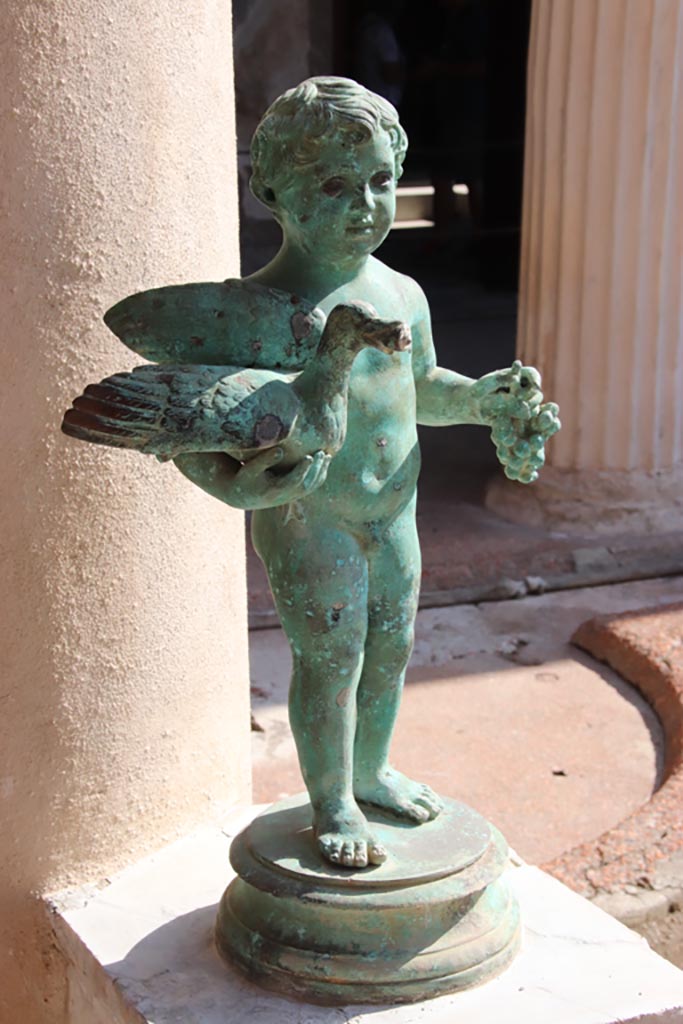
VI.15.1 Pompeii. October 2023.
Second bronze statuette, looking towards north-east corner. Photo
courtesy of Klaus Heese.
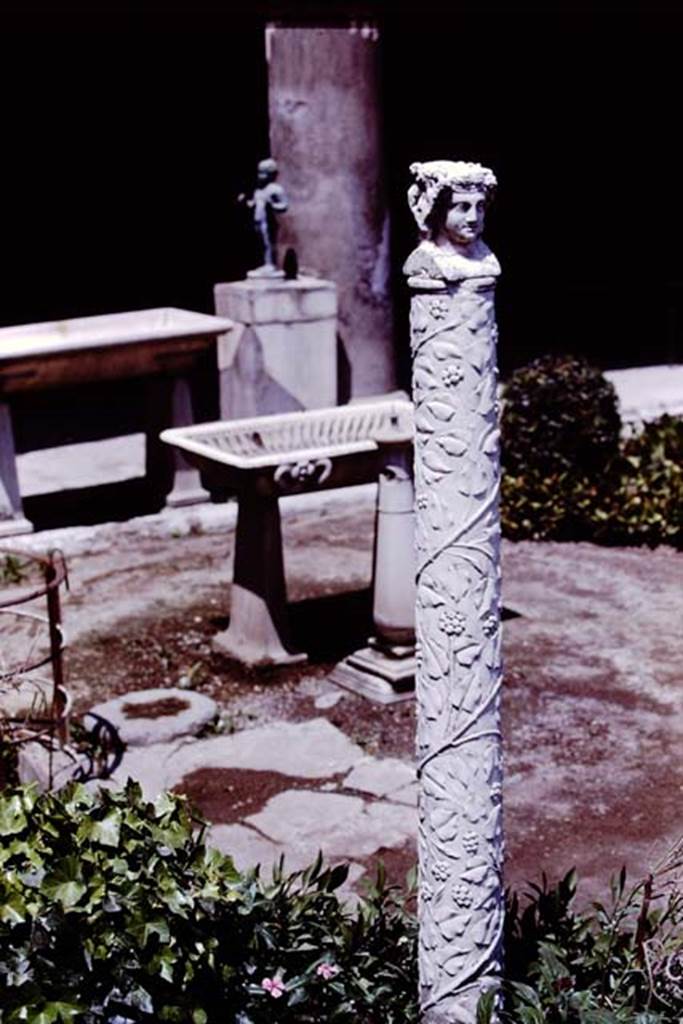
VI.15.1 Pompeii. 1977.
Looking north-east past herm with foliage pattern. Photo by Stanley A. Jashemski.
Source: The Wilhelmina and Stanley A. Jashemski archive in the University of Maryland Library, Special Collections (See collection page) and made available under the Creative Commons Attribution-Non-Commercial License v.4. See Licence and use details.
J77f0556
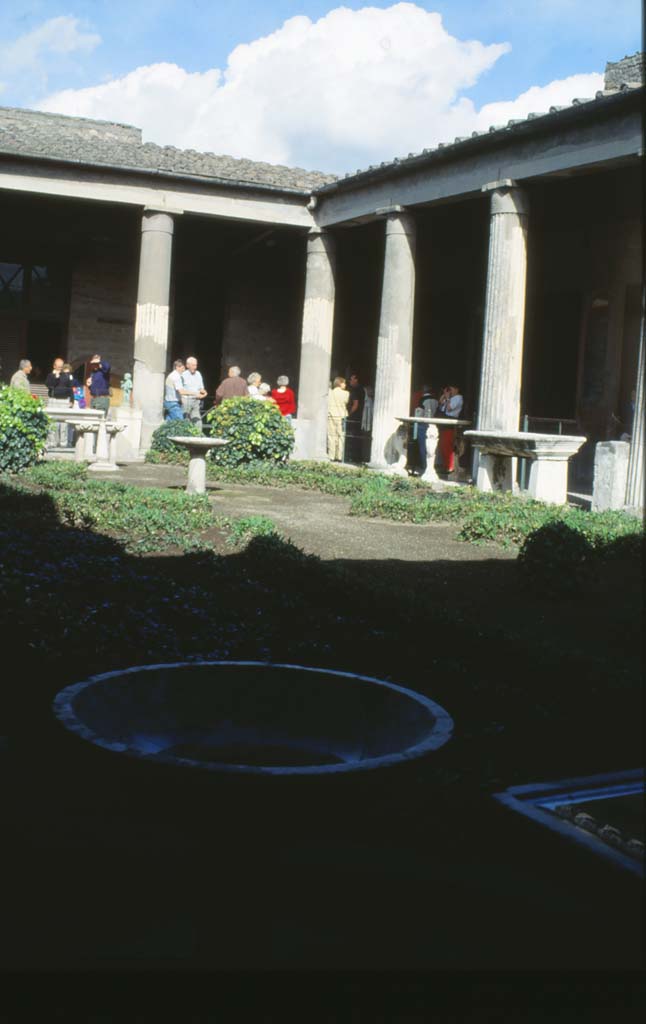
VI.15.1 Pompeii.
October 1992. Looking towards north-east corner of peristyle.
Photo
by Louis Méric courtesy of Jean-Jacques Méric.
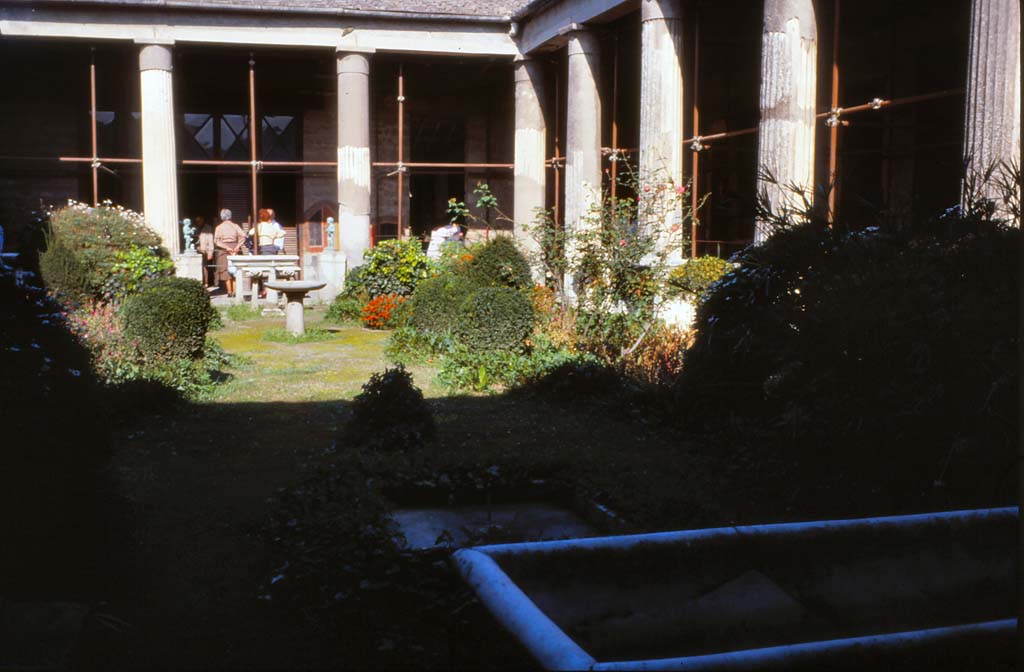
VI.15.1 Pompeii. February
1988. Looking towards north and north-east corner of garden area.
Photo by Joachime
Méric courtesy of Jean-Jacques Méric.
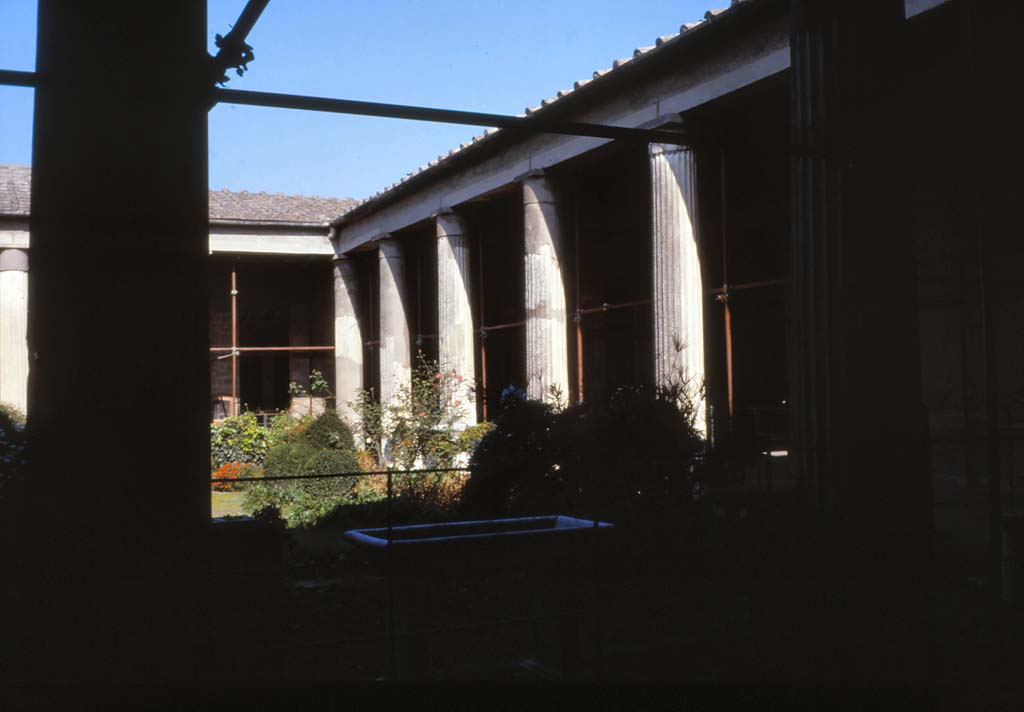
VI.15.1 Pompeii. February 1988. Looking north-east across
peristyle garden area.
Photo by Joachime Méric courtesy of Jean-Jacques Méric.
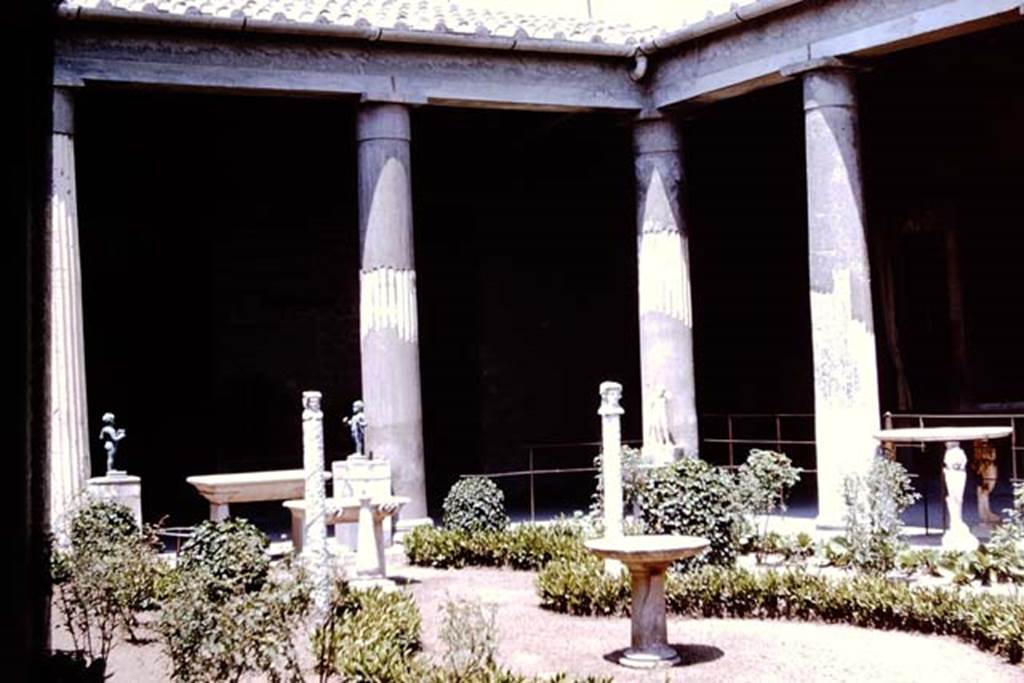
VI.15.1 Pompeii. 1964. North-east corner of peristyle. Photo by Stanley A. Jashemski.
Source: The Wilhelmina and Stanley A. Jashemski archive in the University of Maryland Library, Special Collections (See collection page) and made available under the Creative Commons Attribution-Non-Commercial License v.4. See Licence and use details.
J64f1867
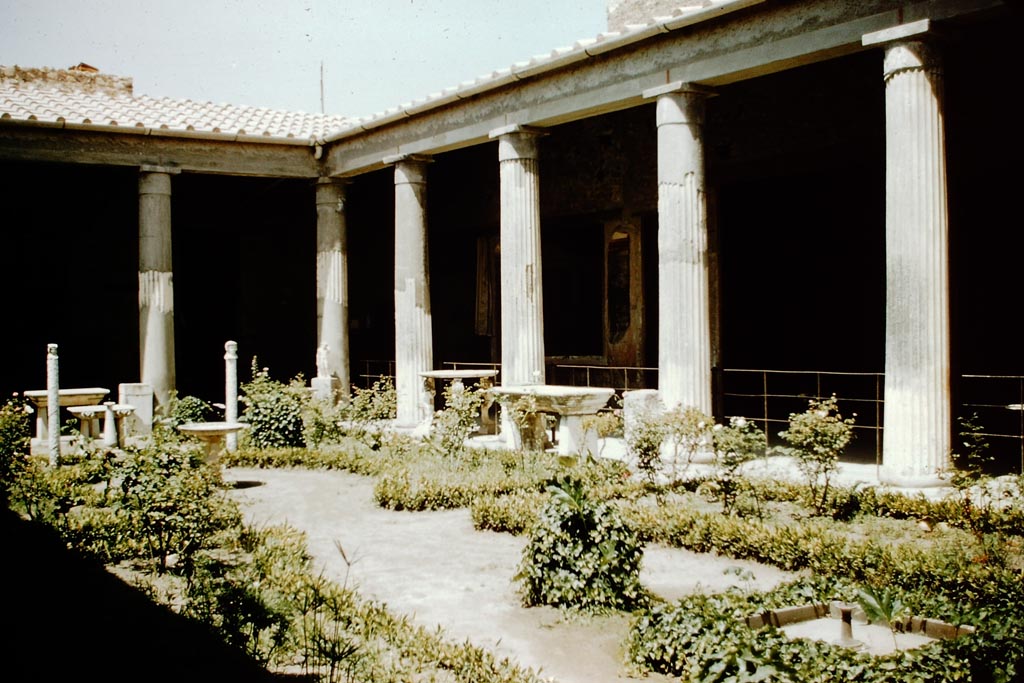
VI.15.1 Pompeii. 1957. Looking towards north-east end of garden area. Photo by Stanley A. Jashemski.
Source: The Wilhelmina and Stanley A. Jashemski archive in the University of Maryland Library, Special Collections (See collection page) and made available under the Creative Commons Attribution-Non-Commercial License v.4. See Licence and use details.
J57f0105
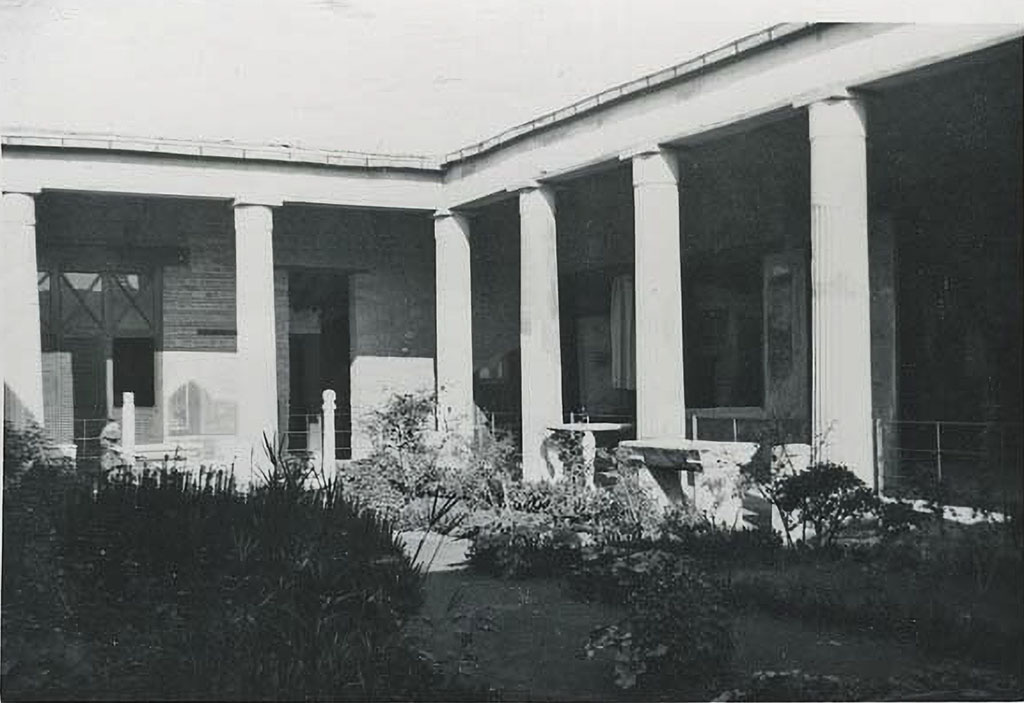
VI.15.1 Pompeii. 1949. Peristyle garden, looking north-east. Photo courtesy of Rick Bauer.
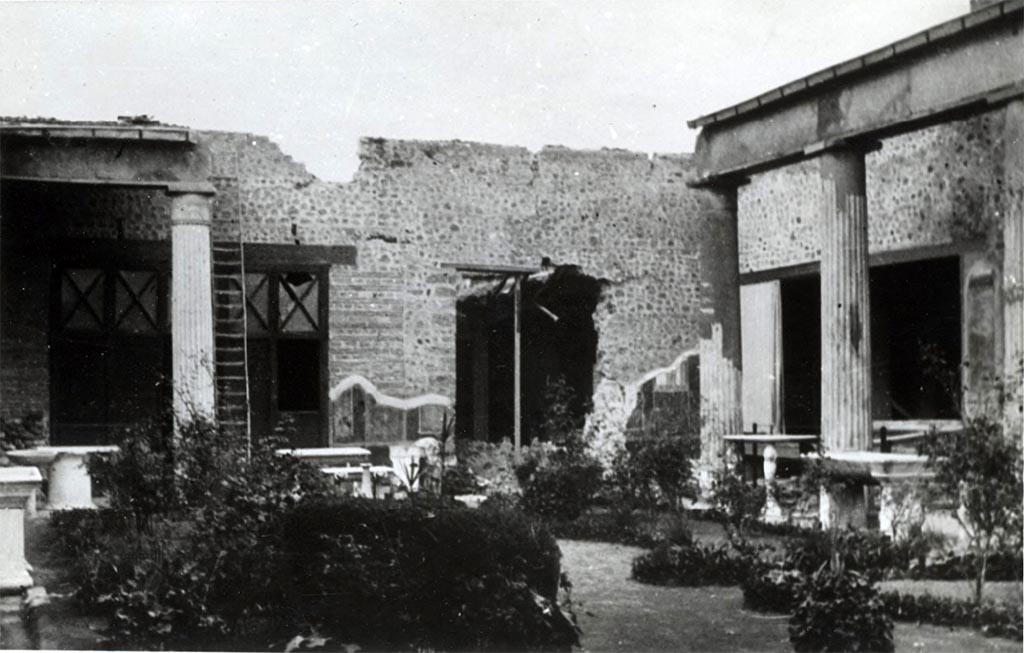
VI.15.1 Pompeii. c.1943-6. War damage in peristyle garden, looking towards north and north-east corner.
Photo courtesy of British School at Rome Digital Collections.
See http://www.bsrdigitalcollections.it/details.aspx?ID=5608&ST=SS
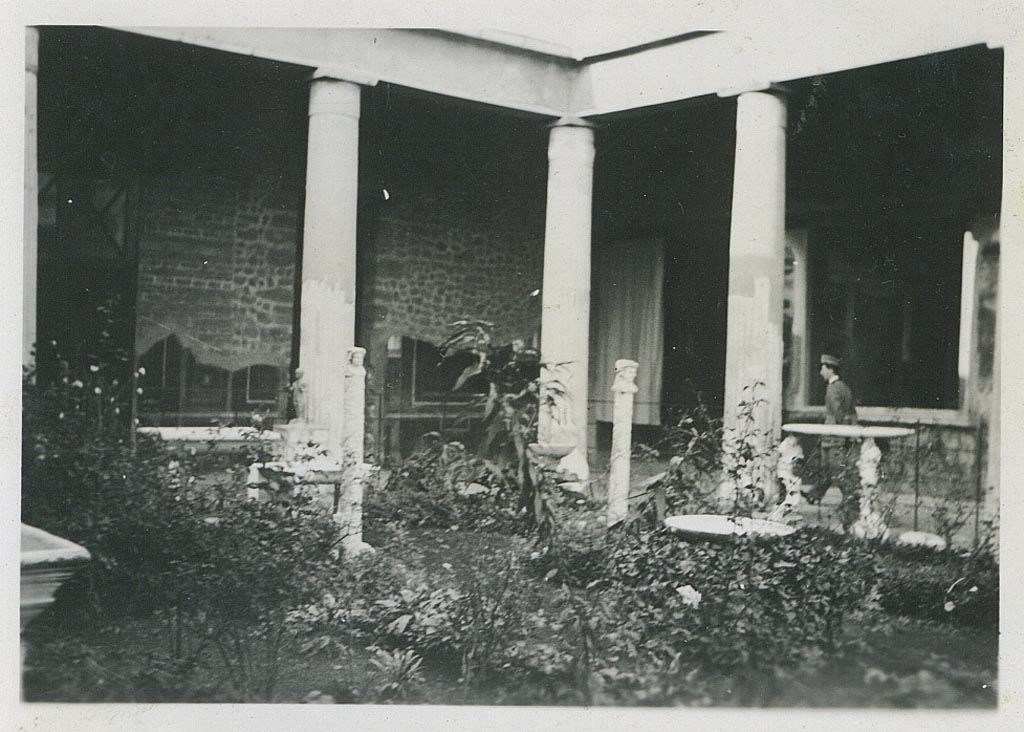
VI.15.1 Pompeii. 4th October 1937. Looking towards north-east corner of peristyle. Photo courtesy of Rick Bauer.
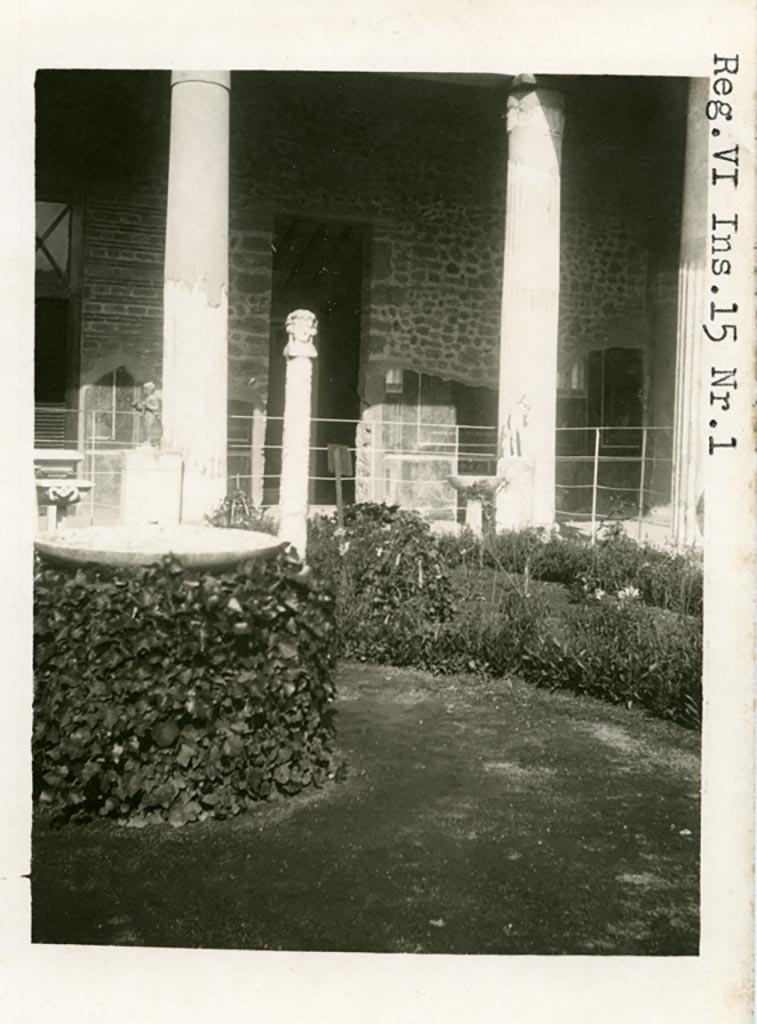
VI.15.1 Pompeii. Pre-1937-39. Looking towards east end of north portico of peristyle.
Photo courtesy of American Academy in Rome, Photographic Archive. Warsher collection no. 505.
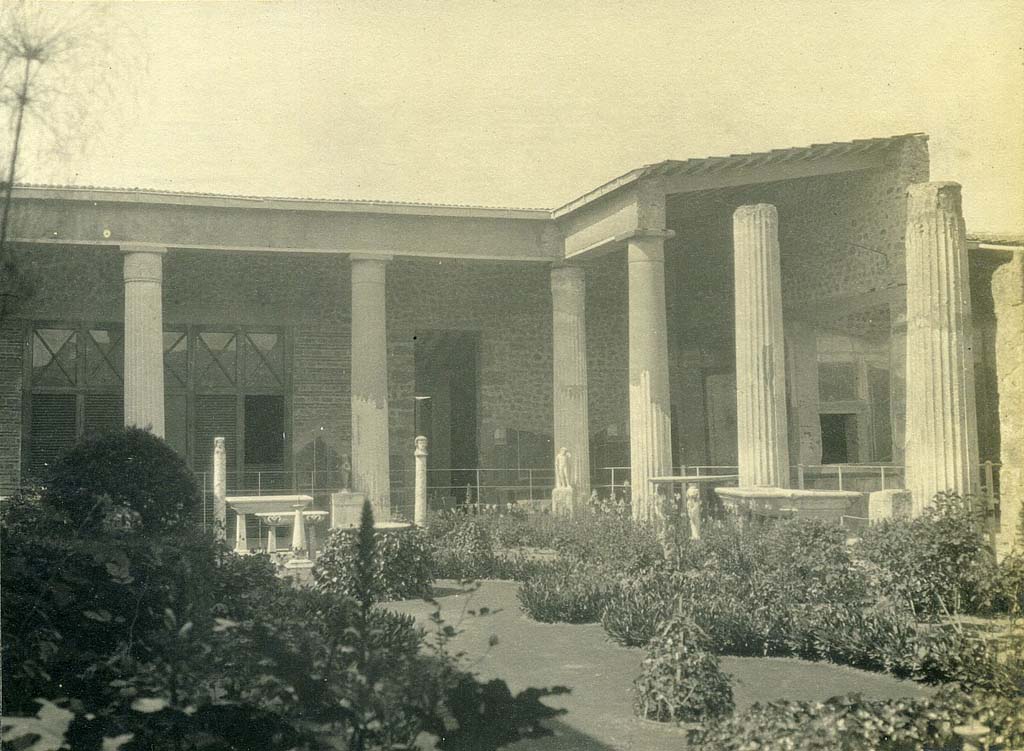
VI.15.1 Pompeii. 5th June 1925. Looking towards the north and north-east corner of the peristyle. Photo courtesy of Rick Bauer.
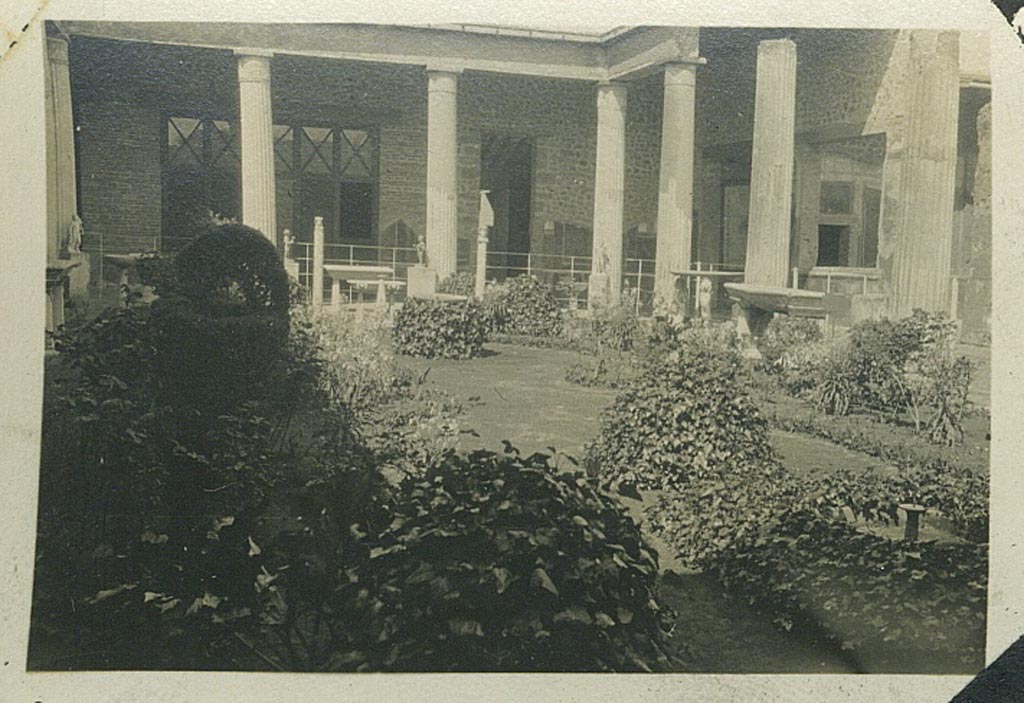
VI.15.1 Pompeii. 29th March 1922. Looking towards north and north-east corner of peristyle gardens. Photo courtesy of Rick Bauer.
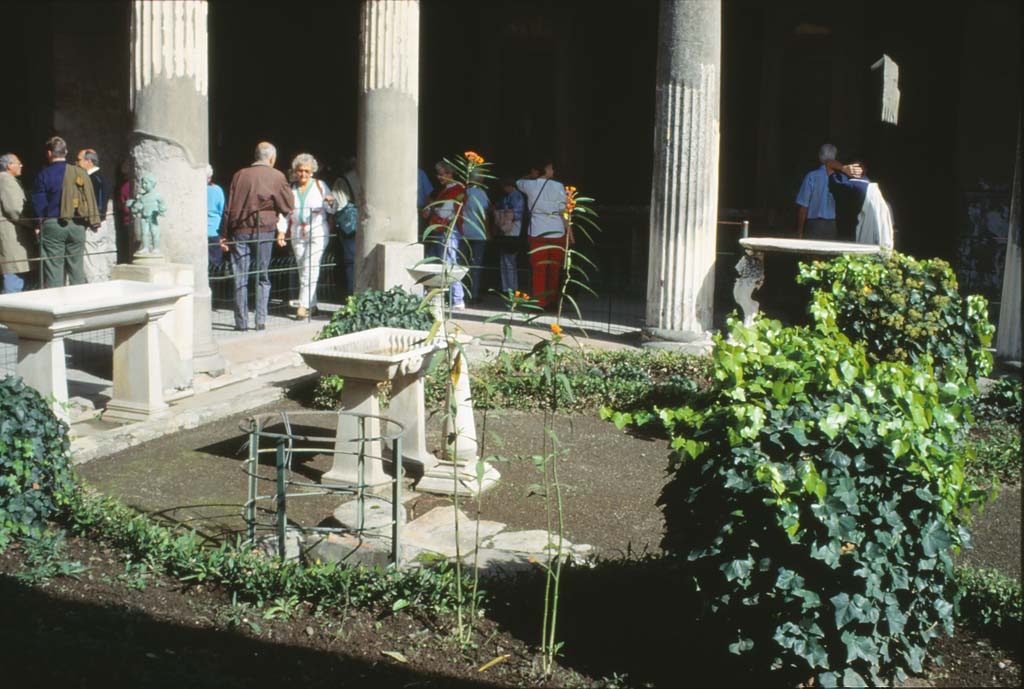
VI.15.1 Pompeii.
October 1992. Looking east towards north-east corner of peristyle garden.
Photo
by Louis Méric courtesy of Jean-Jacques Méric.
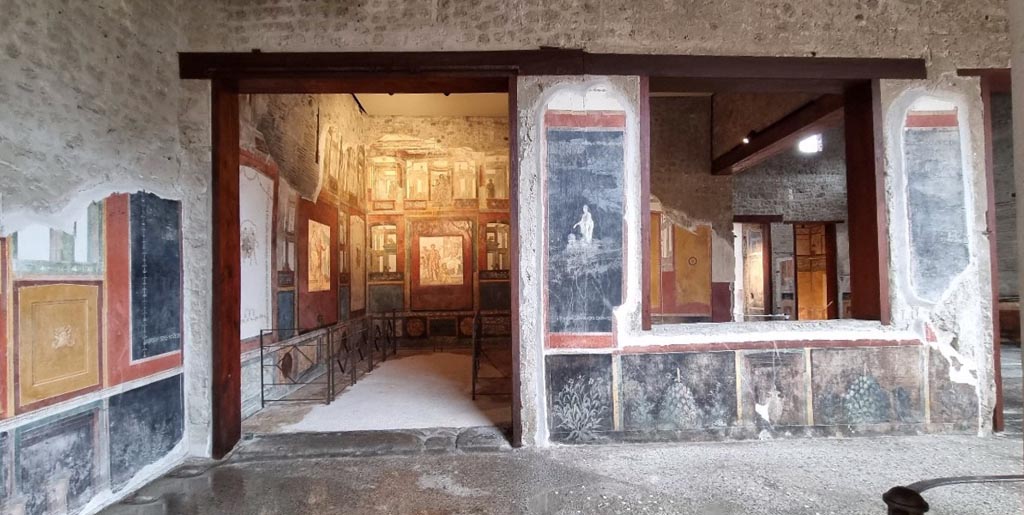
VI.15.1 Pompeii. January 2023.
North-east corner of peristyle with doorway to exedra, on left, and window into north ala, on right. Photo courtesy of Miriam Colomer.
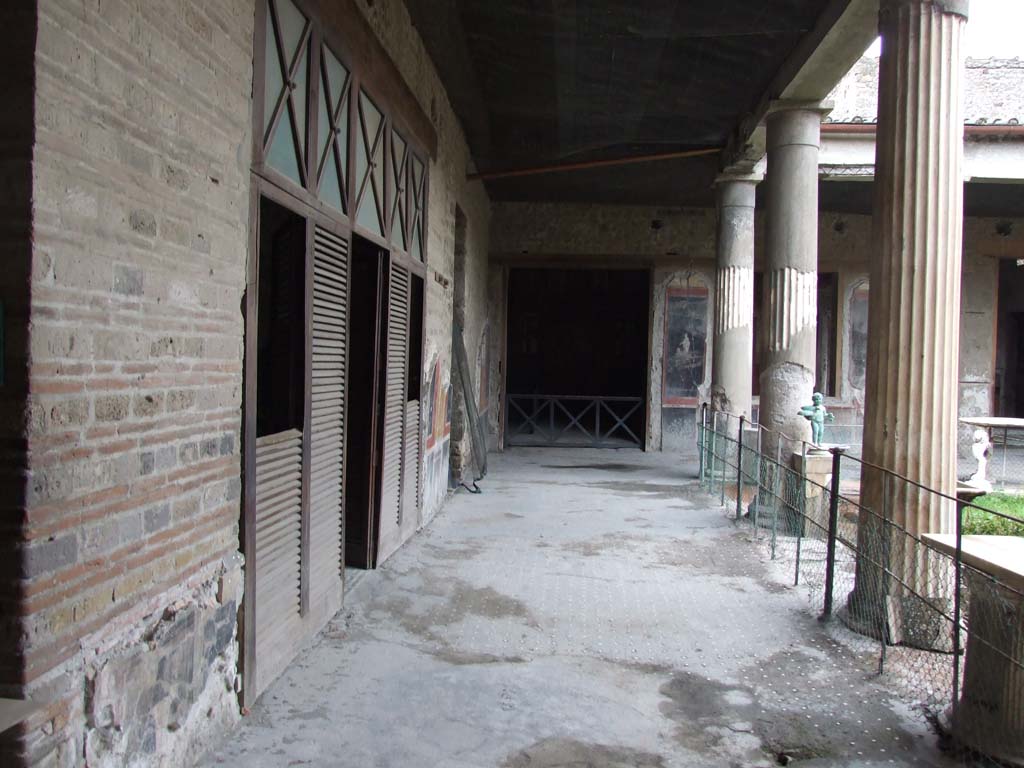
VI.15.1 Pompeii. December 2006. Looking east along north side of peristyle towards north-east corner.
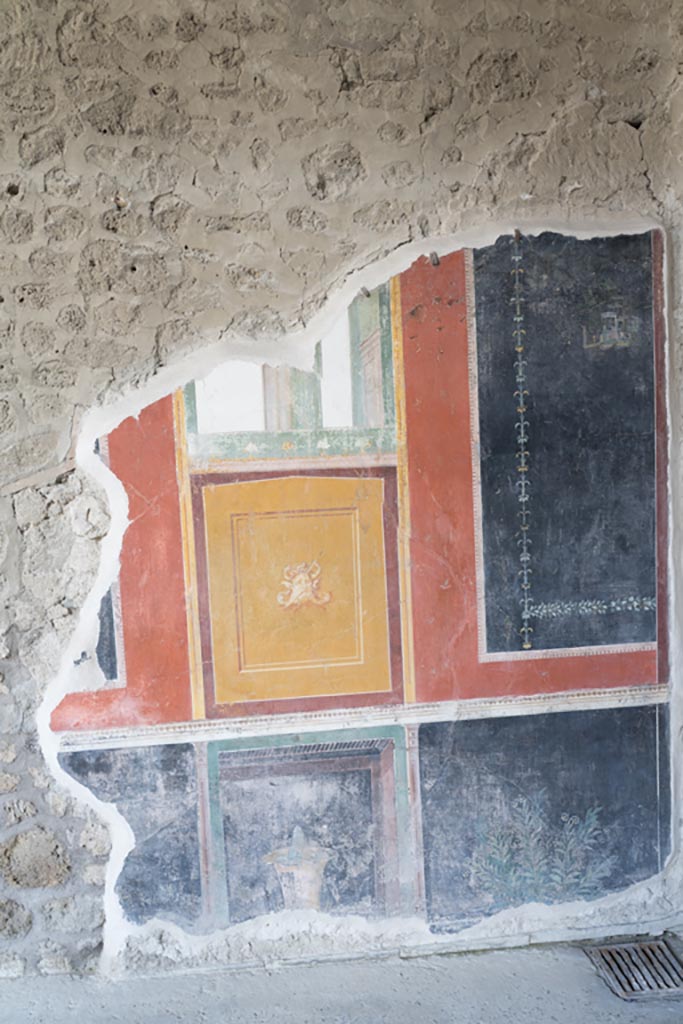
Looking towards north wall of peristyle at east end, in north-east corner. Photo courtesy of Johannes Eber.
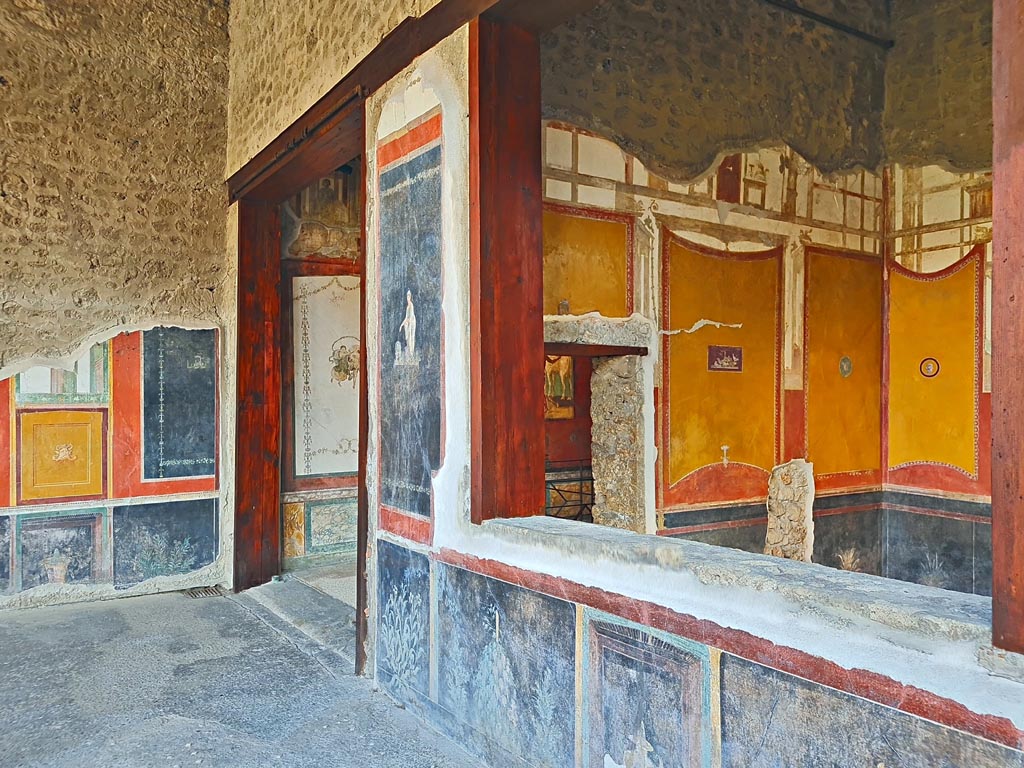
VI.15.1 Pompeii. April 2023.
North-east corner of portico/peristyle, with doorway into exedra (p), centre left, and window into north ala, on right.
Photo courtesy of Giuseppe Ciaramella.
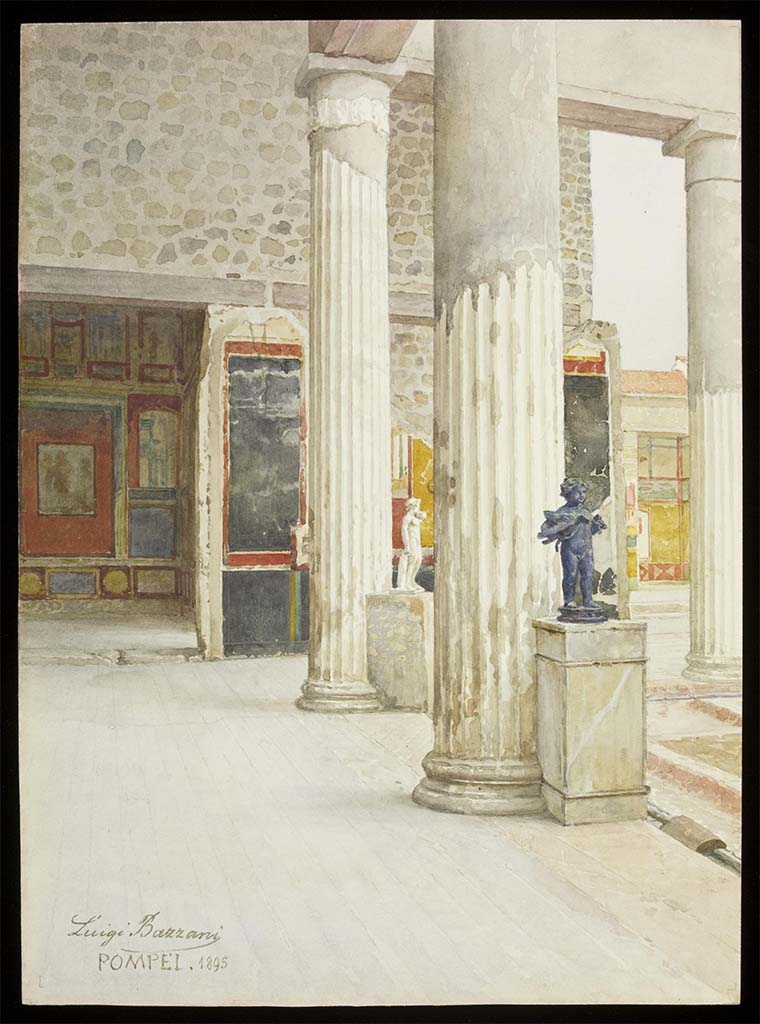
VI.15.1 Pompeii.
1895. Watercolour by Luigi Bazzani.
Looking east along north portico, towards doorway to room in north-east corner.
Photo © Victoria and Albert Museum. Inventory number 8-1898.
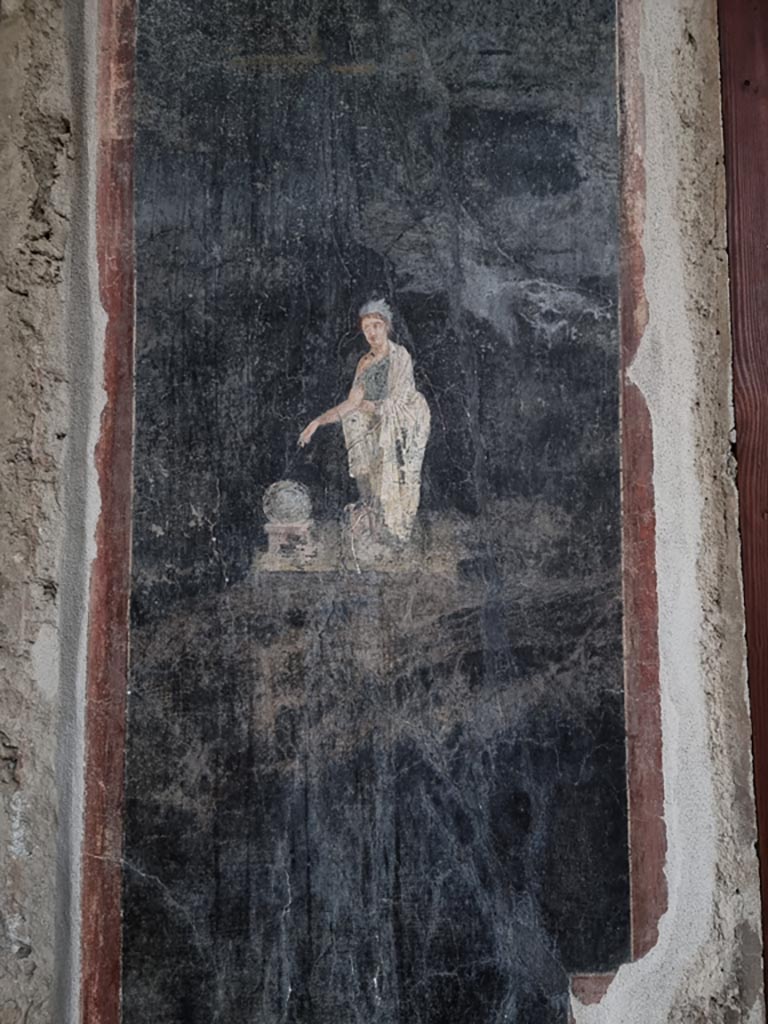
VI.15.1 Pompeii. December 2023.
Painted panel from north-east corner of east portico, painting from between doorway to exedra and window to ala.
Photo courtesy of Miriam Colomer.
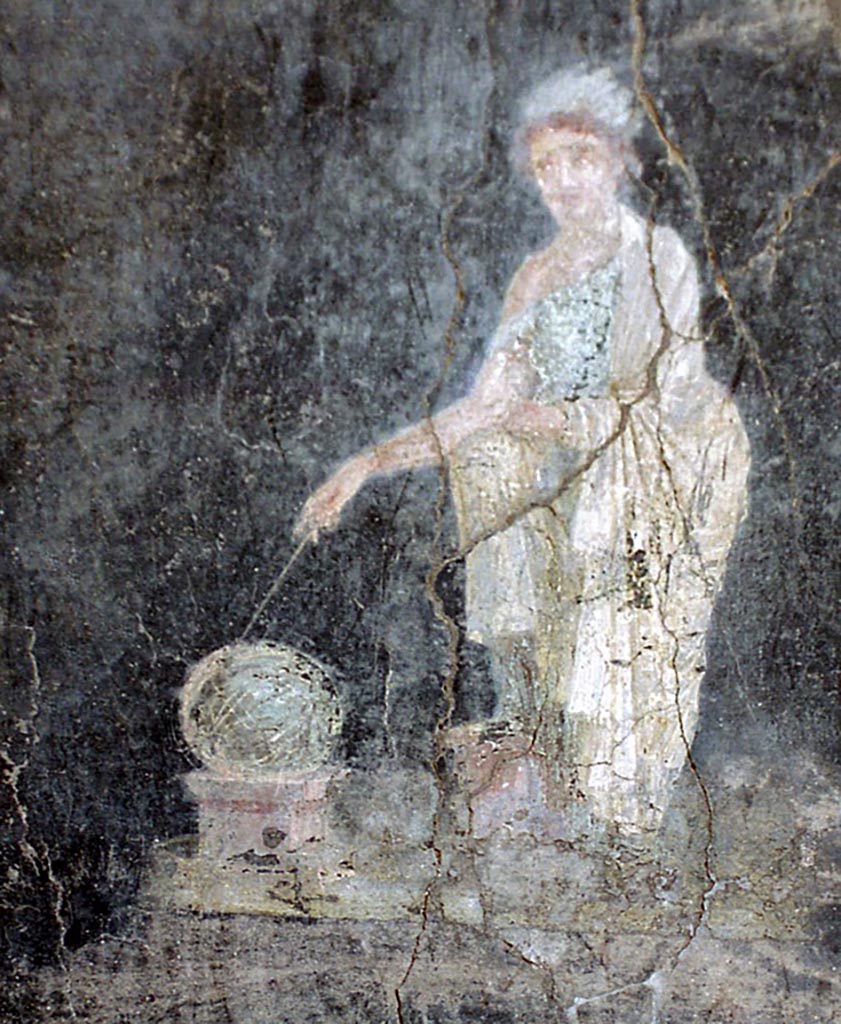
VI.15.1 Pompeii. October 2001.
North-east corner, painting from north side of east portico between doorway to exedra and window to ala.
Painted panel on black background of Urania in green robe with white fringed cloak, with her head surrounded by a crown of feathers, pointing with a stick to the globe resting on a square base. Photo courtesy of Peter Woods.
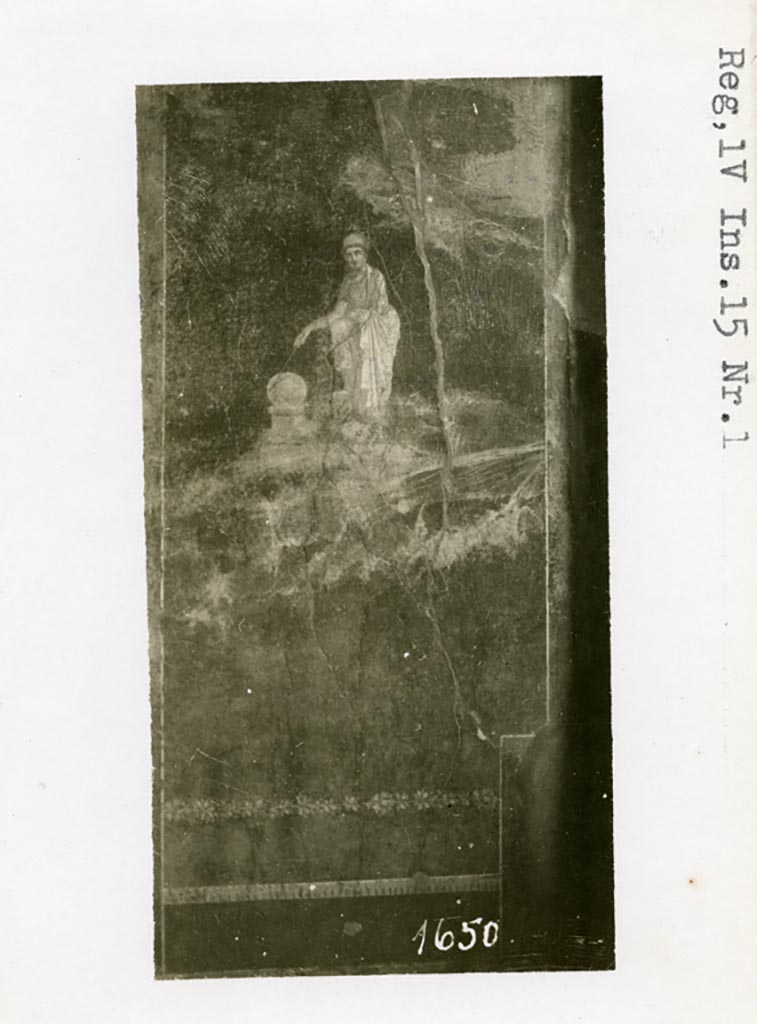
VI.15.1 Pompeii. Pre-1937-39.
North-east corner of peristyle, painting from north side of east portico between doorway to exedra and window to ala.
Photo courtesy of American Academy in Rome, Photographic Archive. Warsher collection no. 1650.
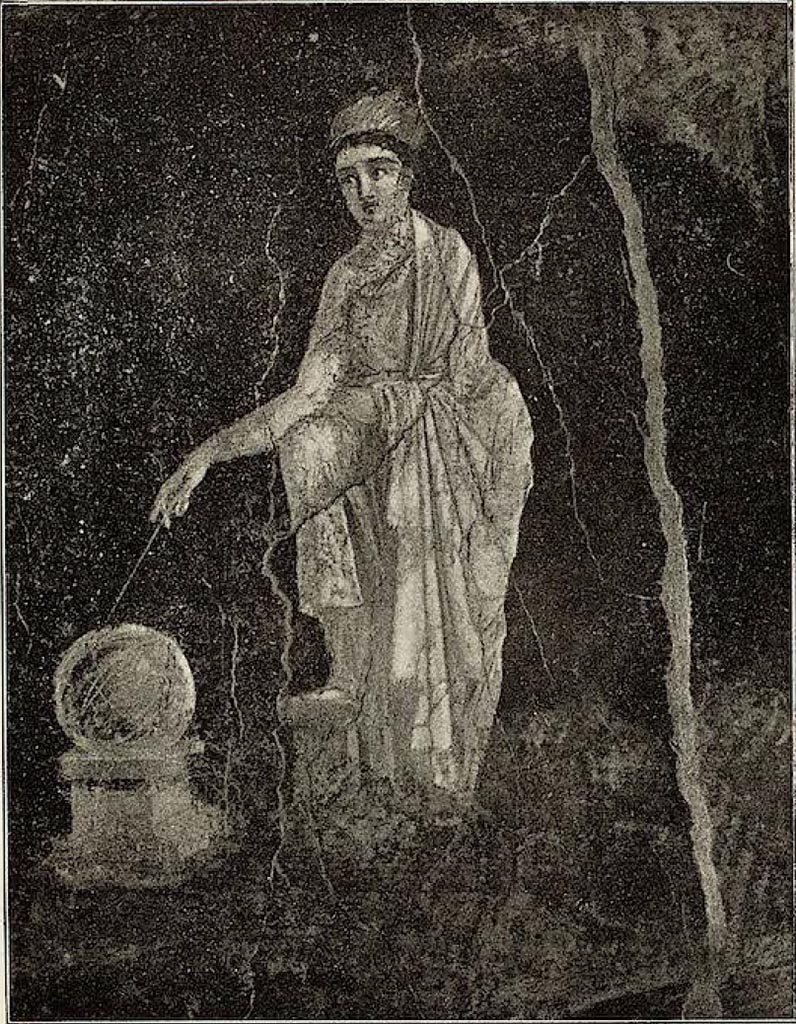
VI.15.1 Pompeii. c.1898. Painted panel on black background of Urania pointing with a stick to the globe resting on a square base.
See Sogliano, A. La Casa dei Vettii in Pompei Mon. Ant 1898,
(p.277/278, fig. 17).
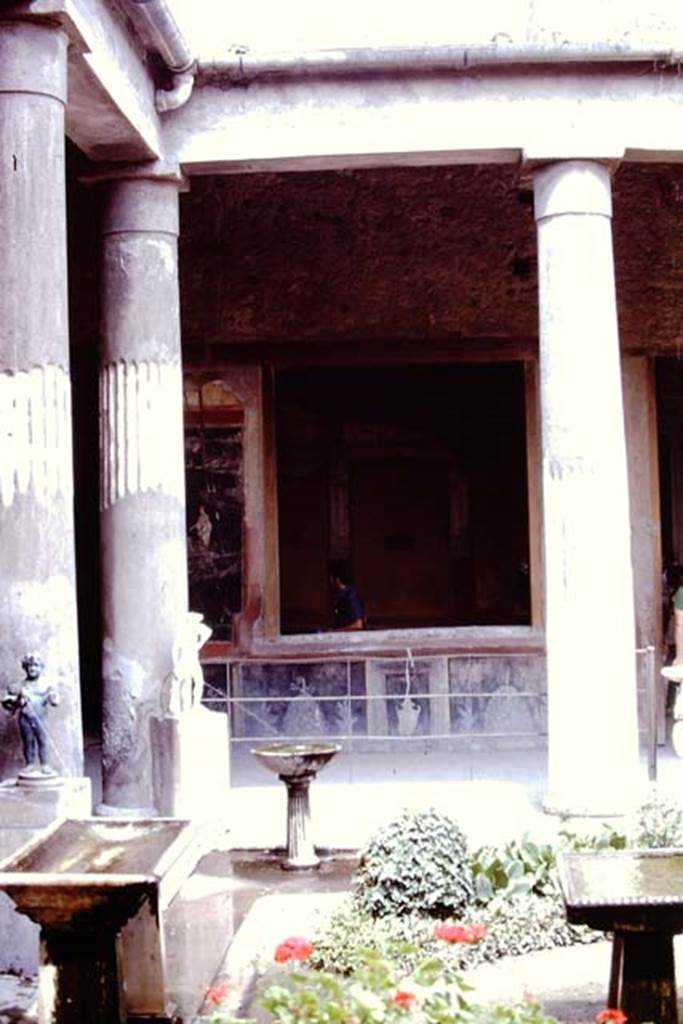
VI.15.1
Pompeii, 1973. North-east corner of garden area. Photo by Stanley A. Jashemski.
Source: The
Wilhelmina and Stanley A. Jashemski archive in the University of Maryland
Library, Special Collections (See collection page) and made available under the Creative
Commons Attribution-Non-Commercial License v.4. See Licence and use details.
J73f0244
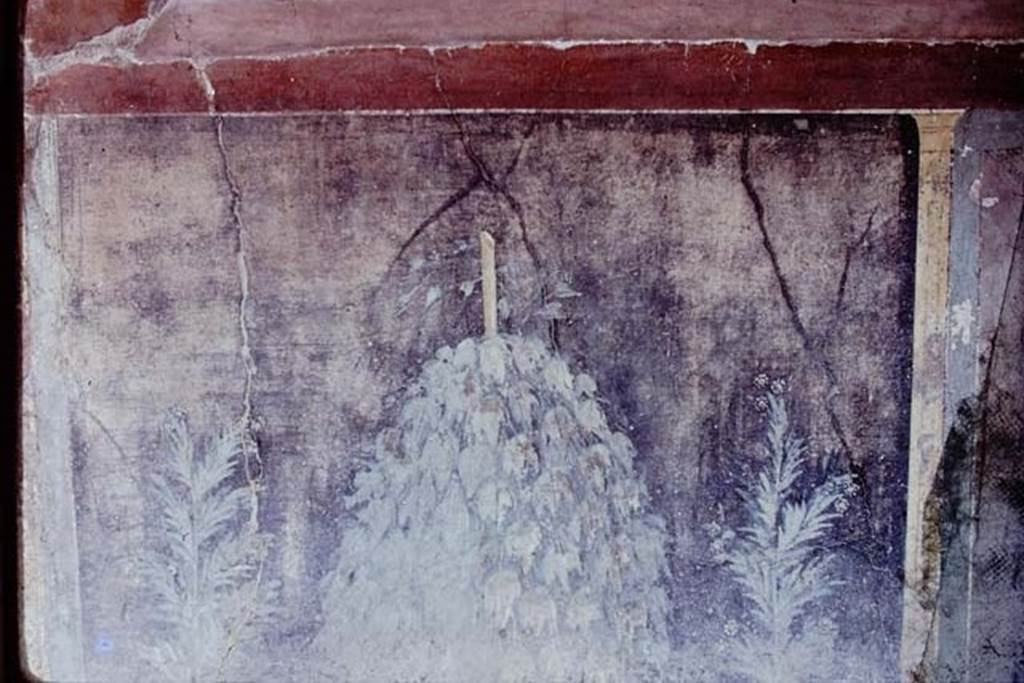
VI.15.1
Pompeii, 1973. Painted wall decoration from zoccolo of peristyle. Photo by
Stanley A. Jashemski.
Source: The
Wilhelmina and Stanley A. Jashemski archive in the University of Maryland
Library, Special Collections (See collection page) and made available under the Creative
Commons Attribution-Non-Commercial License v.4. See Licence and use details.
J73f0243
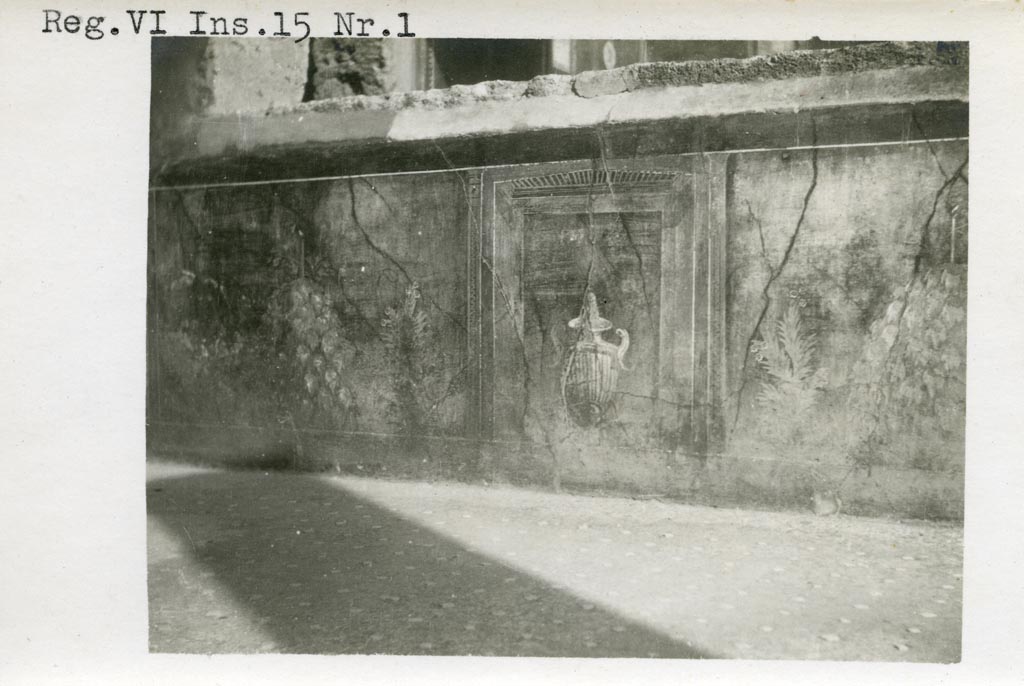
VI.15.1 Pompeii. Pre-1937-39. Detail
of painted wall decoration from under window in north-east corner of
peristyle.
Photo courtesy of American Academy in Rome, Photographic Archive. Warsher collection no. 692.
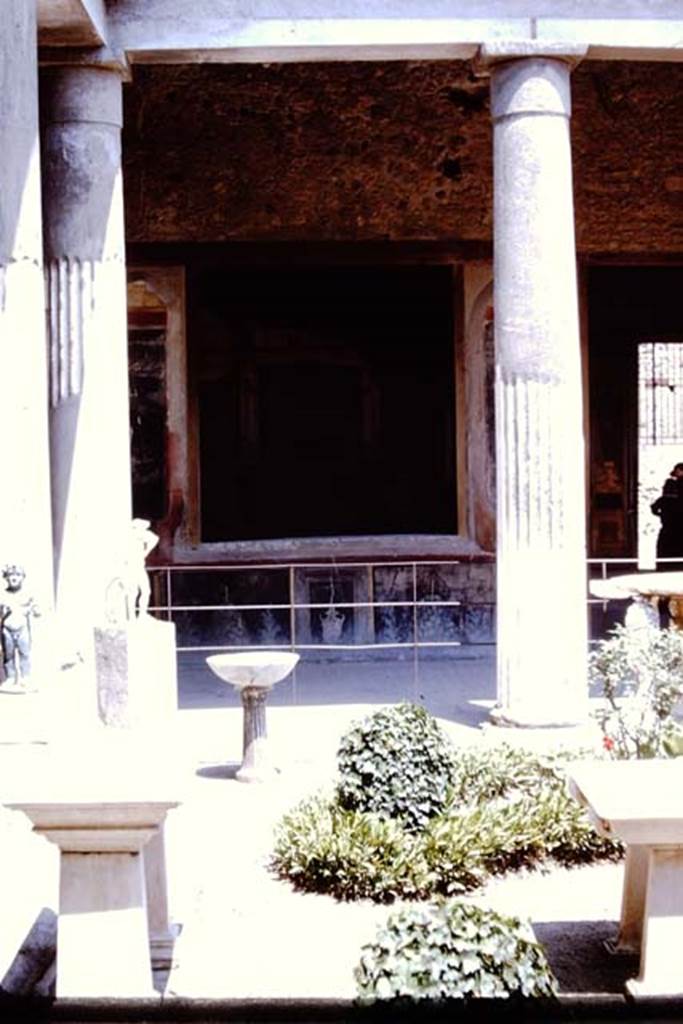
VI.15.1 Pompeii. 1964. Looking east towards north-east corner. Photo by Stanley A. Jashemski.
Source: The Wilhelmina and Stanley A. Jashemski archive in the University of Maryland Library, Special Collections (See collection page) and made available under the Creative Commons Attribution-Non-Commercial License v.4. See Licence and use details.
J64f1870
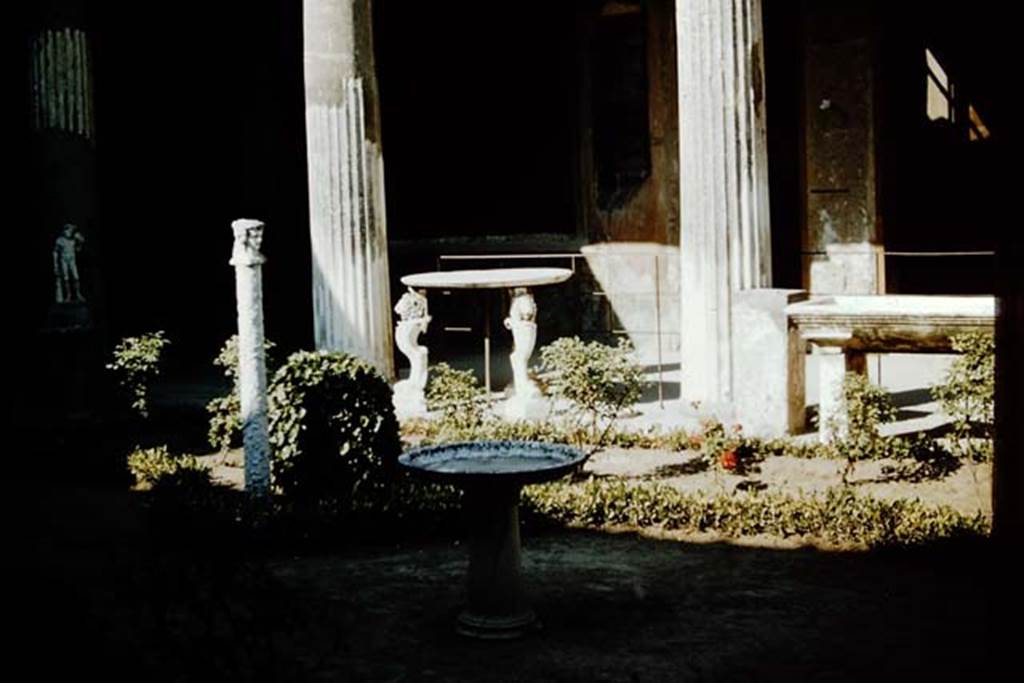
VI.15.1 Pompeii. 1957. North-east corner of peristyle and east portico. Photo by Stanley A. Jashemski.
Source: The Wilhelmina and Stanley A. Jashemski archive in the University of Maryland Library, Special Collections (See collection page) and made available under the Creative Commons Attribution-Non-Commercial License v.4. See Licence and use details.
J57f0409
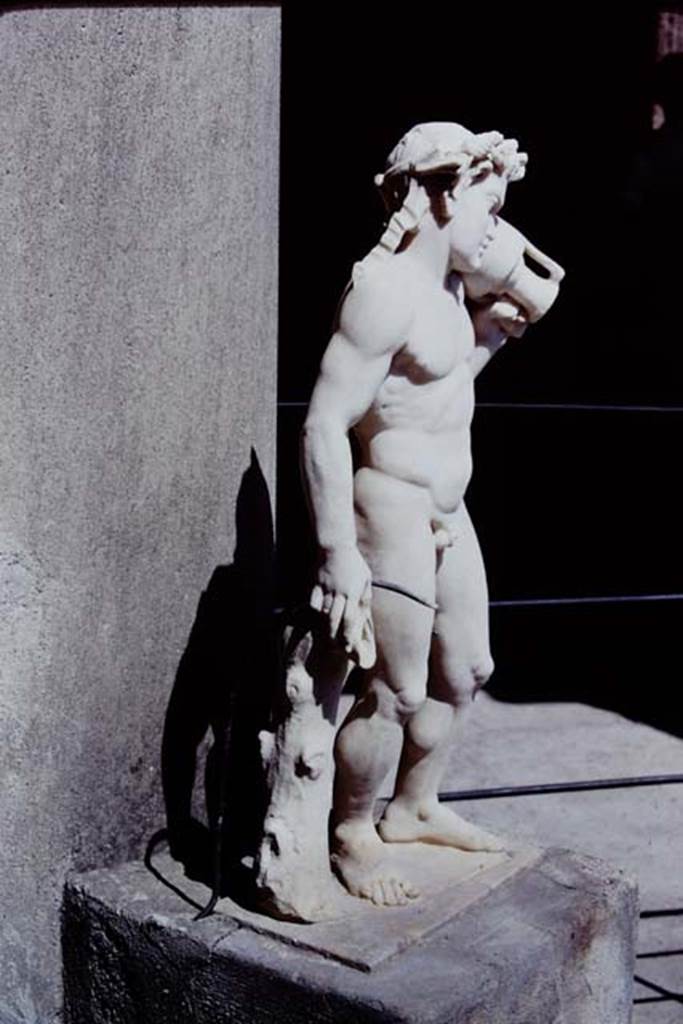
VI.15.1 Pompeii. 1968. Marble statue from north-east corner. Photo by Stanley A. Jashemski.
Source: The Wilhelmina and Stanley A. Jashemski archive in the University of Maryland Library, Special Collections (See collection page) and made available under the Creative Commons Attribution-Non-Commercial License v.4. See Licence and use details.
J68f1966
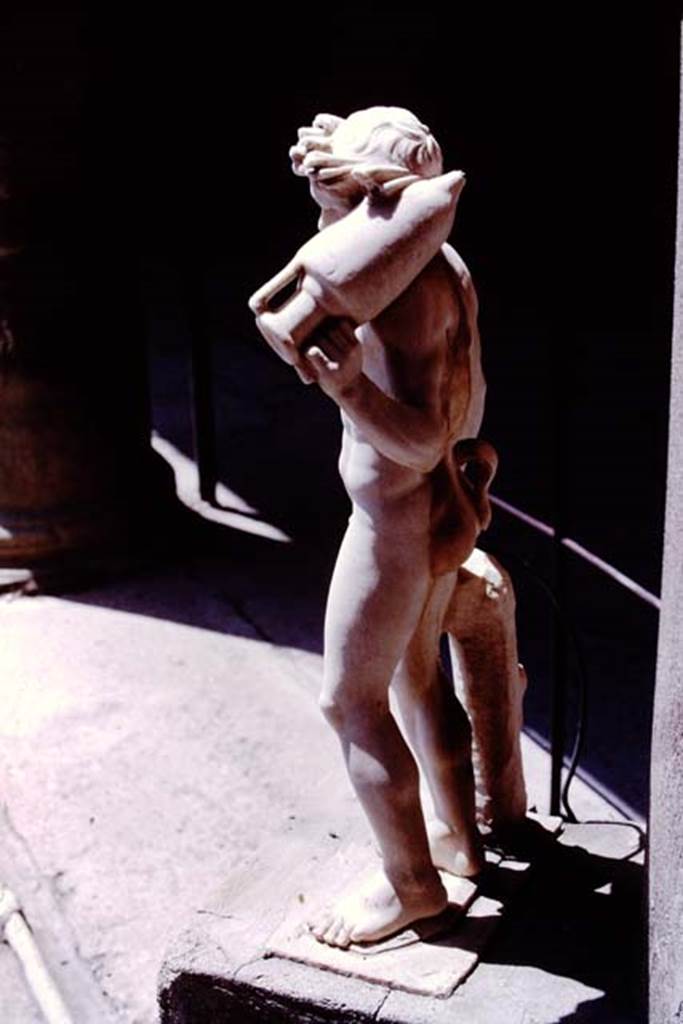
VI.15.1 Pompeii. 1977. Marble statue from north-east corner. Photo by Stanley A. Jashemski.
Source: The Wilhelmina and Stanley A. Jashemski archive in the University of Maryland Library, Special Collections (See collection page) and made available under the Creative Commons Attribution-Non-Commercial License v.4. See Licence and use details.
J77f0557
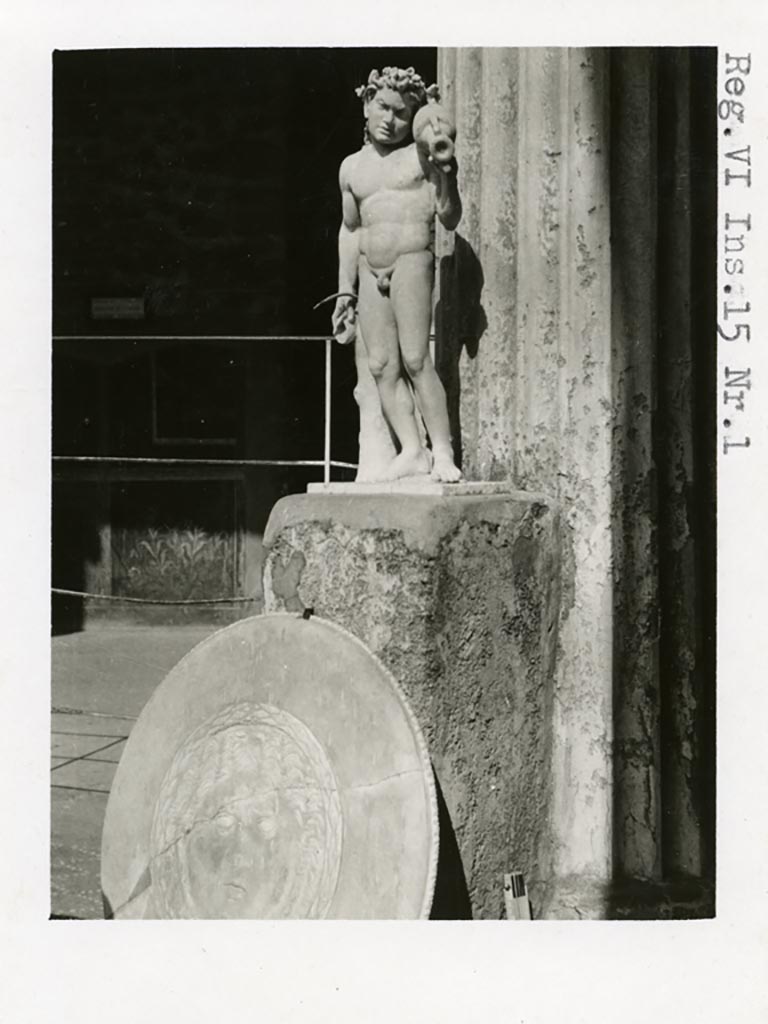
VI.15.1 Pompeii. Pre-1937-39. Looking towards north-east corner with marble statuette.
Photo courtesy of American Academy in Rome, Photographic Archive. Warsher collection no. 1389.
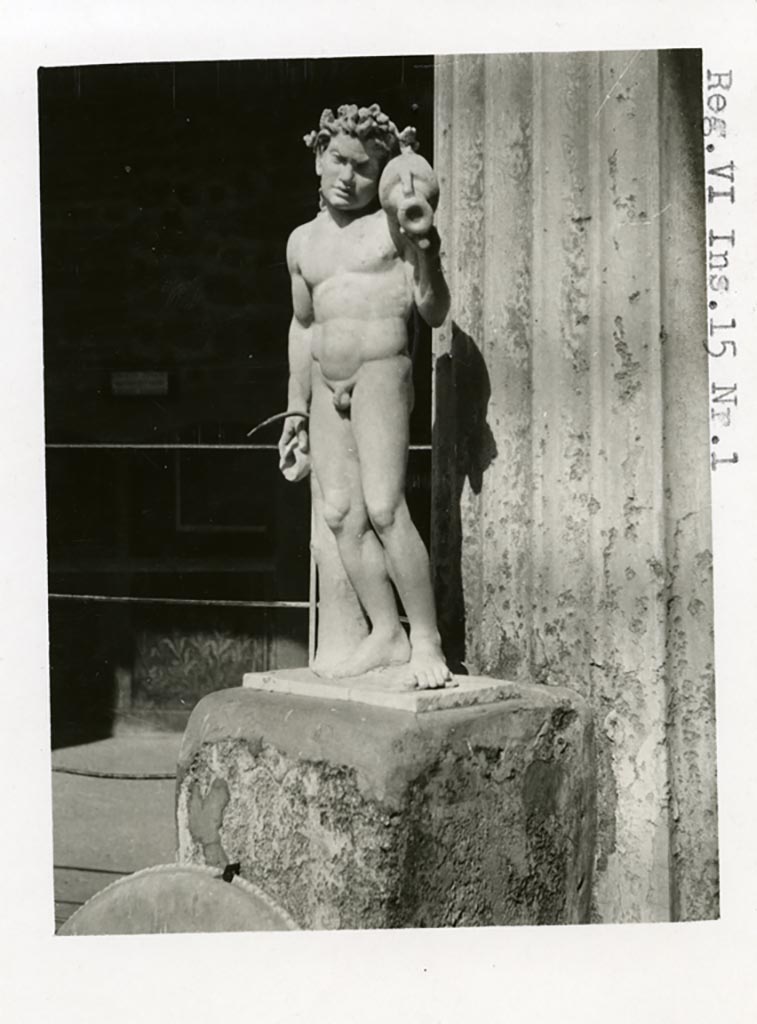
VI.15.1 Pompeii. Pre-1937-39. Marble statue from north-east corner.
Photo courtesy of American Academy in Rome, Photographic Archive. Warsher collection no. 1388.
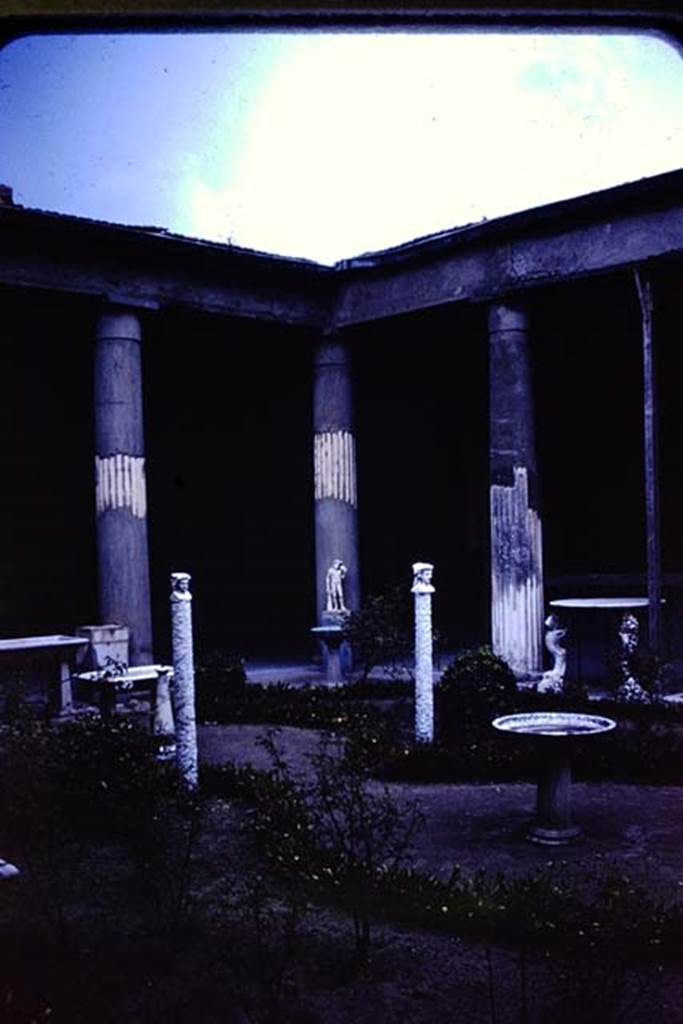
VI.15.1 Pompeii. 1955.
Garden area, looking towards north-east corner. Photo by Stanley A. Jashemski.
Source: The Wilhelmina and Stanley A. Jashemski archive in the University of Maryland Library, Special Collections (See collection page) and made available under the Creative Commons Attribution-Non-Commercial License v.4. See Licence and use details.
J55f0479
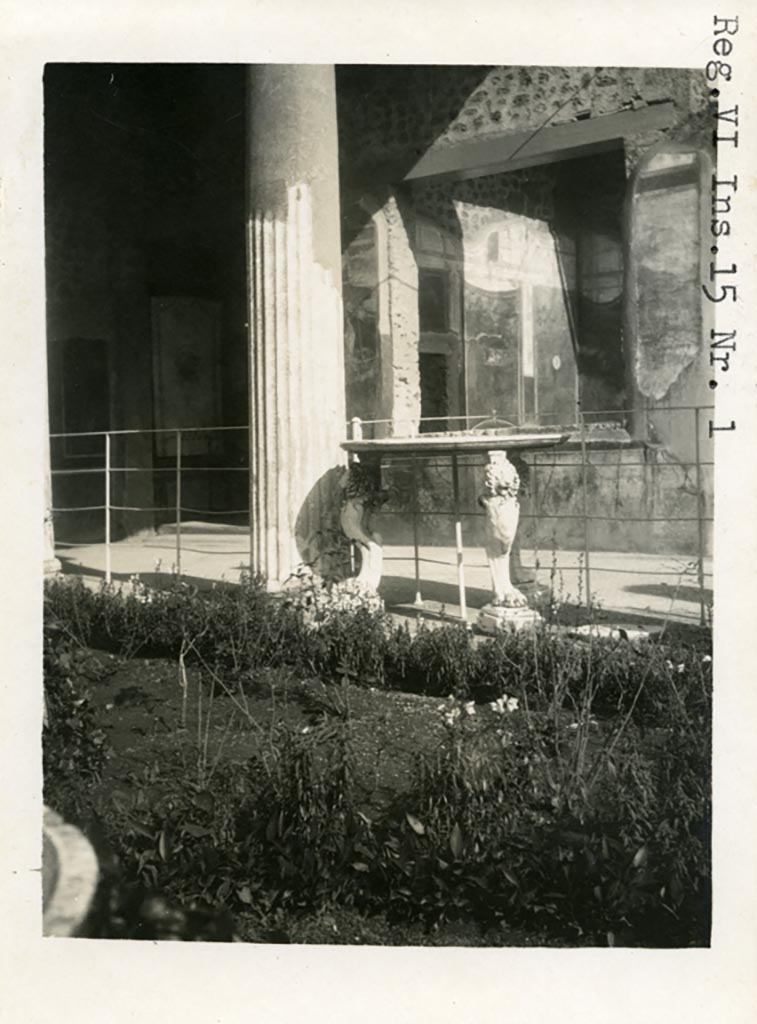
VI.15.1 Pompeii. Pre-1937-39. North-east corner of peristyle, with window in east wall.
Photo courtesy of American Academy in Rome, Photographic Archive. Warsher collection no. 506.
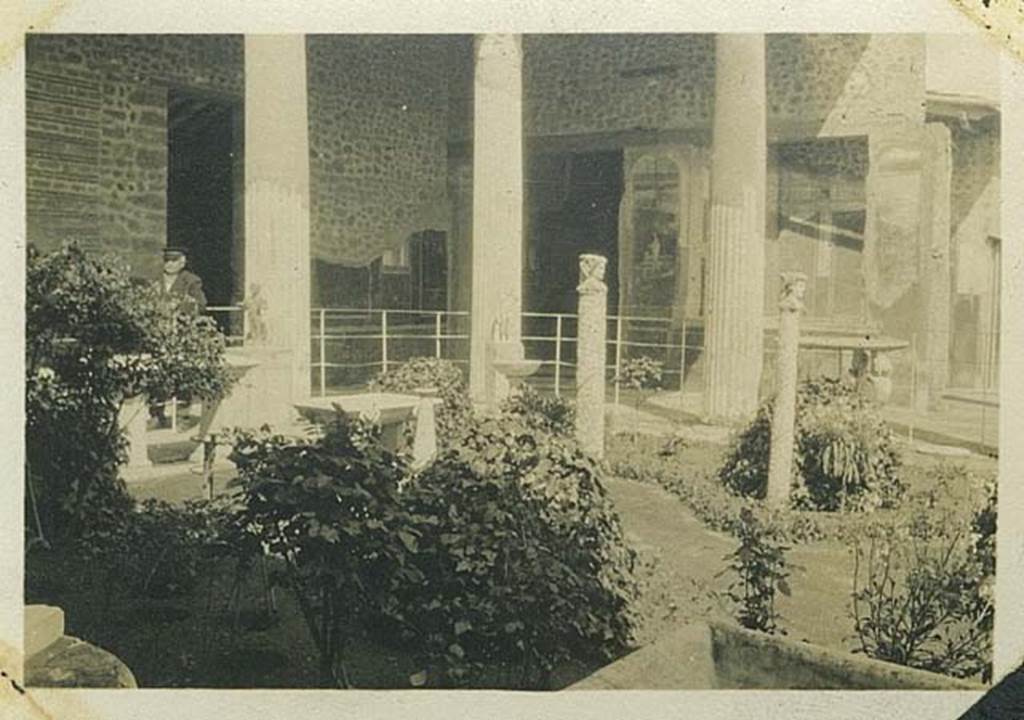
VI.15.1 Pompeii. 29th March 1922. Looking towards the north-east corner. Photo courtesy of Rick Bauer.
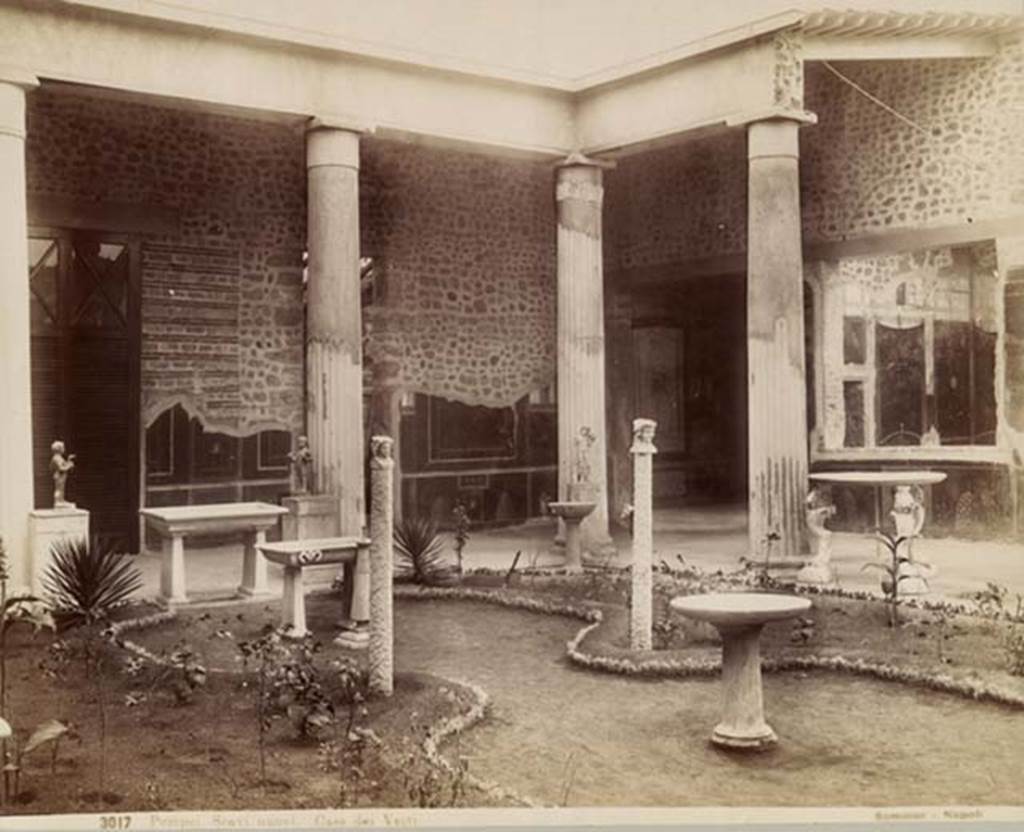
VI.15.1 Pompeii. Undated Albumen photo (Sommer) 3017. Looking towards the north-east corner. Photo courtesy of Rick Bauer.
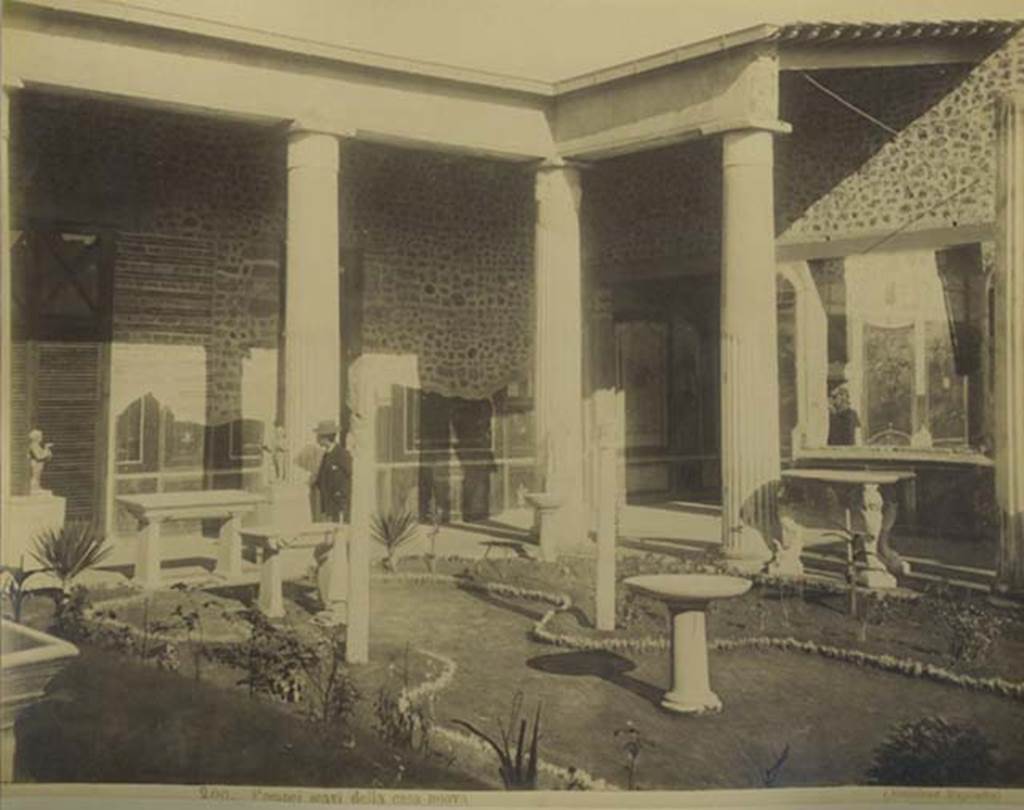
VI.15.1 Pompeii. Mid 1890’s photograph by Esposito, no. 200. Looking towards the north-east corner. Photo courtesy of Rick Bauer.
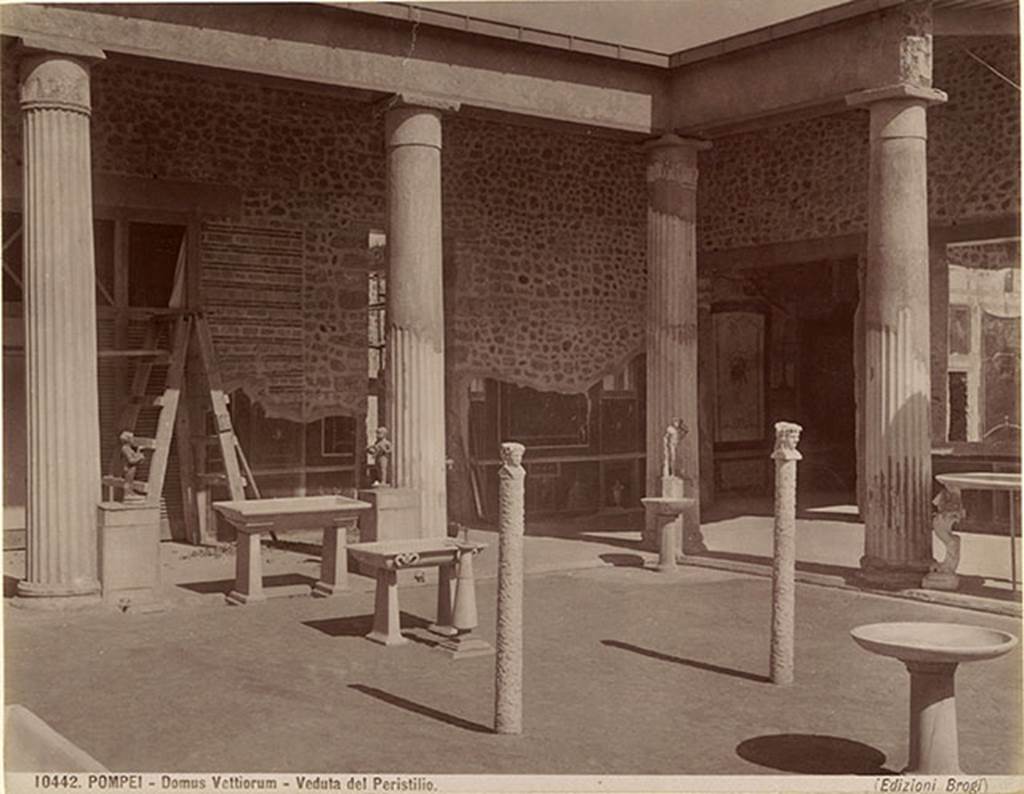
VI.15.1 Pompeii. Late 1890s just after the excavations? Peristyle, looking to the north-east corner.
Albumen photo 10442 by G. Brogi. The portico and walls have been reconstructed.
The two herms and other ornaments can be seen. There has not yet been any planting of the garden. Photo courtesy of Rick Bauer.
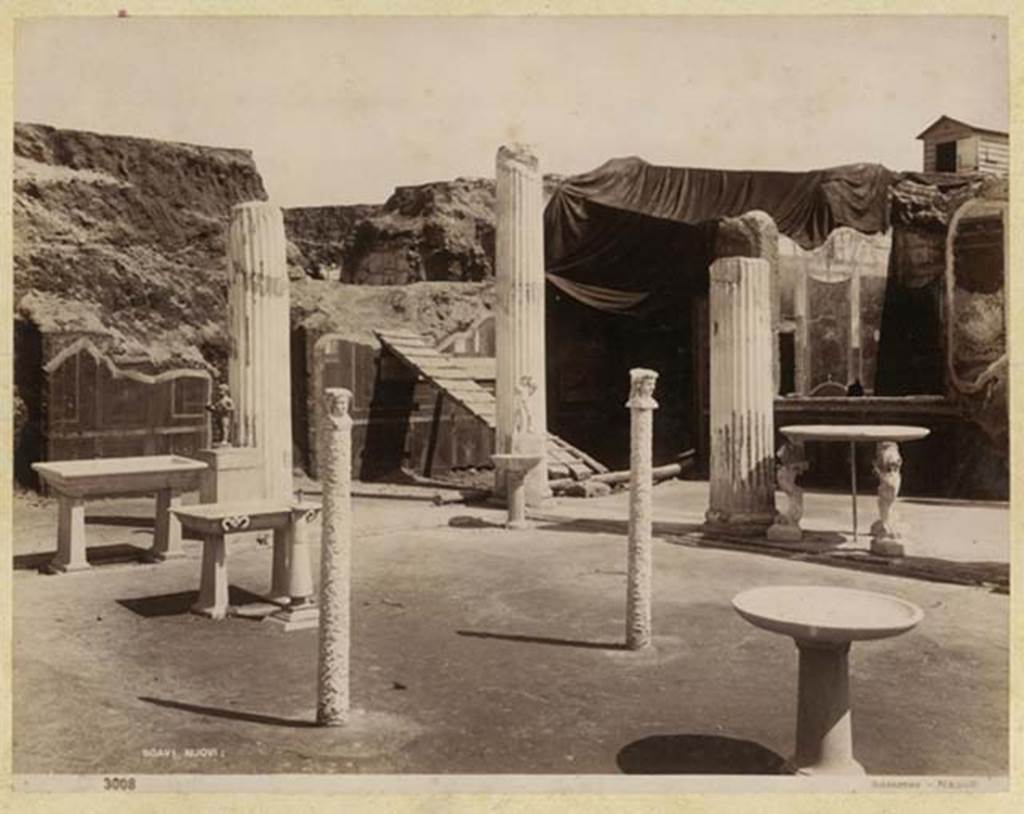
VI.15.1 Pompeii. Photo by G Sommer no. 3008, possibly 1894-95 during excavations.
Looking north-east across peristyle garden showing ornaments in place. Photo courtesy of Rick Bauer.
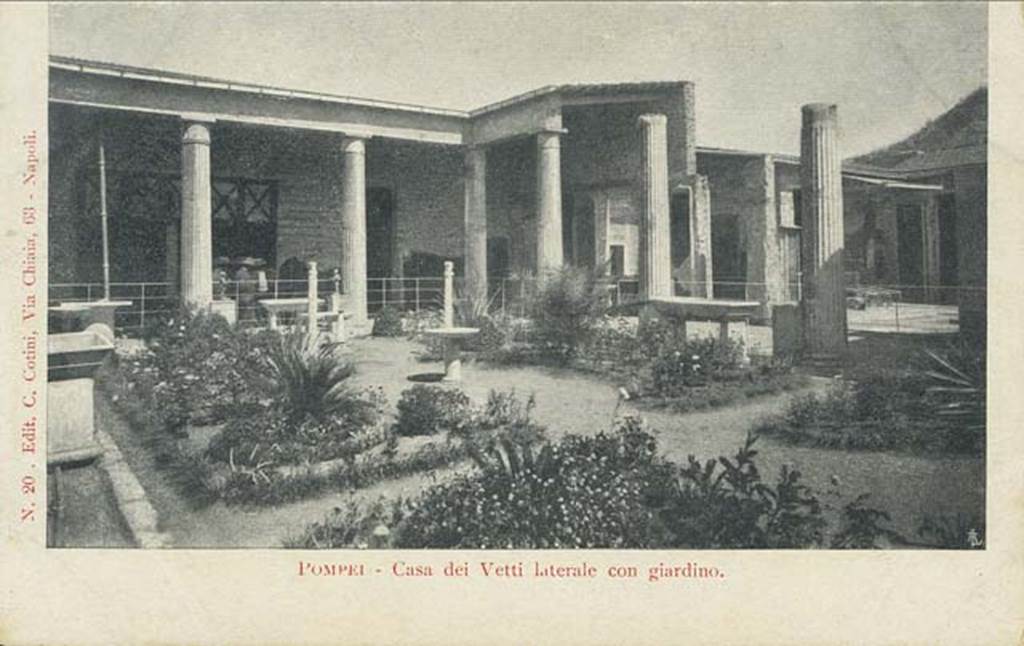
VI.15.1 Pompeii. Early 20th century photograph.
Looking north-east across peristyle garden, with unroofed atrium, on the right. Photo courtesy of Rick Bauer.
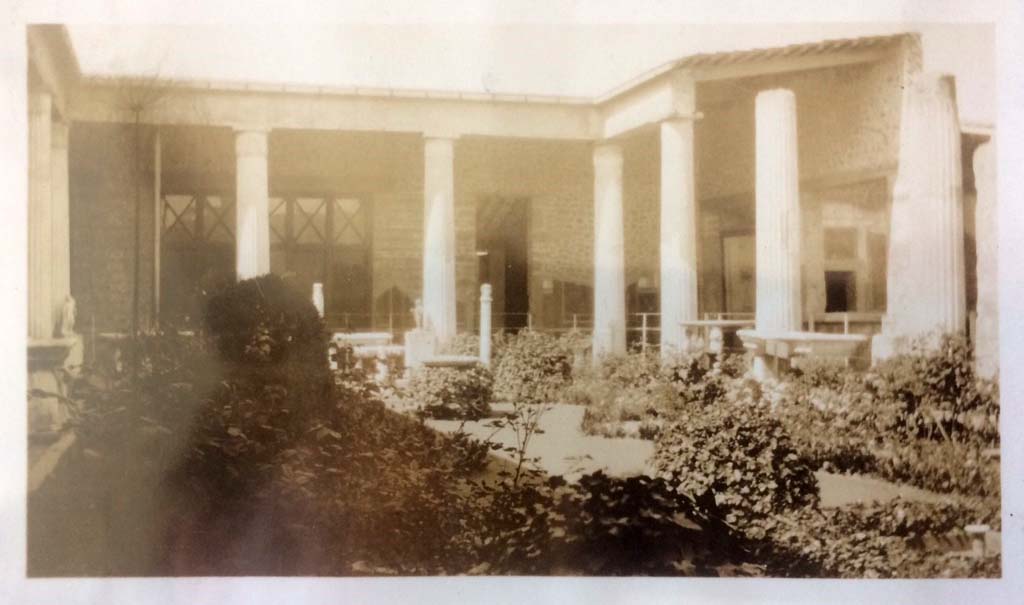
VI.15.1 Pompeii. April 1903.
Looking north across peristyle garden area towards north-east
corner, and unroofed atrium, on right. Photo courtesy of Rick Bauer.
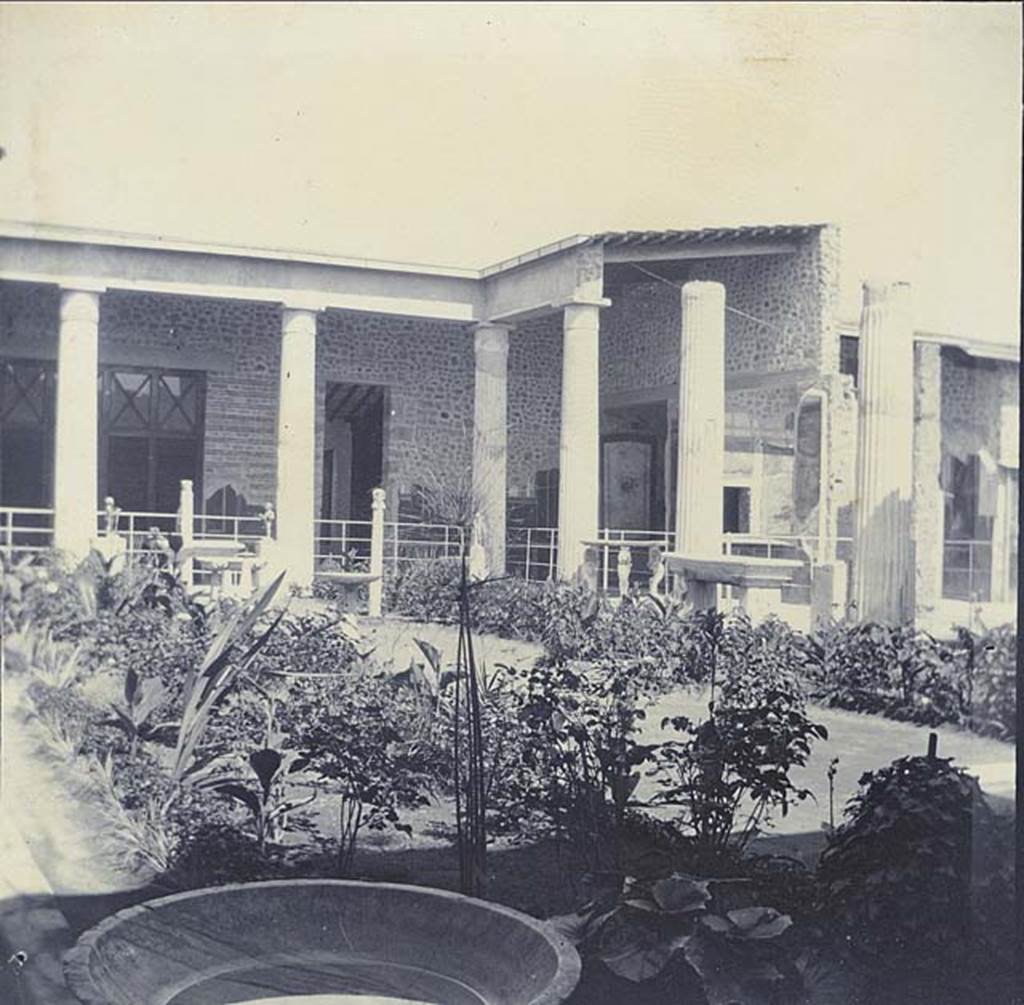
VI.15.1 Pompeii. November 1899. Peristyle garden, looking north-east. Photo courtesy of Rick Bauer.
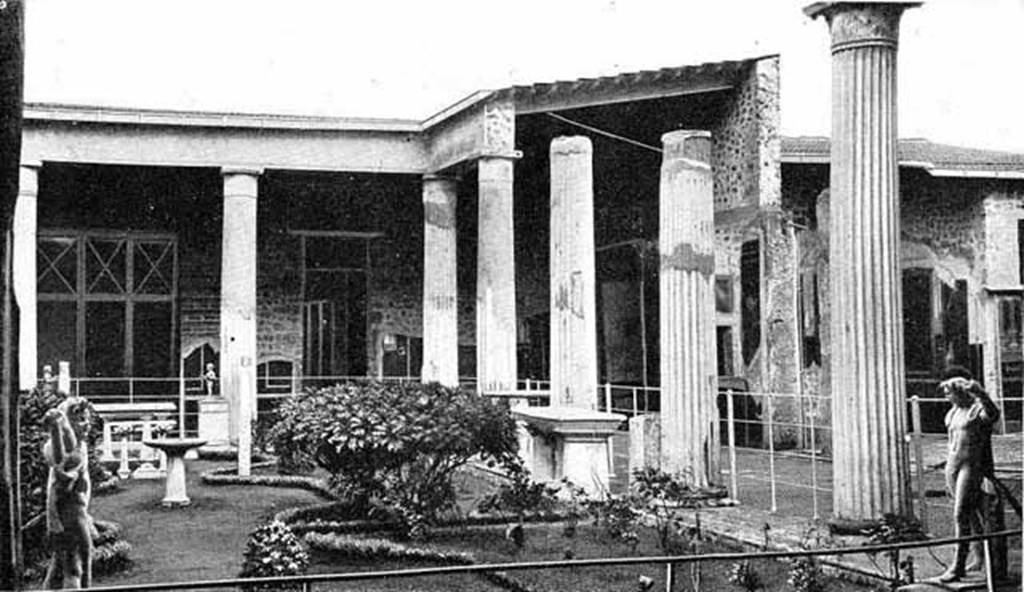
VI.15.1 Pompeii. Early 1900s? Peristyle garden, looking north-east. Photo courtesy of Rick Bauer.
The marble statue of Bacchus can be seen in the lower right corner, seen with a left arm above the elbow.
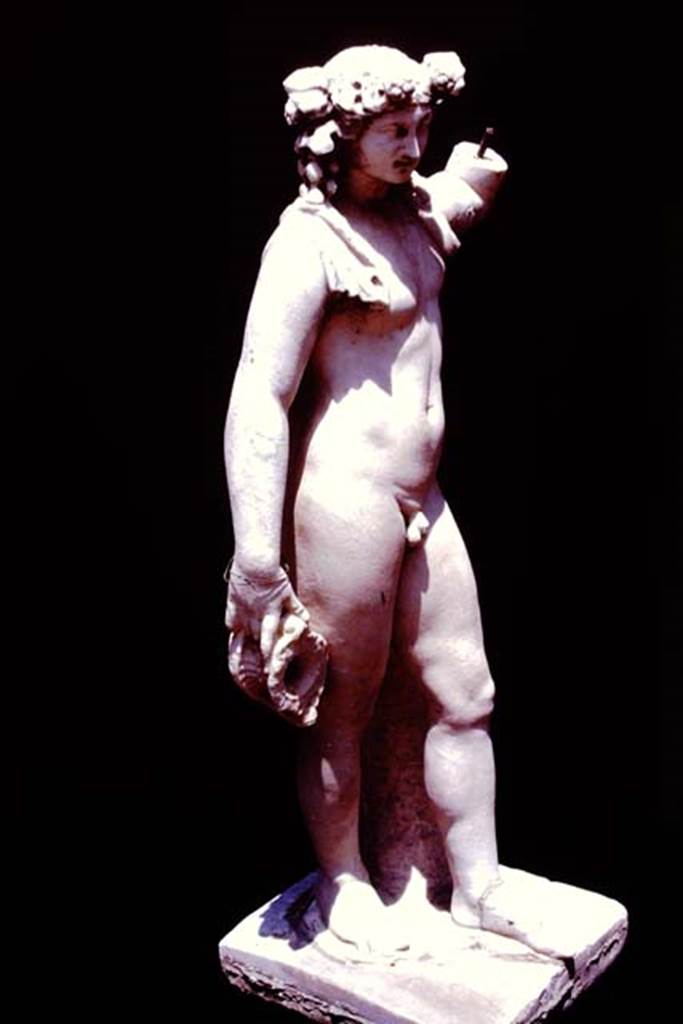
VI.15.1 Pompeii, 1978. Marble statue of Bacchus. Photo by Stanley A. Jashemski.
Source: The Wilhelmina and Stanley A. Jashemski archive in the University of Maryland Library, Special Collections (See collection page) and made available under the Creative Commons Attribution-Non-Commercial License v.4. See Licence and use details.
J78f0588
Compare the left arm with that in the early 1900s photograph, above.
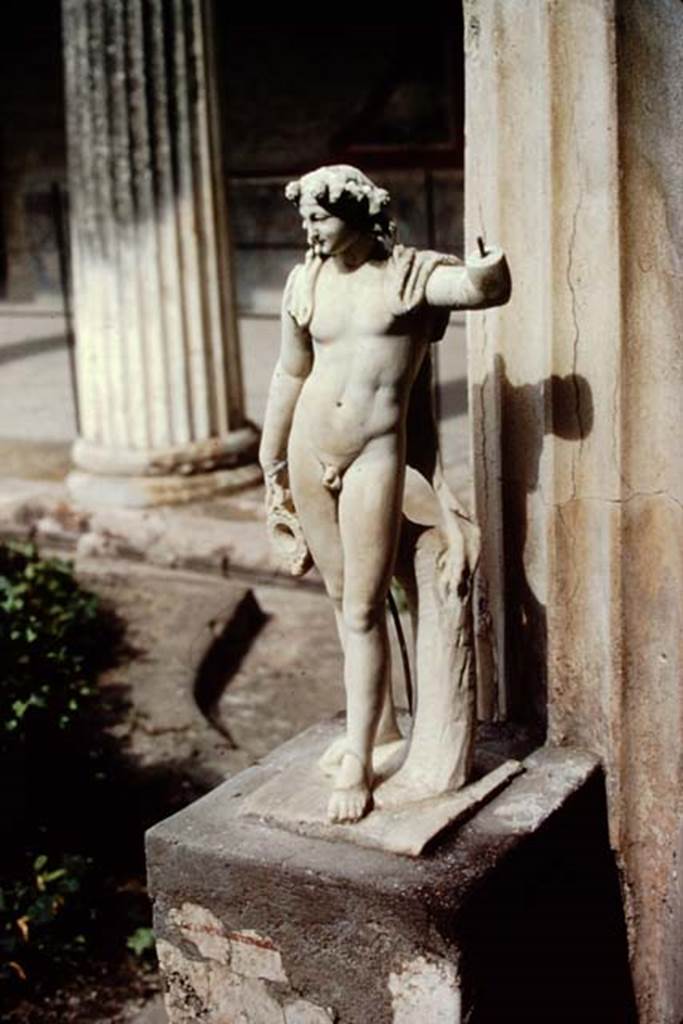
VI.15.1 Pompeii. 1972.
Peristyle garden, marble statue of Bacchus in situ in south-east corner. Photo by Stanley A. Jashemski.
Source: The Wilhelmina and Stanley A. Jashemski archive in the University of Maryland Library, Special Collections (See collection page) and made available under the Creative Commons Attribution-Non-Commercial License v.4. See Licence and use details.
J72f0408
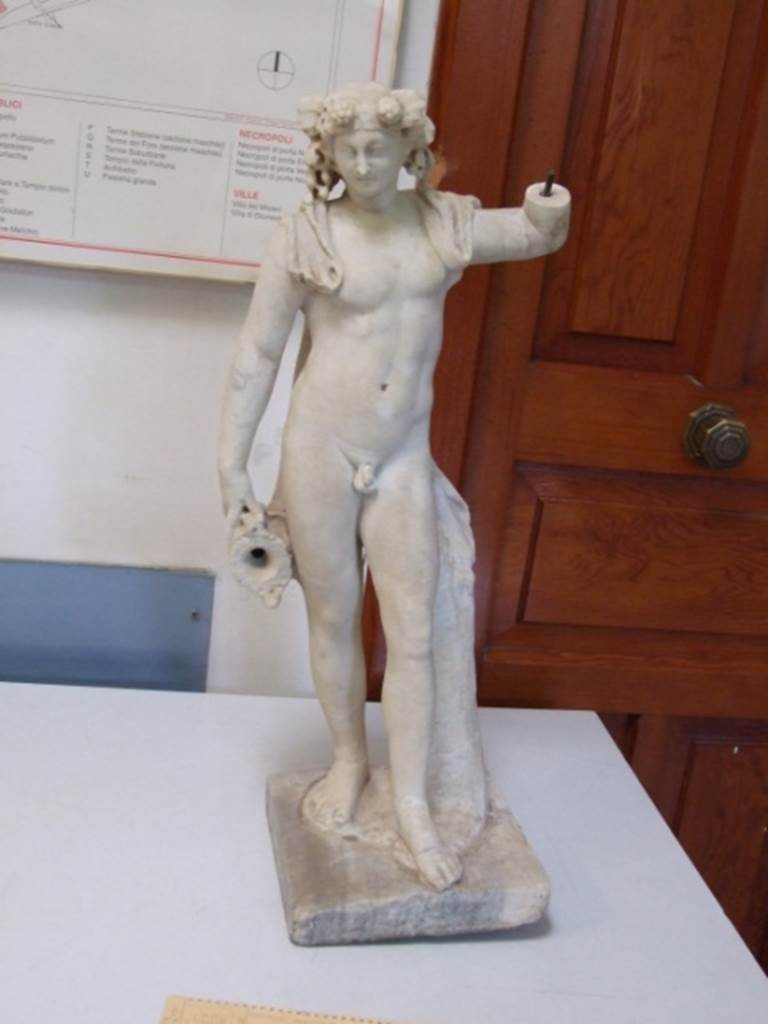
VI.15.1 Pompeii. Marble statue of Bacchus, 63cm high.
Found in 1894 in south-east corner of peristyle.
Kuivalainen comments on the condition –
A thyrsus, possibly made of bronze, was missing already during the excavation; now the whole left arm above the elbow is lost.
Traces of yellow were earlier visible on the nebris and hair, and of black on the eyes and eyebrows.
See Kuivalainen, I., 2021. The Portrayal of Pompeian Bacchus.
Commentationes Humanarum Litterarum
140. Helsinki: Finnish Society of Sciences and Letters, (H7, p.213).
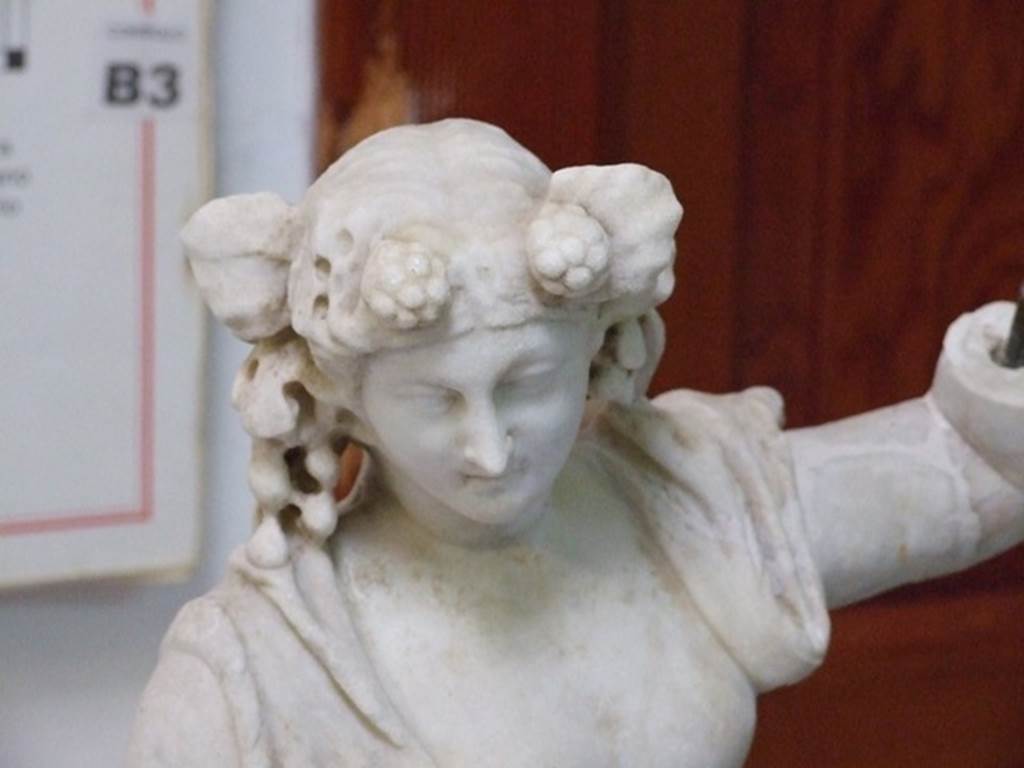
VI.15.1 Pompeii. Detail of marble statue of Bacchus, 63cm
high. Found in 1894.
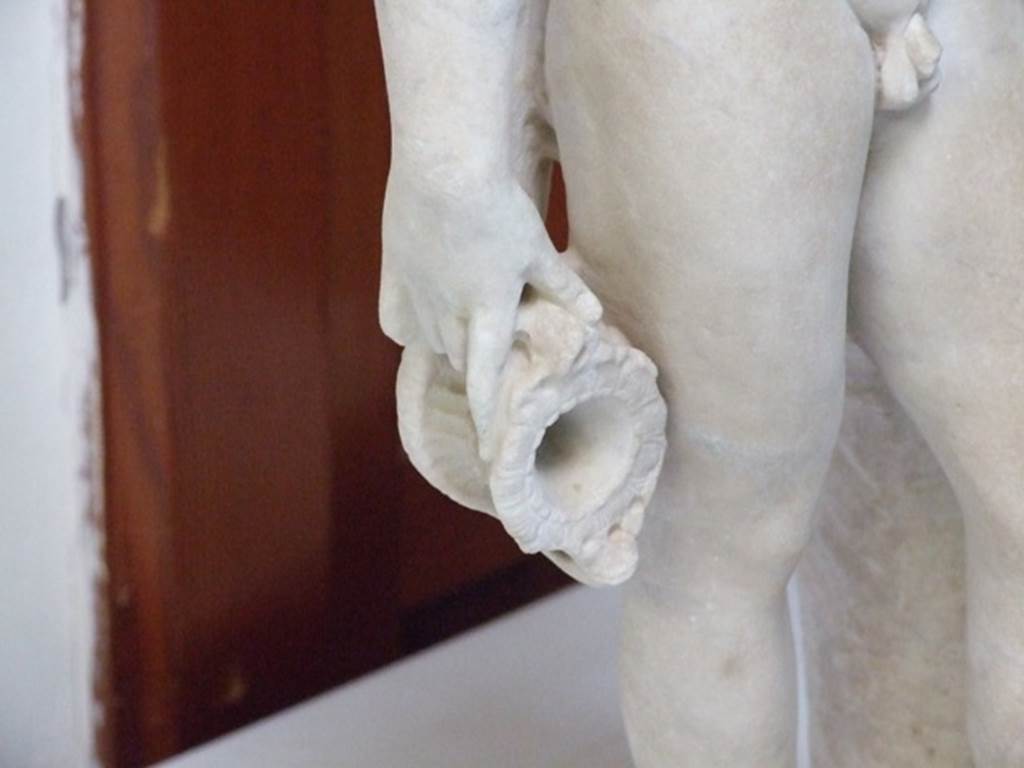
VI.15.1 Pompeii. Detail of marble statue of Bacchus, 63cm
high. Found in 1894.
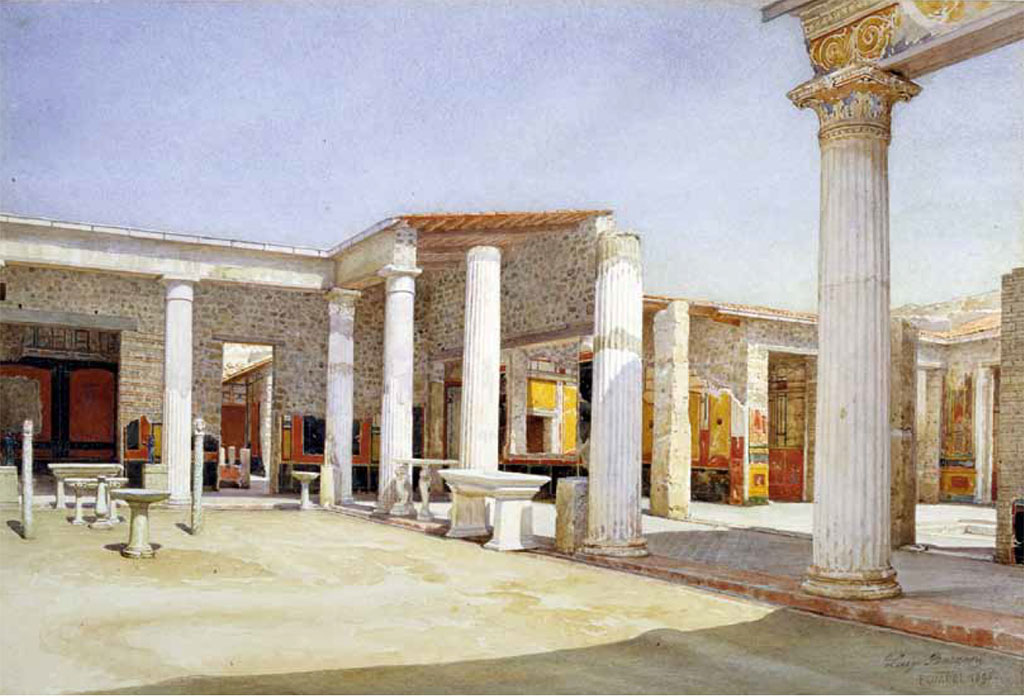
VI.15.1 Pompeii.
1895. Watercolour by Luigi Bazzani.
Looking towards the north-east corner of peristyle, and towards north side of unroofed atrium, on right.
The external architrave of the column on the right was decorated with leafy spirals made of stucco and painted in bright colours, see below.
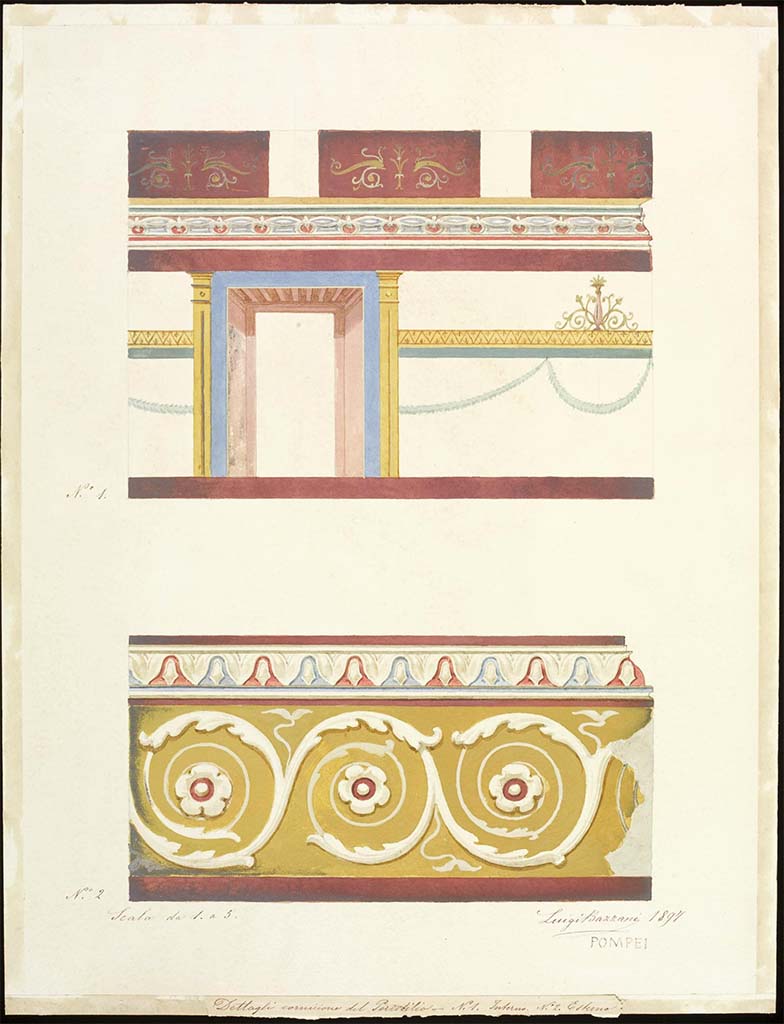
VI.15.1 Pompeii. 1897. Watercolour by Luigi Bazzani.
At the top is the decoration of the internal architrave of the peristyle, above the columns.
With a white background, it shows garlands and festoons, whilst the spaces between the beams were adorned with repetitive motifs on a red background.
The painting below shows the decorations with leafy spirals made of stucco and painted in bright colours, from the external architrave.
Photo © Victoria and Albert Museum. Inventory
number 19-1898.
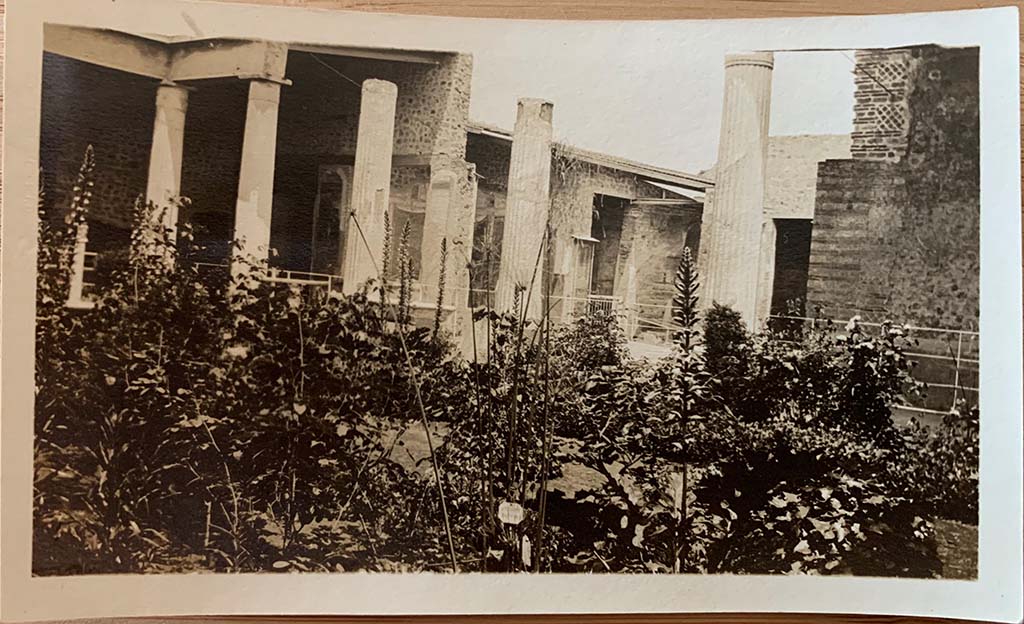
VI.15.1 Pompeii. 1907. Peristyle garden, looking towards uncovered atrium, on east side. Photo courtesy of Rick Bauer.
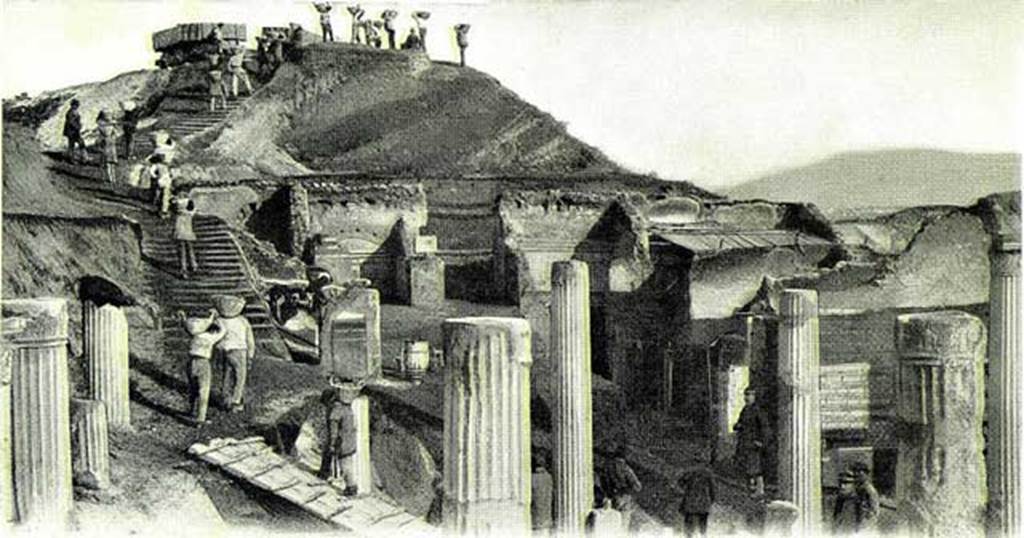
VI.15.1 Pompeii. c.1894. Looking east from north-west corner of peristyle during the excavations.
The marble pedestals for statues from the middle of the east portico can be seen in the lower centre.
The entrance doorway, looking east out onto the vicolo, can be seen in the centre of the photo. Photo courtesy of Rick Bauer.
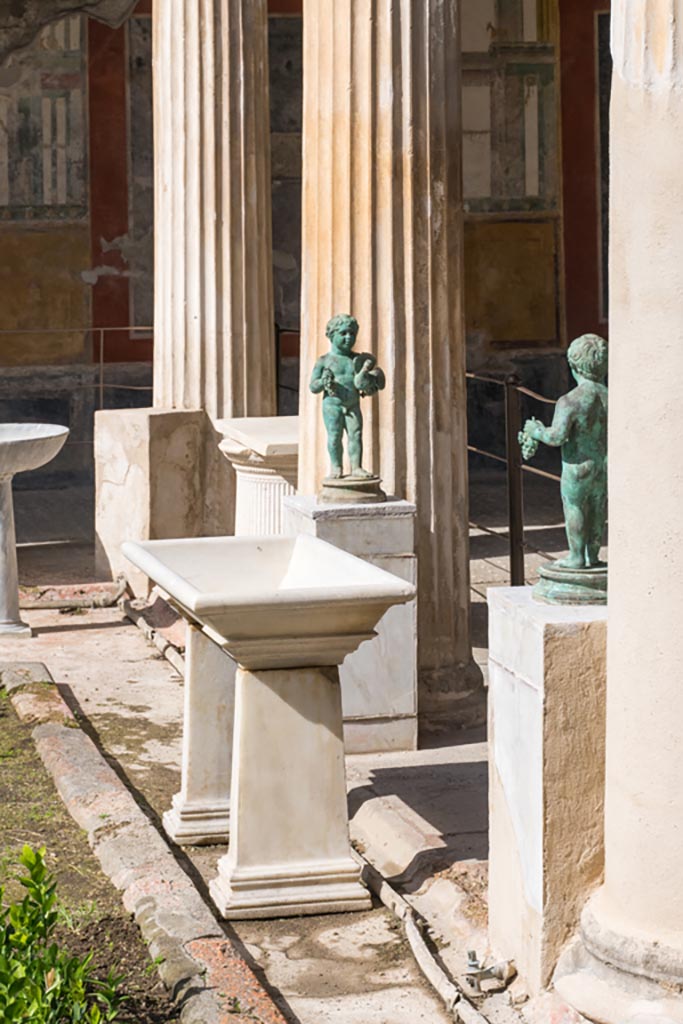
VI.15.1 Pompeii. March 2023.
North side of peristyle, looking west. Photo courtesy of Johannes Eber.
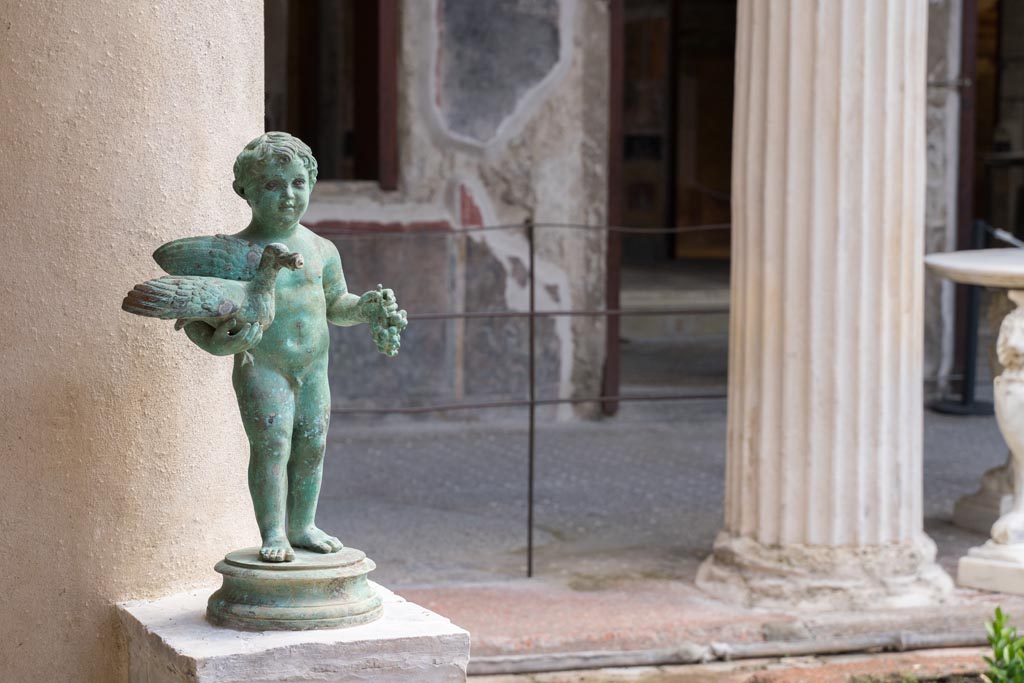
VI.15.1 Pompeii. March 2023. North side of peristyle, looking east. Photo courtesy of Johannes Eber.
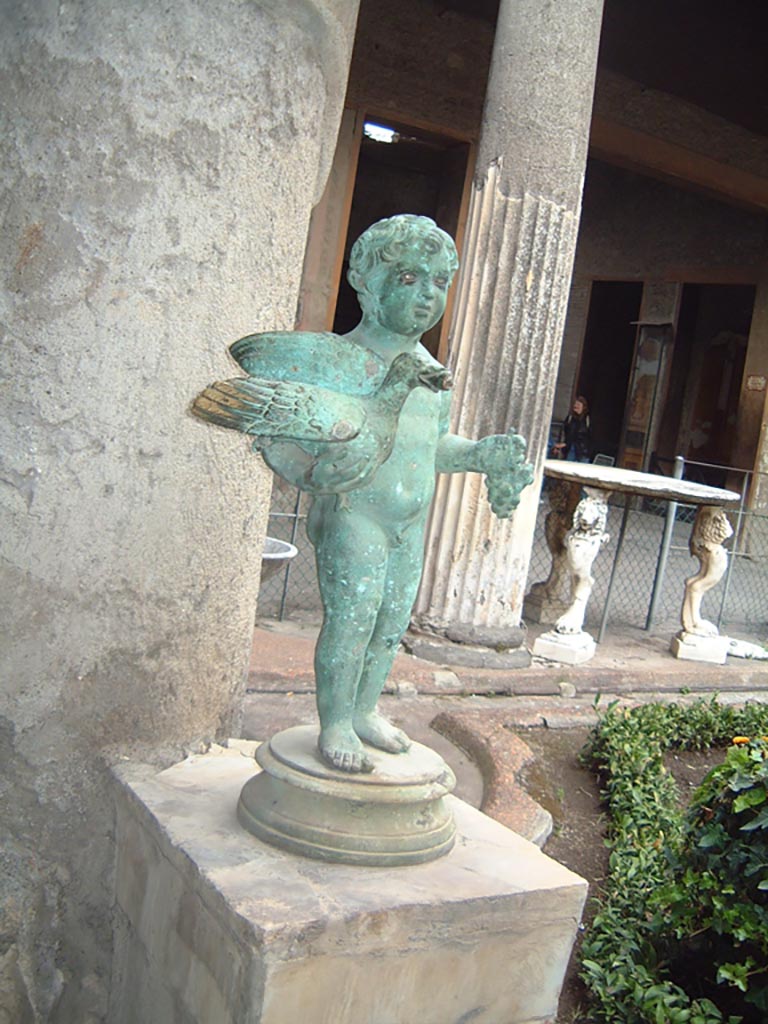
VI.15.1 Pompeii. North side of peristyle, looking east.
Bronze garden fountain statuette of boy, bird and grapes, May 2001.
Photograph courtesy of Current Archaeology.
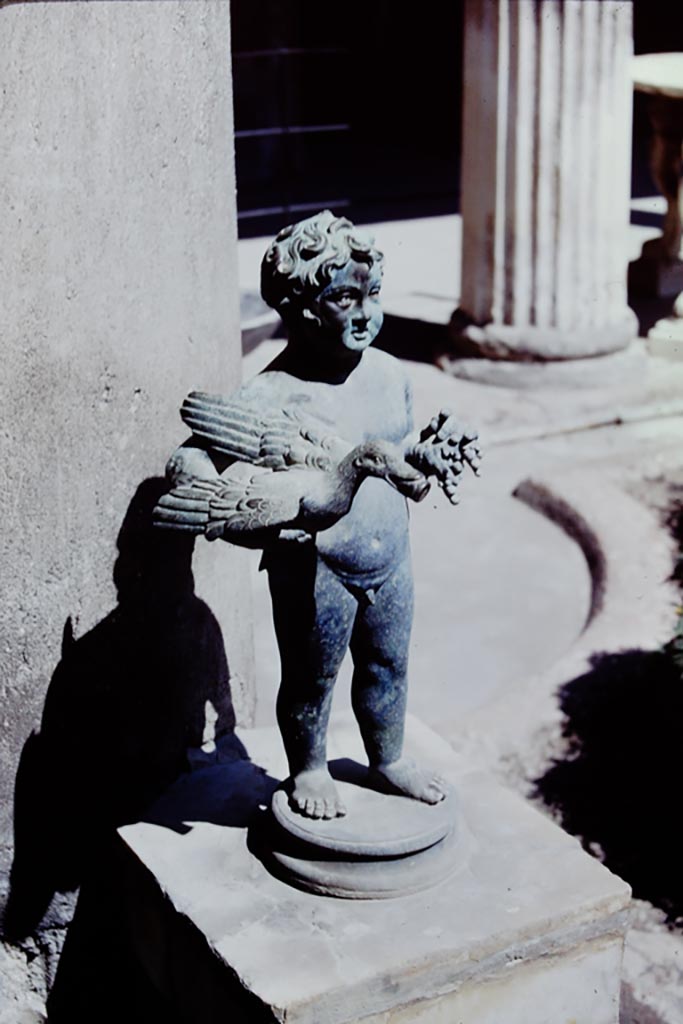
VI.15.1 Pompeii. 1968. North side of peristyle, looking east.
Bronze garden fountain statuette of boy, bird and grapes. Photo by Stanley A. Jashemski.
Source: The Wilhelmina and Stanley A. Jashemski archive in the University of Maryland Library, Special Collections (See collection page) and made available under the Creative Commons Attribution-Non-Commercial License v.4. See Licence and use details.
J68f1964
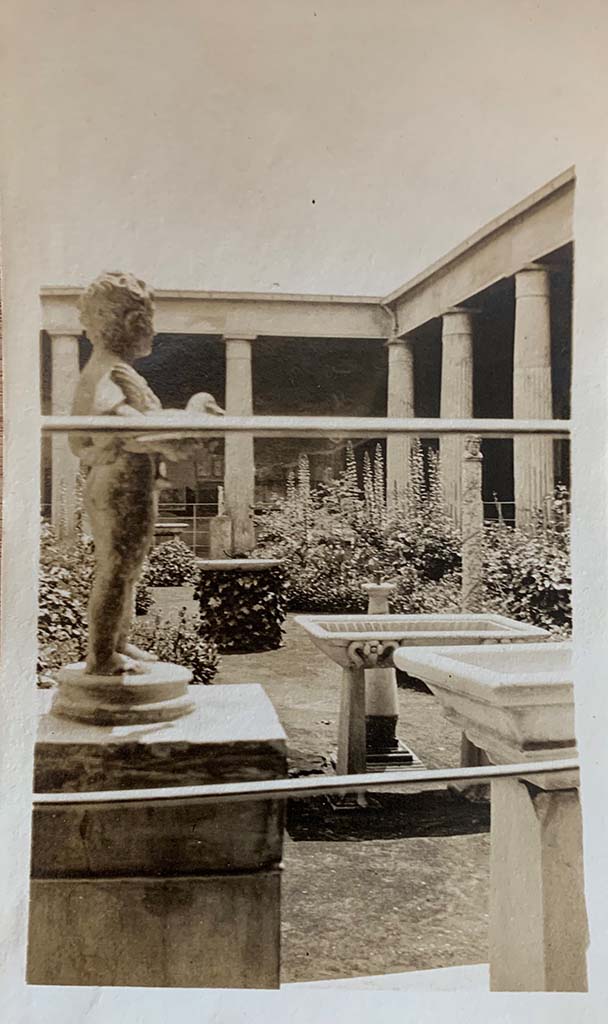
VI.15.1 Pompeii. 1907. North side of peristyle, looking south across garden area.
Bronze garden fountain statuette of boy, bird and grapes. Photo courtesy of Rick Bauer.
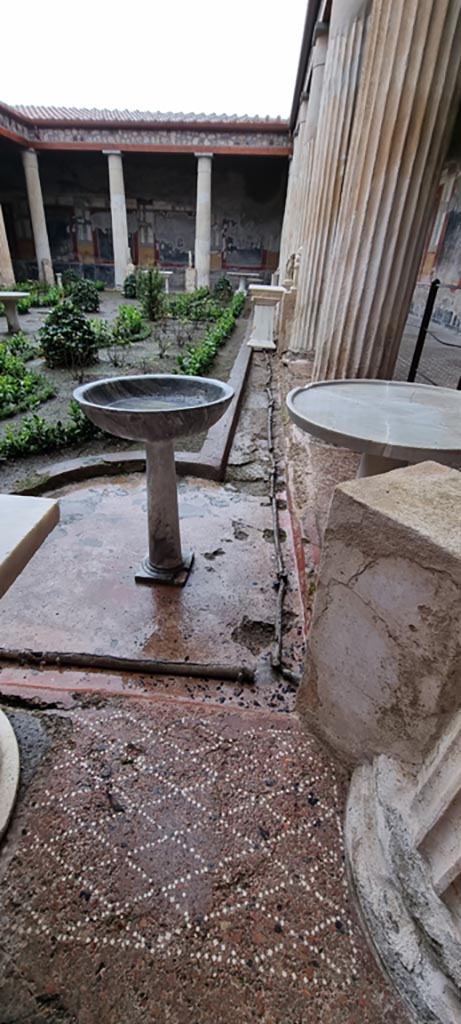
VI.15.1 Pompeii. January 2023.
Looking south along west side of peristyle. Photo courtesy of Miriam Colomer.
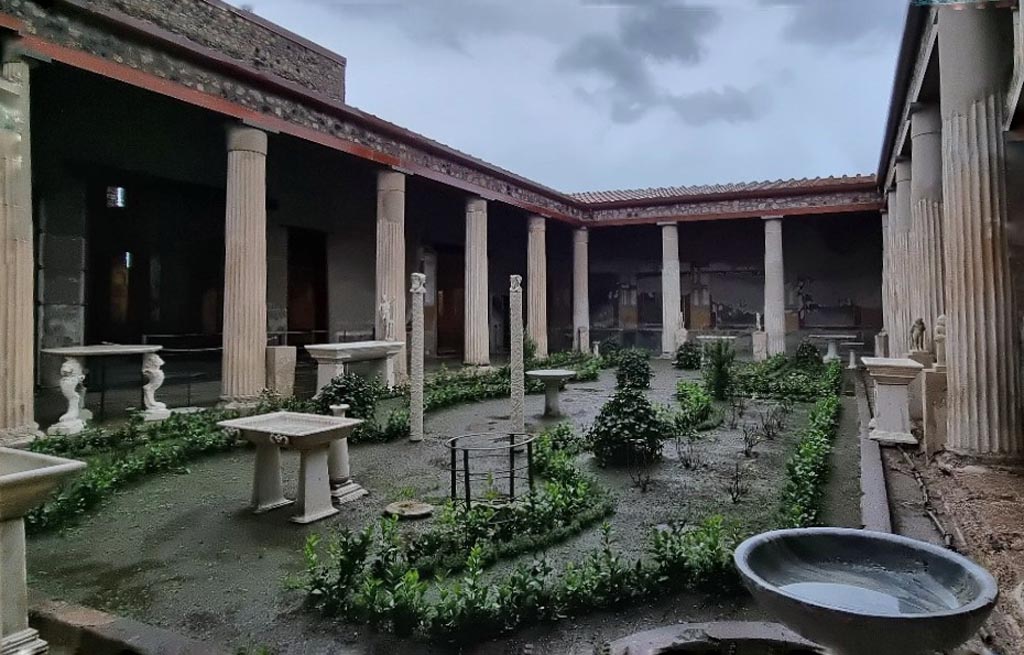
VI.15.1 Pompeii. January 2023. Looking south-east across peristyle from north-west corner. Photo courtesy of Miriam Colomer.
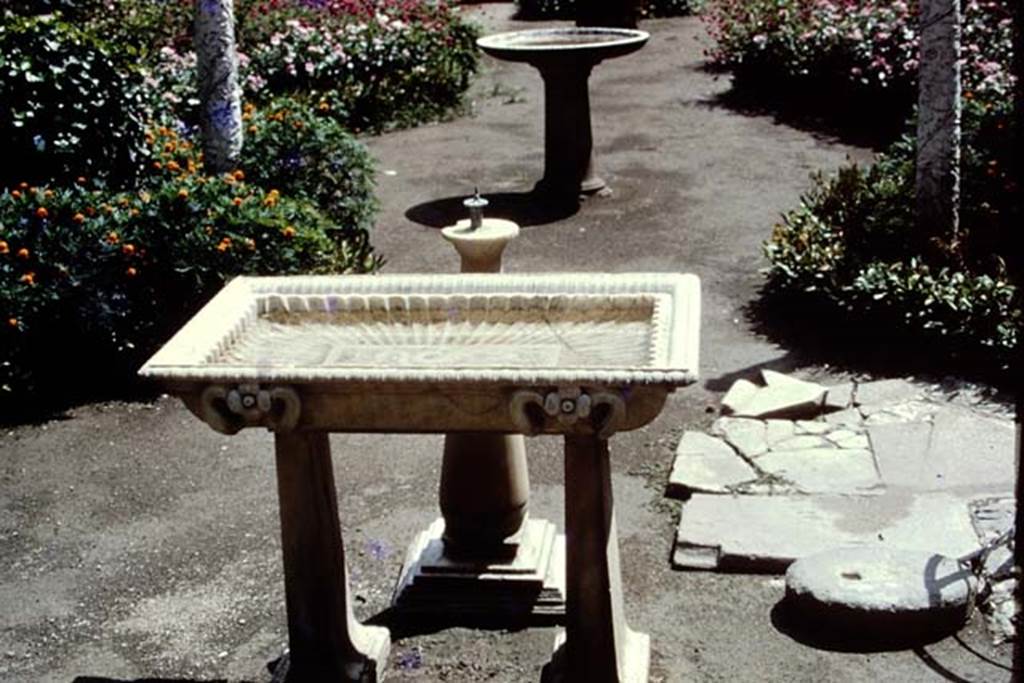
VI.15.1 Pompeii. 1968. Looking south across garden from north end. Photo by Stanley A. Jashemski.
Source: The Wilhelmina and Stanley A. Jashemski archive in the University of Maryland Library, Special Collections (See collection page) and made available under the Creative Commons Attribution-Non-Commercial License v.4. See Licence and use details.
J68f2051
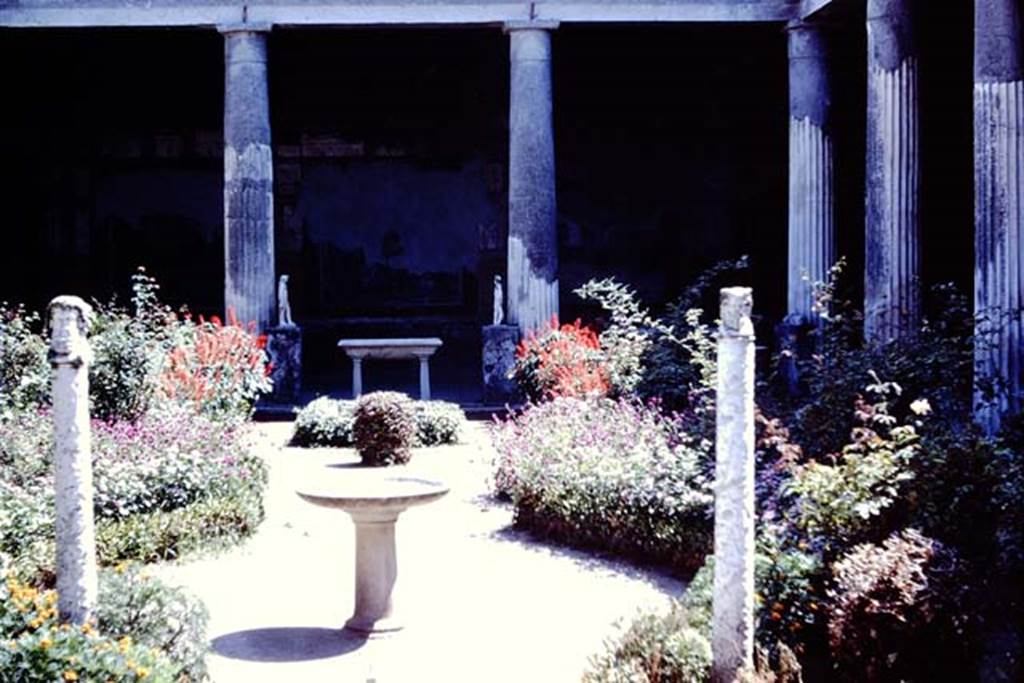
VI.15.1 Pompeii. 1968. Looking south across peristyle garden from north portico. Photo by Stanley A. Jashemski.
Source: The Wilhelmina and Stanley A. Jashemski archive in the University of Maryland Library, Special Collections (See collection page) and made available under the Creative Commons Attribution-Non-Commercial License v.4. See Licence and use details.
J68f1962
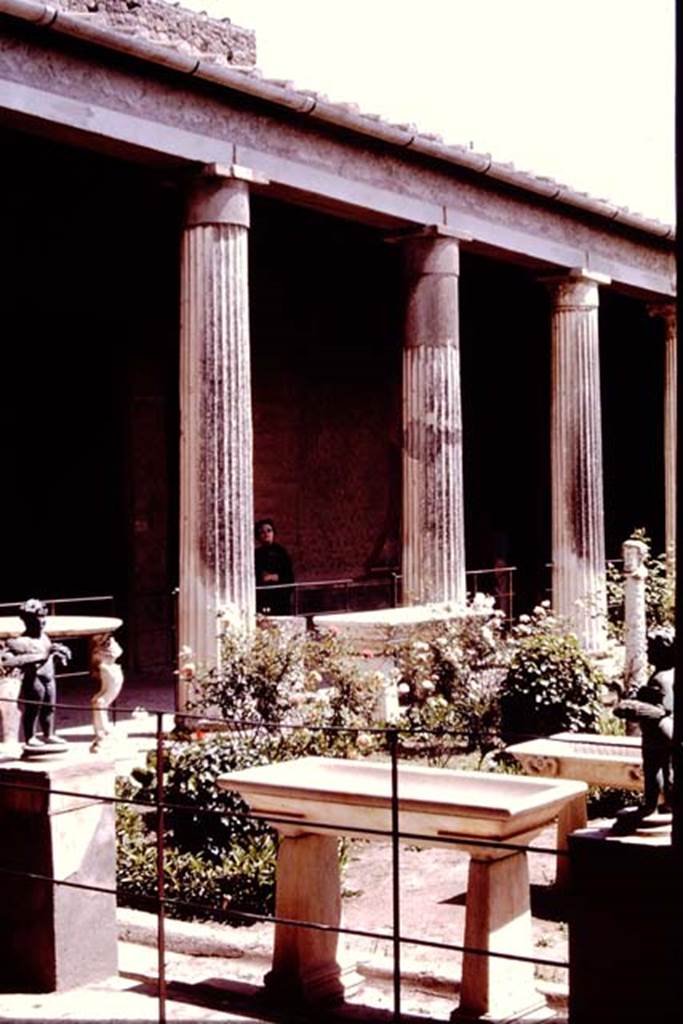
VI.15.1 Pompeii. 1964. Looking south-east from north portico. Photo by Stanley A. Jashemski.
Source: The Wilhelmina and Stanley A. Jashemski archive in the University of Maryland Library, Special Collections (See collection page) and made available under the Creative Commons Attribution-Non-Commercial License v.4. See Licence and use details.
J64f0027
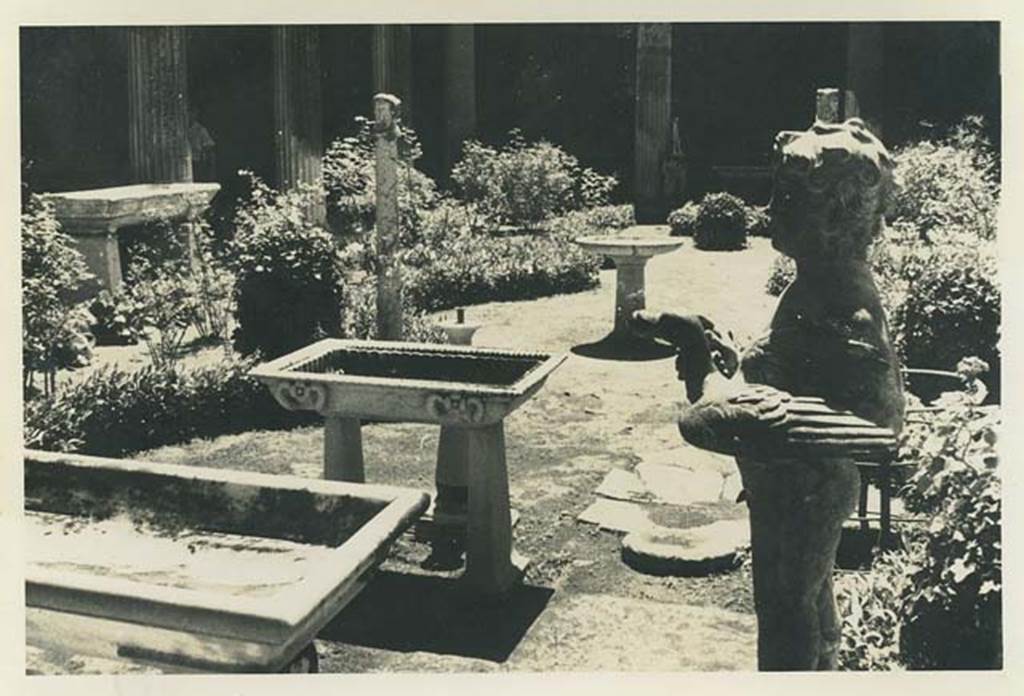
VI.15.1 Pompeii. 22nd July 1961. Looking south-east from north portico. Photo courtesy of Rick Bauer.
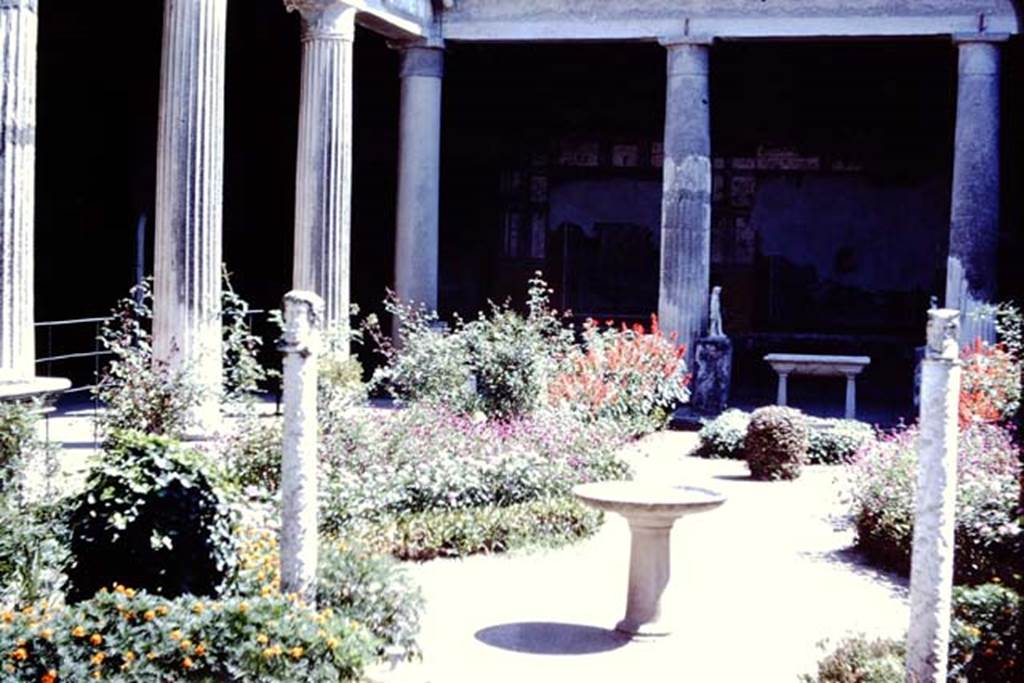
VI.15.1 Pompeii. 1968. Looking south-east across peristyle garden. Photo by Stanley A. Jashemski.
Source: The Wilhelmina and Stanley A. Jashemski archive in the University of Maryland Library, Special Collections (See collection page) and made available under the Creative Commons Attribution-Non-Commercial License v.4. See Licence and use details.
J68f1963
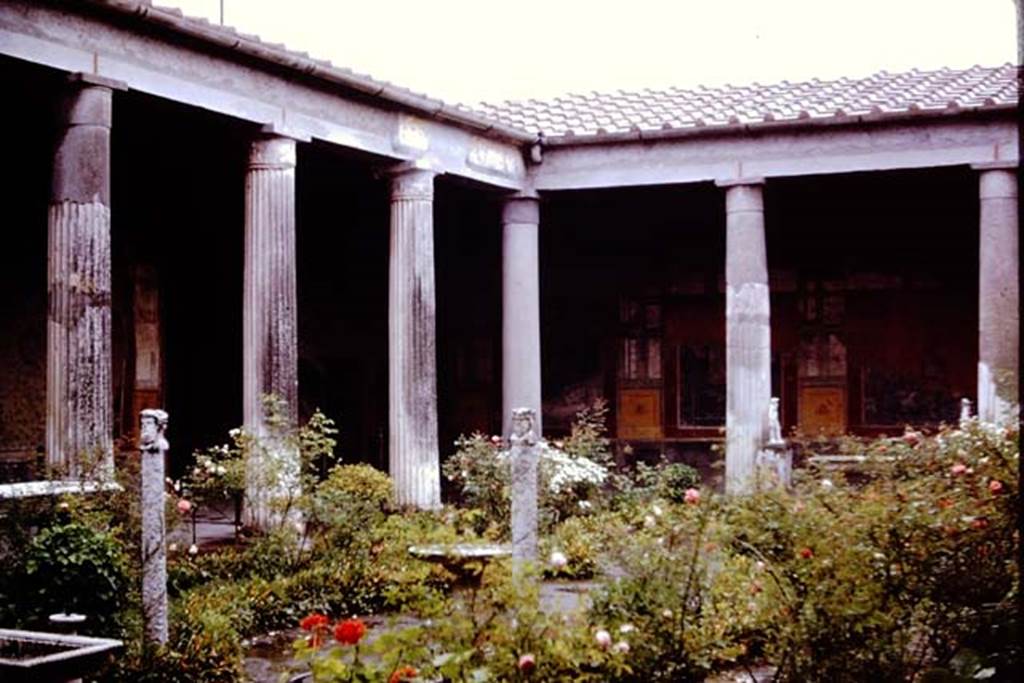
VI.15.1 Pompeii. 1961. Looking south-east across peristyle garden. Photo by Stanley A. Jashemski.
Source: The Wilhelmina and Stanley A. Jashemski archive in the University of Maryland Library, Special Collections (See collection page) and made available under the Creative Commons Attribution-Non-Commercial License v.4. See Licence and use details.
J61f0424
Part 4 Part 1 Part 2 VI.15.1 Plan