VI.14.39 Pompeii. Casa Lucrum
Gaudium or Officina di tornitore.
Excavated 1876.
For detailed room descriptions see the room plan Room Plan
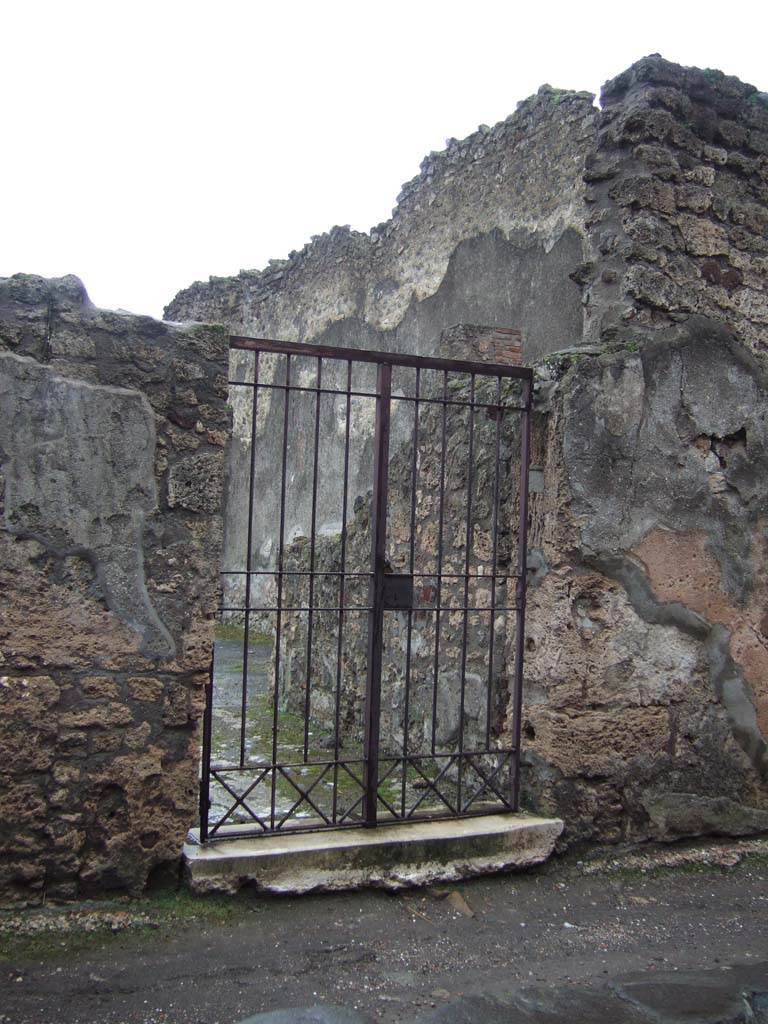
VI.14.39 Pompeii. December 2005. Entrance doorway leading into fauces/entrance corridor.
The fauces or entrance corridor had a threshold of marble, and the doorway would have been closed with two door-shutters.
According to Mau, it seemed that the shutter on the left would have remained closed, as only on the right did he see the circle that attached and closed the door with the bolt.
The flooring was made up of irregular pieces of marble and was interrupted by a strip that was intended to carry away the rainwater from the impluvium to the street.
This strip was formed of opus Signinum with a few pieces of marble and resembled the flooring of the atrium (opus Signinum with crushed lava), but from which it was distinguishable.
See Mau in Bullettino dell’Instituto di Corrispondenza
Archeologica (DAIR), 1878, (p.89)
![VI.14.39 Pompeii. 1878. Drawing of graffiti on outside wall. According to Presuhn, near the door to 39 on the outside wall was yellow painted plaster completely covered in scribblings. He described a dog, a student’s alphabet and under other inscriptions that of a slave, MODESTA TERMINALIS. All three are by different hands. See Presuhn E., 1878. Pompeji: Die Neuesten Ausgrabungen von 1874 bis 1878. Leipzig: Weigel. (V, Plate III, p. 6).
According to Epigraphik-Datenbank Clauss/Slaby (See www.manfredclauss.de) this reads as Modesta Terminans [CIL IV 4549]](6%2014%2039_files/image005.jpg)
VI.14.39 Pompeii. 1878. Drawing of graffiti on outside wall.
According to Presuhn, near the door to 39 on the outside wall was yellow painted plaster completely covered in scribblings.
He described a dog, a student’s alphabet, and below other inscriptions that of a slave, MODESTA TERMINALIS. All three are by different hands.
See Presuhn E., 1878. Pompeji: Die Neuesten Ausgrabungen von 1874 bis 1878. Leipzig: Weigel. (V, Plate III, p. 6).
According to Epigraphik-Datenbank Clauss/Slaby (See www.manfredclauss.de) this reads as
Modesta Terminans [CIL IV 4549]
According to Mau, when excavated the lower front exterior dado of the house was painted with a narrow black band (0.39m).
Above this was a rough imitation of yellow marble, divided into rectangles by dark stripes surrounded by two white lines.
Each rectangle was higher than it was wide.
At the height of l.77, and above the yellow imitation marble, was a rough white stucco.
Visible were also the remains of an older layer of less crude stucco, on which could be read the large letters of ancient graffiti.
Two small windows that were on either side of the entrance doorway were walled up by the ancients.
See Mau in Bullettino dell’Instituto di Corrispondenza Archeologica
(DAIR), 1878, (p.88)
See Notizie degli Scavi di Antichità, 1876, (p.147)

VI.14.39 Pompeii. 1876 drawing of graffiti on outside wall.
According to NdS, an Oscan inscription had been painted in large red letters after the seventh doorway in the roadway.
On the rough plaster that covered the wall constructed in Sarno stone, the only words that could be read were those above.
See Notizie degli Scavi di Antichità, May 1876, (p.243).
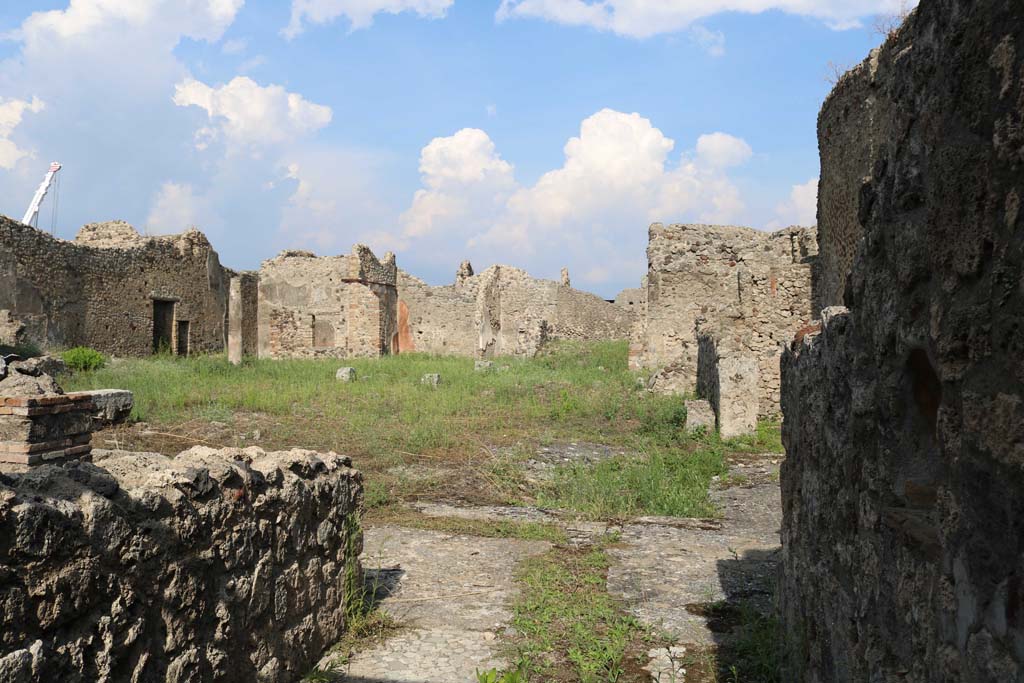
VI.14.39 Pompeii. December 2018. Looking east from entrance
corridor towards atrium. Photo courtesy of Aude Durand.
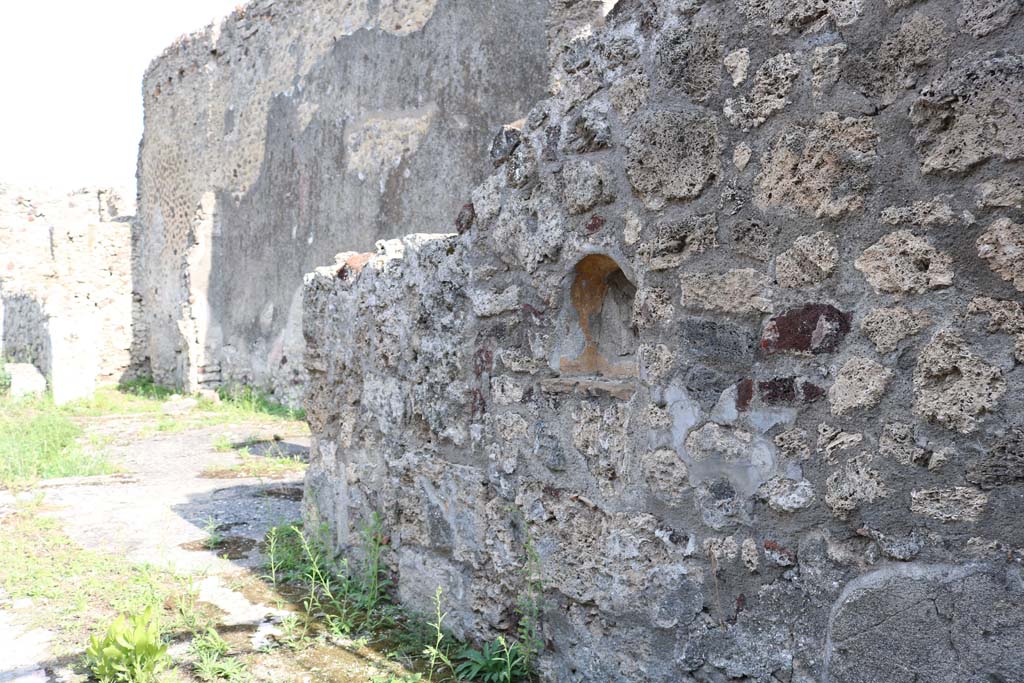
VI.14.39 Pompeii. December 2018. South wall of entrance
corridor, with niche. Photo courtesy of Aude Durand.
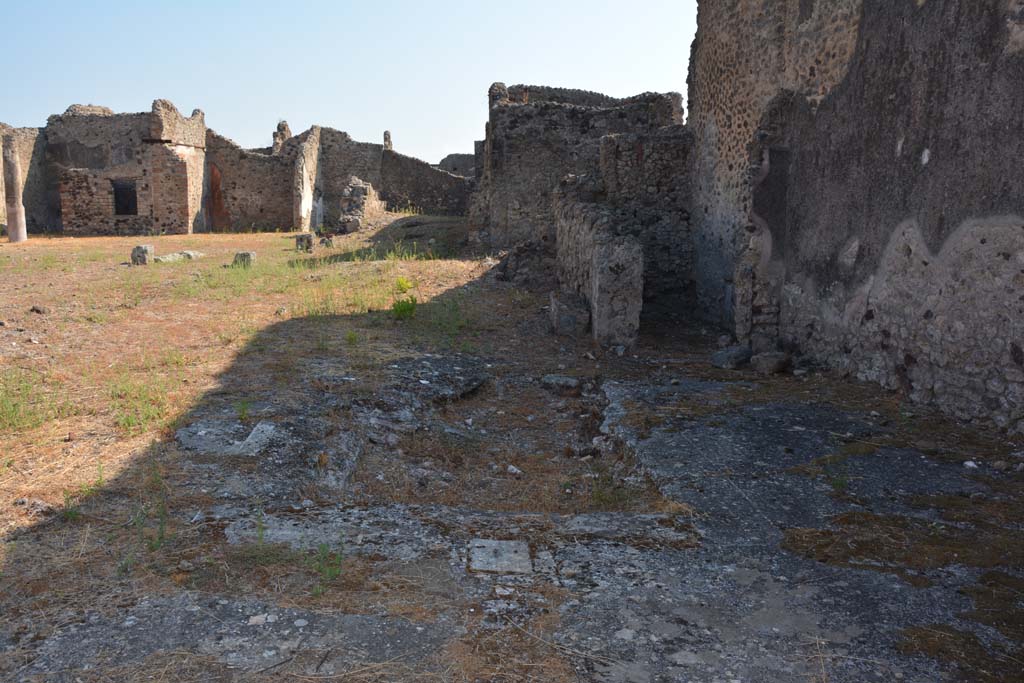
VI.14.39 Pompeii. September 2019.
Looking east from entrance doorway, across atrium and tablinum, garden area, and exedra at the very rear overlooking the garden.
Foto Annette Haug, ERC Grant 681269 DÉCOR.
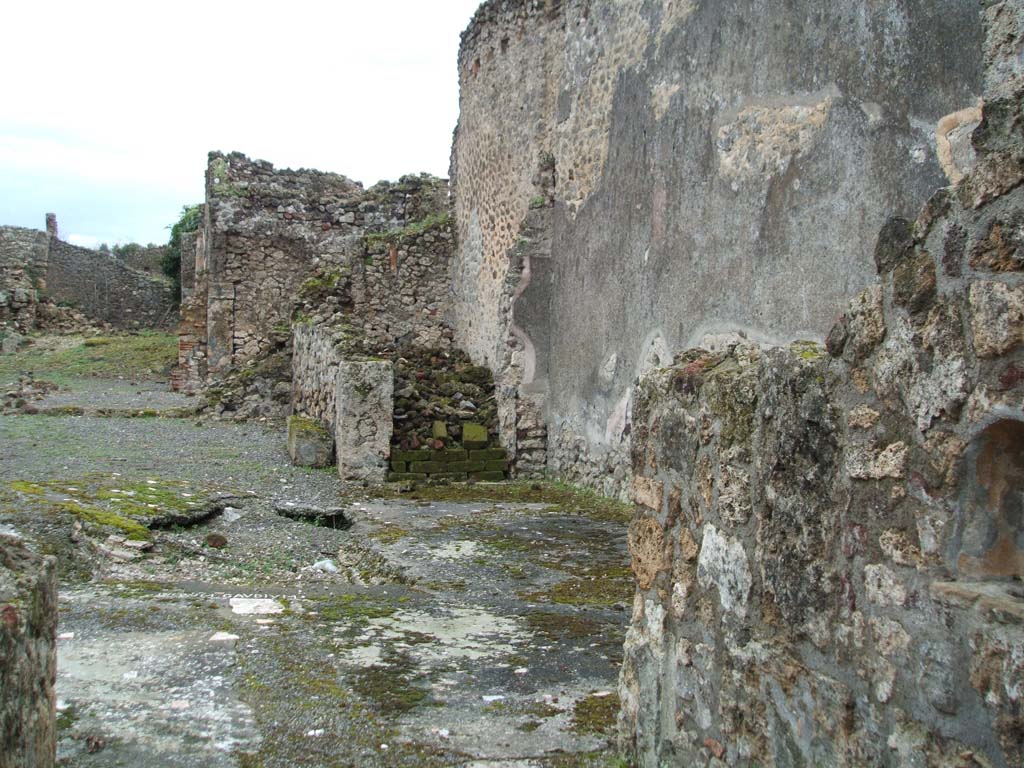
VI.14.39 Pompeii. December 2004.
Looking east from entrance doorway, across atrium and tablinum, garden area, and exedra at the very rear overlooking the garden.
According to Garcia y Garcia, the same bomb that damaged the previous house also brought down this one.
It now appears completely ruined.
The dividing wall between VI.14.38 and 39 does not exist anymore.
Of the two staircases, one going up to the first floor, the other going down to the basement, no traces remain.
The IV Style painted plaster also perished.
See Garcia y Garcia, L., 2006. Danni di guerra a Pompei. Rome: L’Erma di Bretschneider. (p.93-4, incl. photos by Tatiana Warscher).
According to Jashemski, the small garden (approximately the green area on the left of the above photo) had a narrow portico.
This portico on the north was supported by two columns and an engaged column.
The terrace, or loggia, was on the east side. The exedra was at the eastern rear side of the terrace, and overlooked the garden.
Both the terrace and exedra were 0.95m above the garden and could be reached by four steps.
Another set of steps on the left (north) led to a basement area.
Another roof covered the terrace and steps.
There was a terracotta puteal near the two columns in the garden.
Also found near the south wall was a circular basin of grey marble, supported by a cylindrical foot of cipolin.
See Jashemski, W. F., 1993. The Gardens of Pompeii, Volume II: Appendices. New York: Caratzas. (p.151)
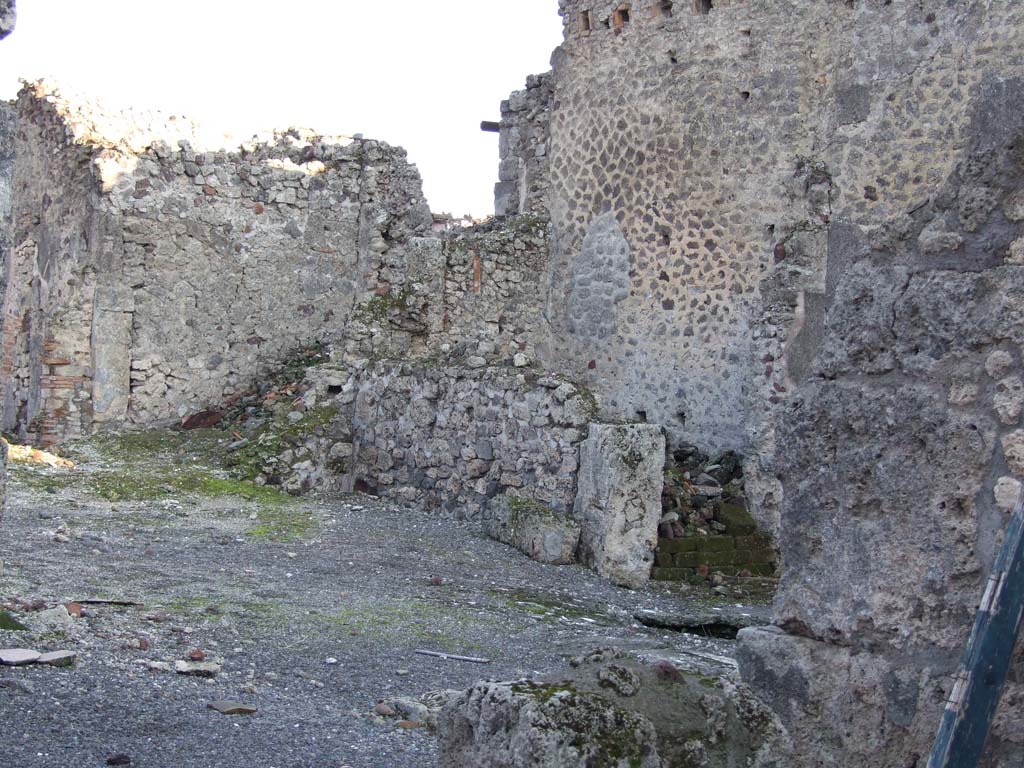
VI.14.39 Pompeii. December 2007.
Looking south-east across area of atrium and tablinum, towards doorway to small room “e” on south side of tablinum.
According to NdS, this room “e” was a cubiculum.
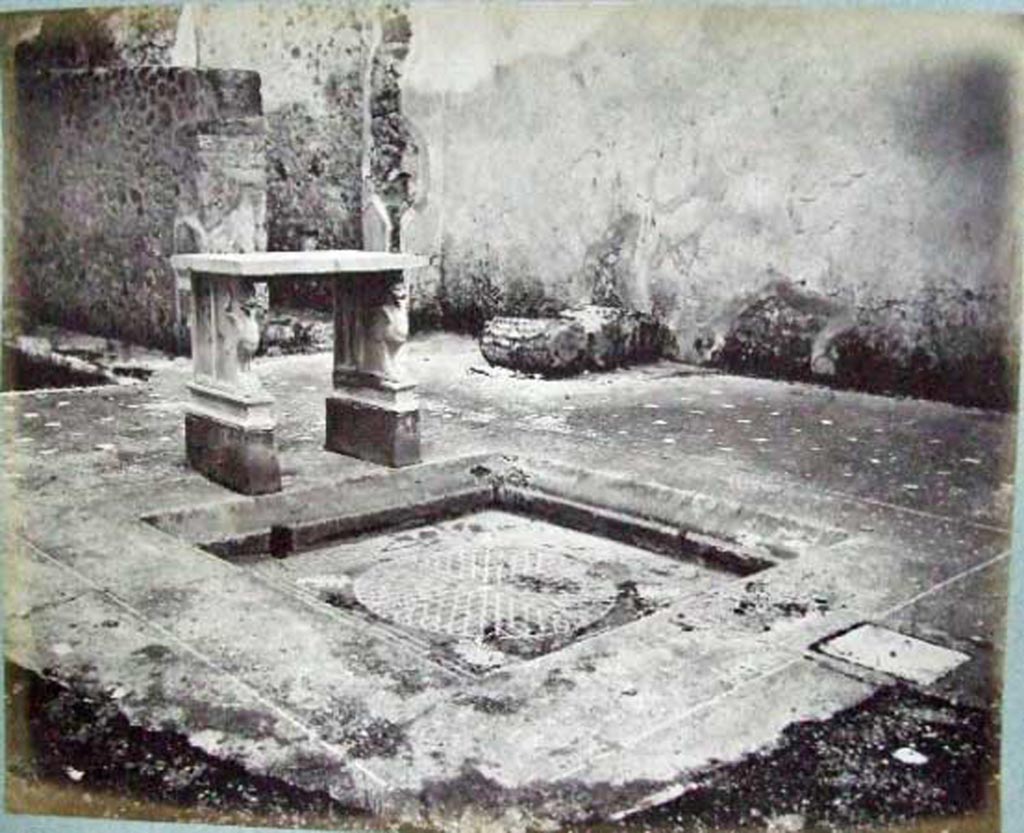
VI.14.39 Pompeii.
Casa Lucrum Gaudium or Officina di tornitore.
Looking south-east across atrium and tablinum, showing how it looked before bombing in 1943.
Old undated photograph courtesy of the Society of Antiquaries, Fox Collection.
According to Mau in BdI, the floor of the atrium was made of opus Signinum with crushed lava.
Near to the impluvium was a vent covered by a piece of square stone.
The rim of the impluvium was made of the same opus Signinum as the atrium floor, but with white stones.
In the front rim, between a line of white stones that surrounded it, one could read in letters not very regular, the words – LVCRVM GAVDIVM
At the rear were the two table legs, supported on a brick base which was painted red (0.25 high).
The base of each leg was marble and shaped like a griffin with a lion’s head.
See Mau in Bullettino dell’Instituto di Corrispondenza
Archeologica (DAIR), 1878, (p.90).
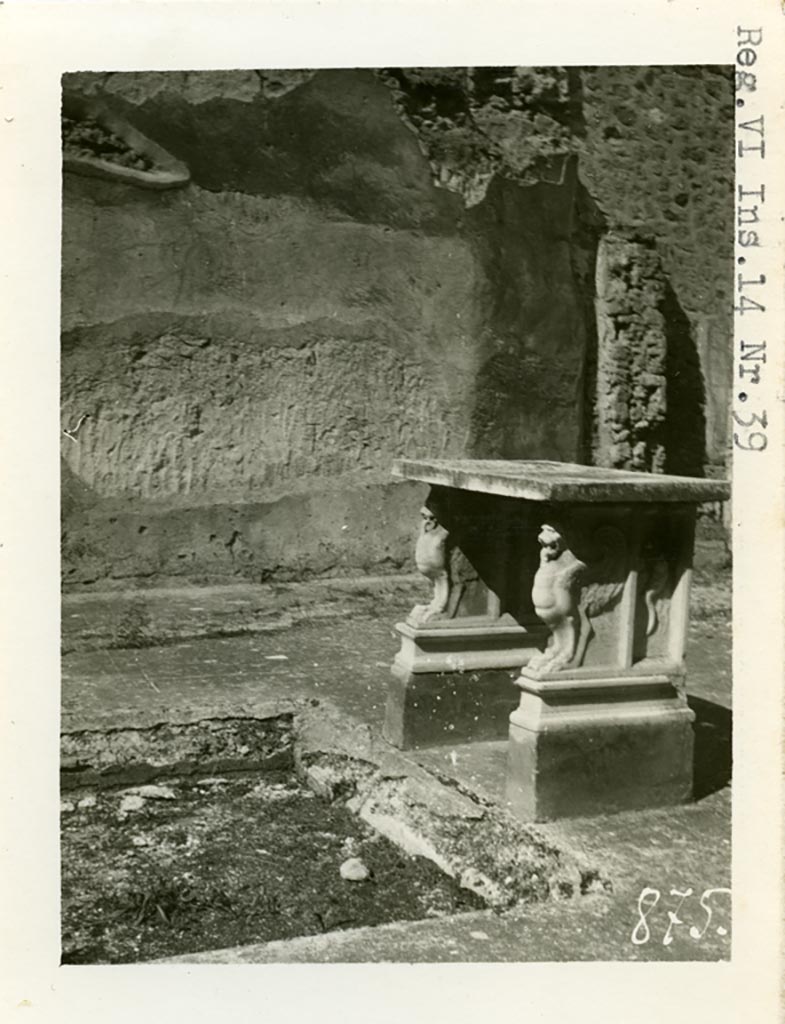
VI.14.39 Pompeii. Pre-1937-39. Looking north-east across atrium.
Photo courtesy of American Academy in Rome, Photographic Archive. Warsher collection no. 875.
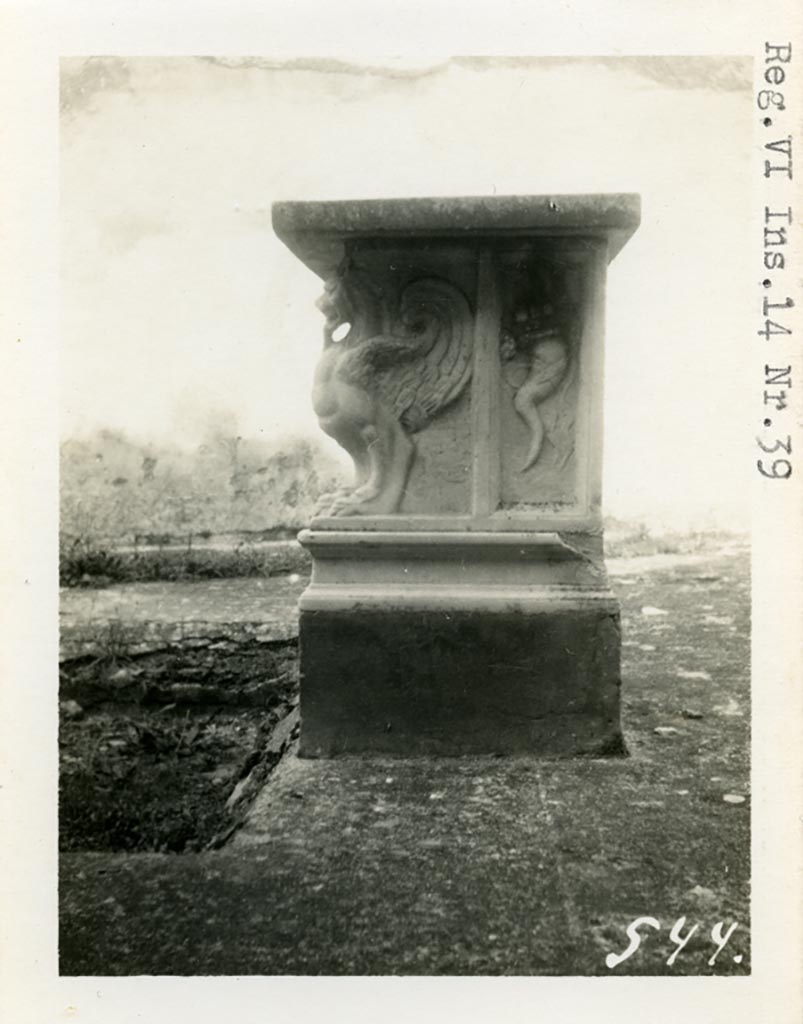
VI.14.39 Pompeii. Pre-1937-39. Detail of table, at east side of impluvium in atrium.
Photo courtesy of American Academy in Rome, Photographic Archive. Warsher collection no. 544.
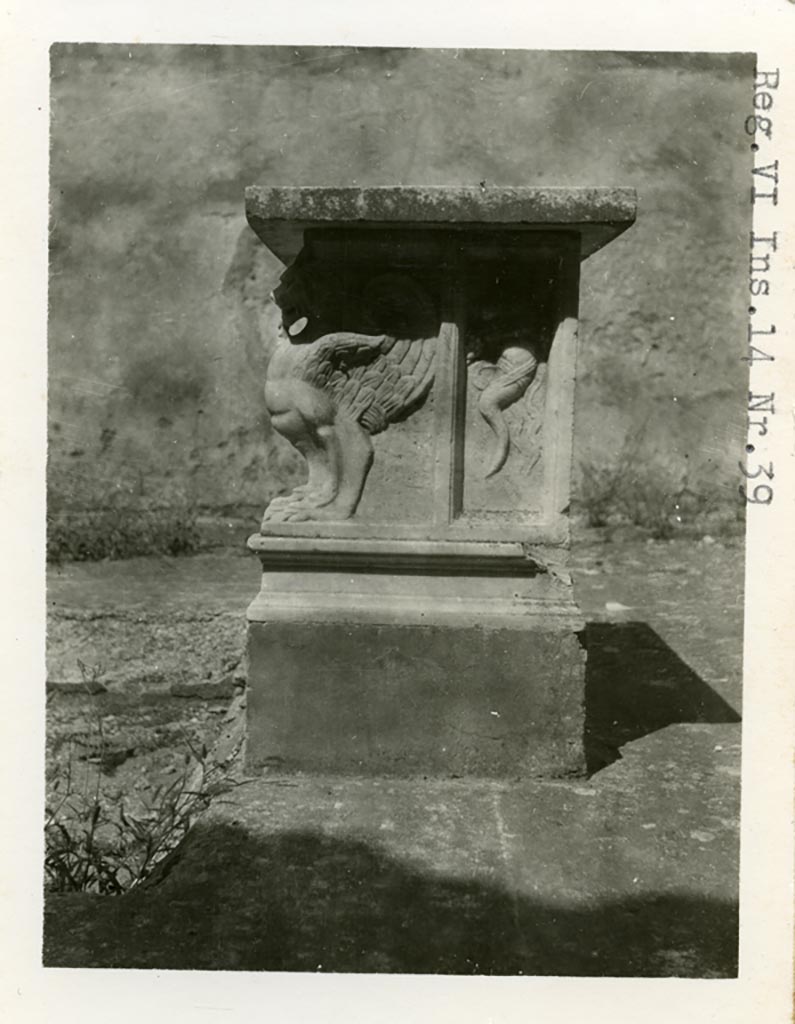
VI.14.39 Pompeii. Pre-1937-39. Detail of table, at east side of impluvium in atrium.
Photo courtesy of American Academy in Rome, Photographic Archive. Warsher collection no. 1807.
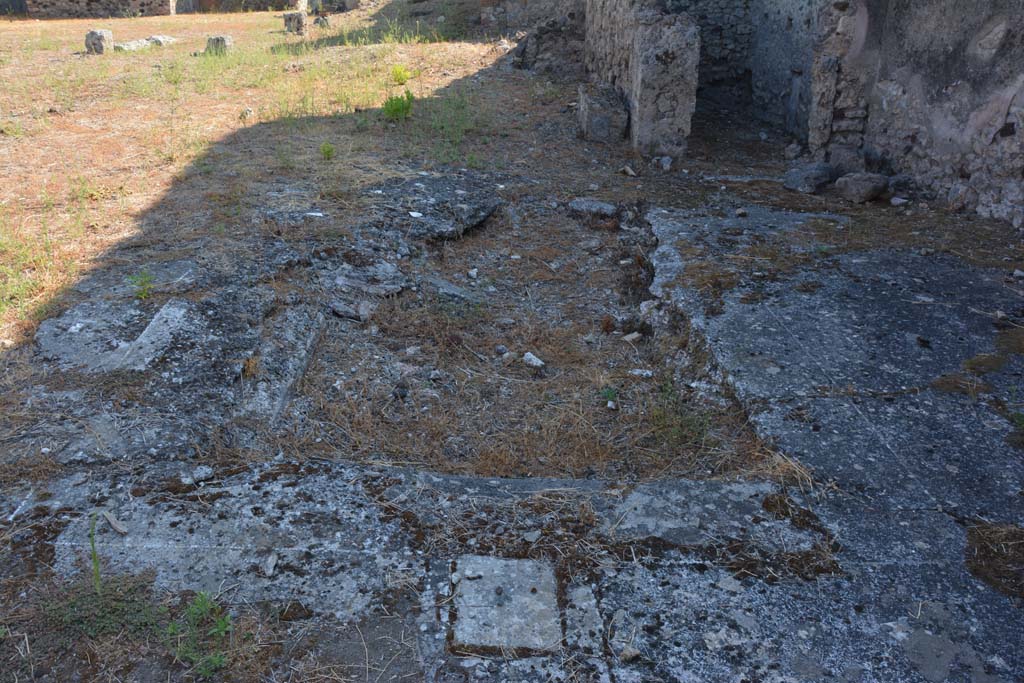
VI.14.39 Pompeii. September 2019. Looking east across impluvium in
atrium.
Foto Annette Haug, ERC
Grant 681269 DÉCOR
![VI.14.39 Pompeii. December 2004. Remains of impluvium in atrium with mosaic.
Written on the margin of the impluvium was the motto LVCRVM GAVDIVM [CIL X 875].
According to Cooley, “Lucrum Gaudium” translated as “Profit, joy”.
See Cooley, A. and M.G.L., 2004. Pompeii: A Sourcebook. London: Routledge. (p.169)](6%2014%2039_files/image017.jpg)
VI.14.39 Pompeii. December 2004. Remains of impluvium in atrium with mosaic.
Written on the margin of the impluvium was the motto LVCRVM GAVDIVM [CIL X 875].
According to Cooley, “Lucrum Gaudium” translated as “Profit, joy”.
See Cooley, A. and M.G.L., 2004. Pompeii: A Sourcebook. London: Routledge. (p.169)
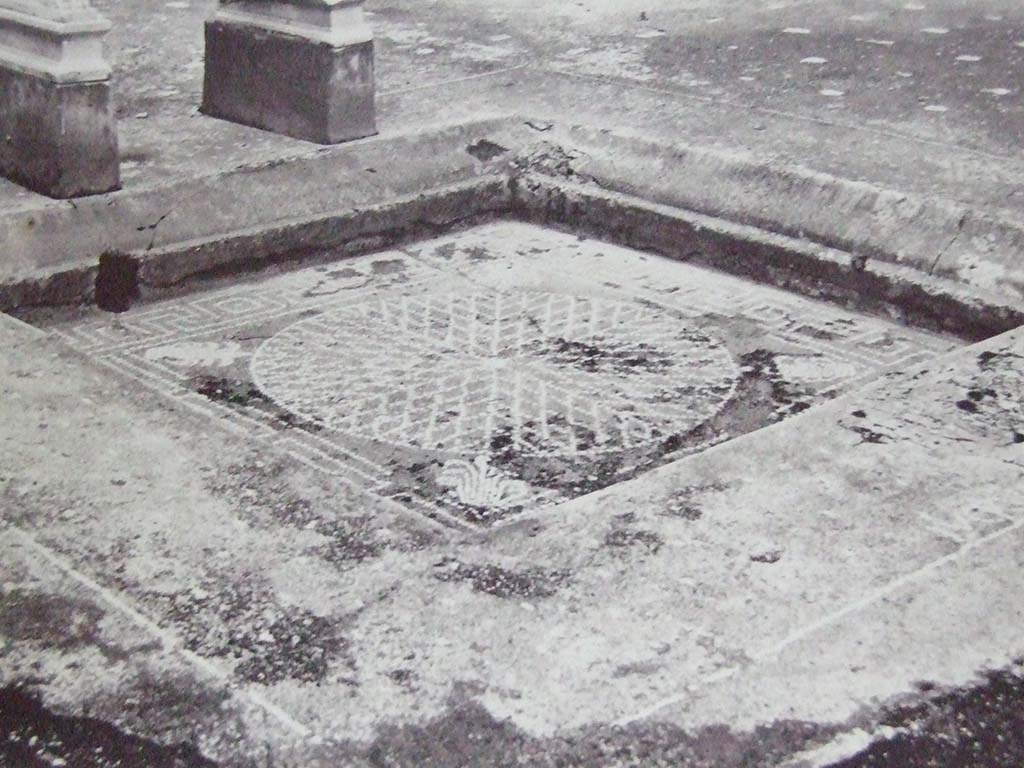
VI.14.39 Pompeii. Casa Lucrum Gaudium or Officina di tornitore. Impluvium.
Old undated photograph courtesy of the Society of Antiquaries, Fox Collection.
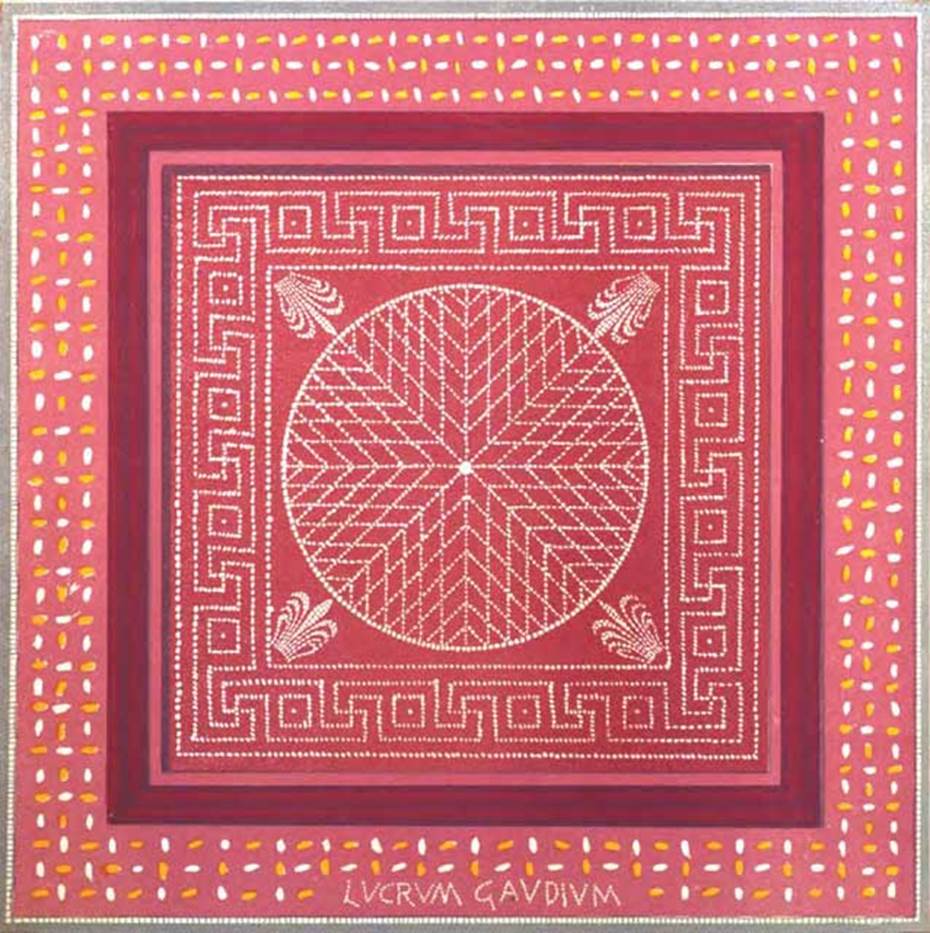
VI.14.39 Pompeii. 1878. Drawing of Lucrum Gaudium impluvium mosaic.
See Presuhn E.,
1878. Pompeji: Die Neuesten Ausgrabungen
von 1874 bis 1878. Leipzig: Weigel. (V, plate V).
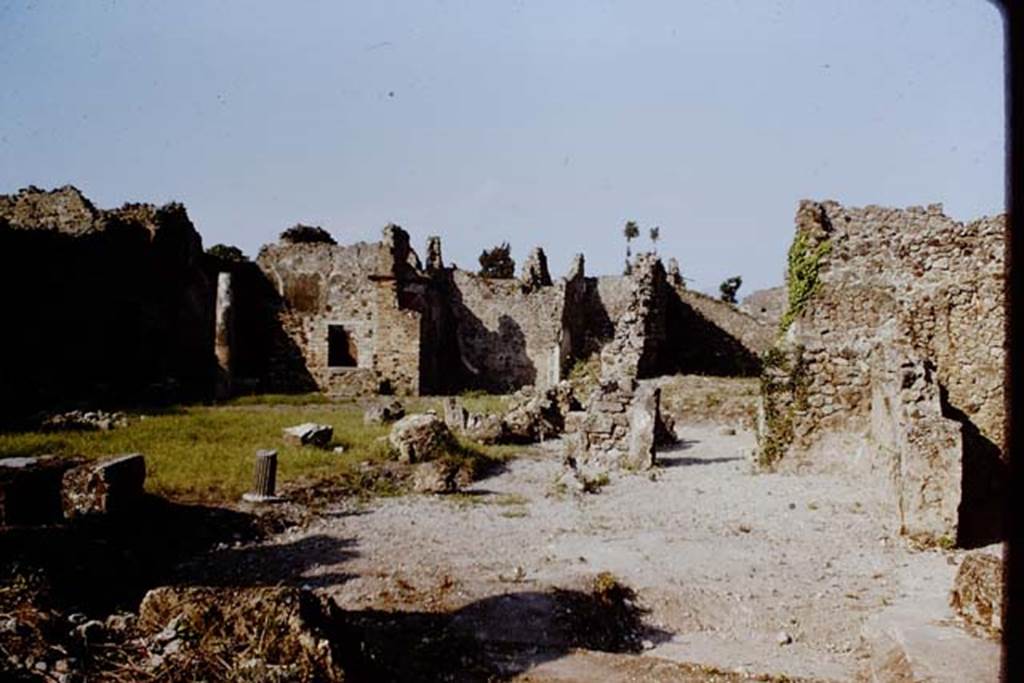
VI.14.38, on left, and VI.14.39 on right, Pompeii. 1966. Looking east. Photo by Stanley A. Jashemski.
Source: The Wilhelmina and Stanley A. Jashemski archive in the University of Maryland Library, Special Collections (See collection page) and made available under the Creative Commons Attribution-Non Commercial License v.4. See Licence and use details.
J66f0335
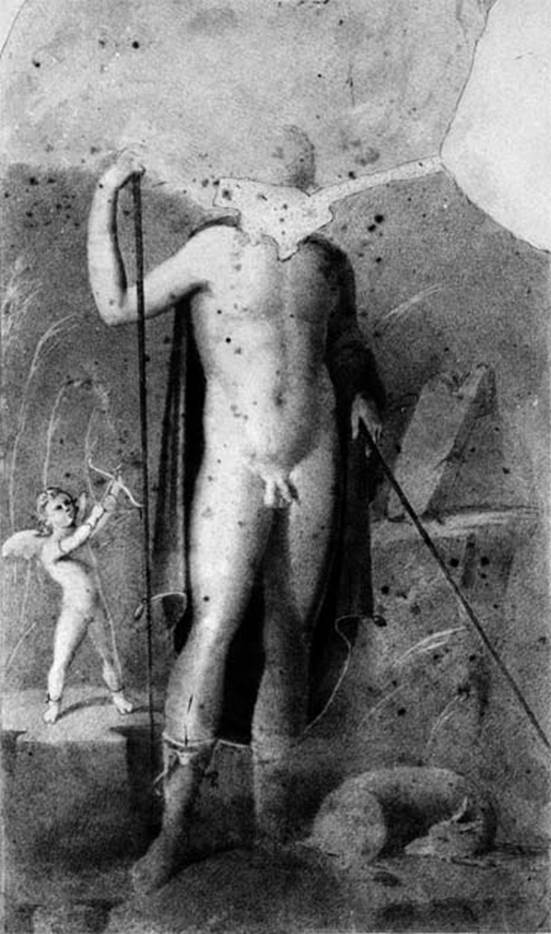
VI.14.39 Pompeii. Exedra.
Old undated photograph of painting of Cyparissus being aimed at by cupid.
According to Schefold, this was found in room “i”, an exedra.
See Schefold, K., 1962. Vergessenes Pompeji. Bern: Francke. (p.73, Pl. 54, 3)
According to Sogliano, the painting was from exedra “L”.
See Sogliano, A., 1879. Le pitture murali campane scoverte negli anni 1867-79. Napoli: Giannini. (p. 28, no. 110).
According to PPP, the painting was found in the central panel of the north wall of exedra “m”.
See Bragantini, de Vos, Badoni, 1983. Pitture e Pavimenti di Pompei, Parte 2. Rome: ICCD. (p.294).
According to Mau, this was the most important 2nd Style painting found in the house.
In exedra, room “i”, on both of the interior entrance areas of the room were paintings of hanging fish, as seen in many examples in Naples Museum.
On the left wall in the central panel was a large painting, although it was rather damaged.
It showed a young man (Cyparissus), naked other than yellow boots laced up his legs and a cloak of purple covering his back and left arm.
In his right hand he held a spear, with another one under his left arm.
At his feet lay an animal, perhaps a deer or goat?
His painted head was lost.
On his left was a cupid, in the act of firing his arrow.
See Mau in Bullettino dell’Instituto di Corrispondenza
Archeologica (DAIR), 1878, (p. 92)
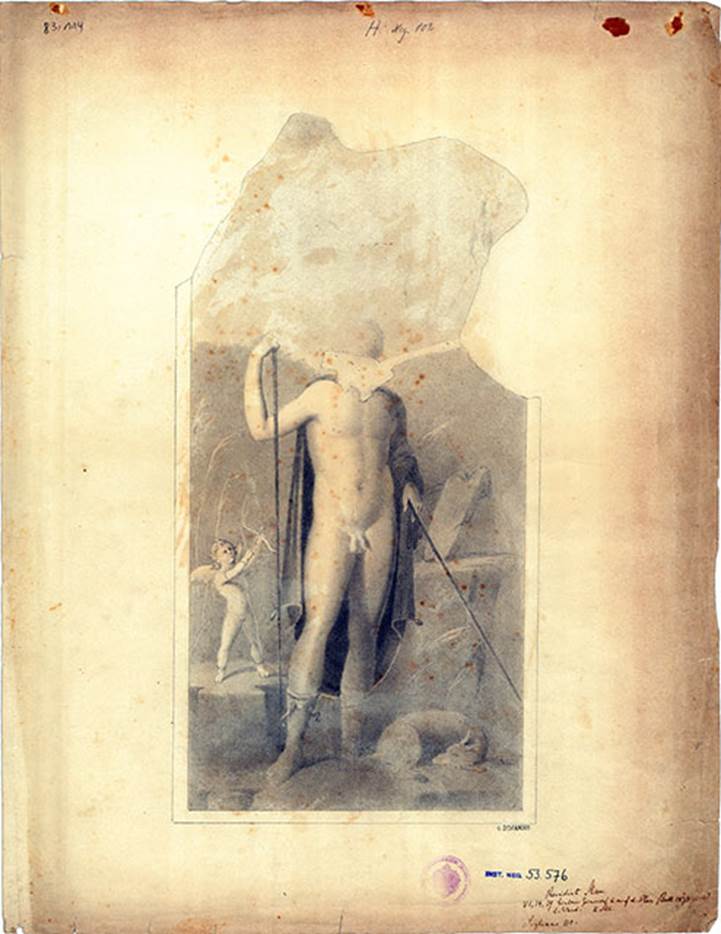
VI.14.39 Pompeii. Exedra.
Drawing by G. Discanno of painting of Cyparissus being aimed at by cupid.
DAIR describe it as Drawing: Cupid shoots an arrow at a young hunter.
Rear room. Left wall. Second style.
DAIR 83.114.
Photo © Deutsches Archäologisches Institut, Abteilung Rom, Arkiv.
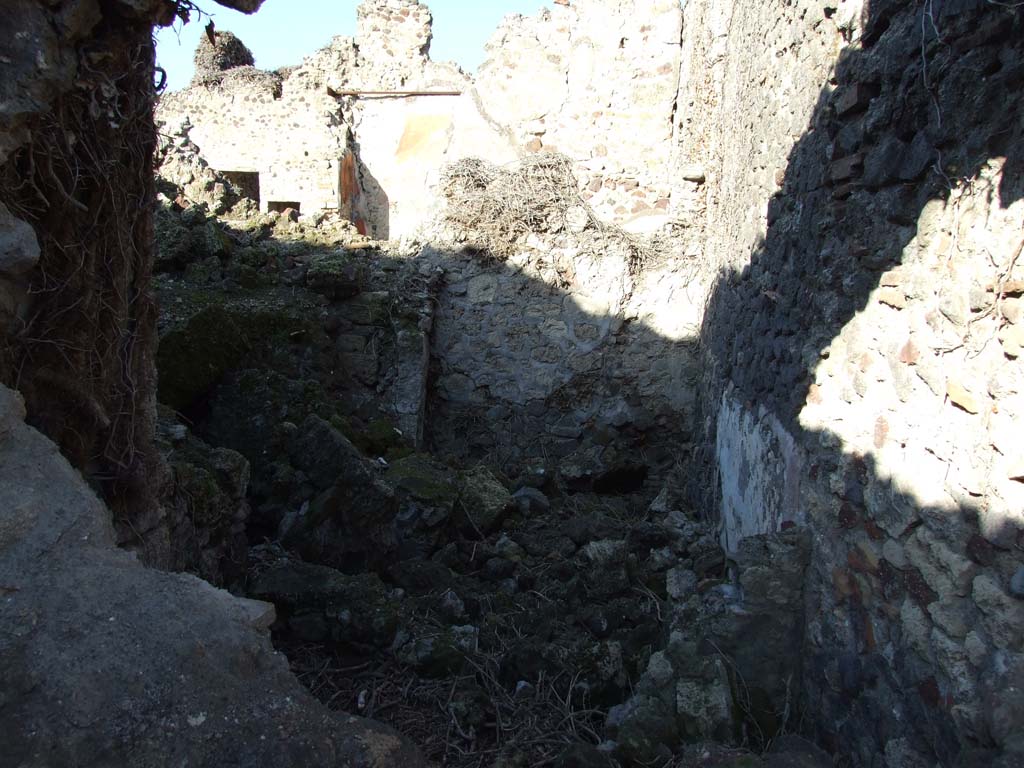
VI.14.39 in foreground, looking north into rear rooms, taken from VI.14.22. December 2007.
These may have originally been underground rooms, the kitchen and wine cellar.
In the background is a room at the east (rear) of the peristyle of VI.14.38.
According to Boyce, on the east wall of the subterranean kitchen of VI.14.39, was a lararium painting in two zones.
The upper zone contained a sacrificial scene with the Genius on the right of an altar.
On the left was a Camillus, wreathed and wearing a short, girded tunic.
On each side of this group stood a wreathed Lar, carrying rhyton and situla.
In the lower zone, to the right of an altar furnished with an egg, was a red serpent with large crest and beard.
Behind the serpent, at the extreme right of the painting, was a jar.
On the left of the altar some other indistinguishable object, seems to have replaced the second serpent.
Across the top of the upper zone was stretched a garland, and in the background between the figures were painted plants.
See Boyce G. K., 1937. Corpus
of the Lararia of Pompeii. Rome:
MAAR 14. (p.53, no. 206)
See Sogliano, A.,
1879. Le pitture murali campane scoverte
negli anni 1867-79. Napoli: (p. 13, no. 28)
See Giacobello, F., 2008. Larari Pompeiani: Iconografia e culto dei Lari in ambito domestico. Milano: LED Edizioni, (p.179 for a description of the lararium, no longer conserved in the underground kitchen, due to the house being badly damaged in 1943 bombing).
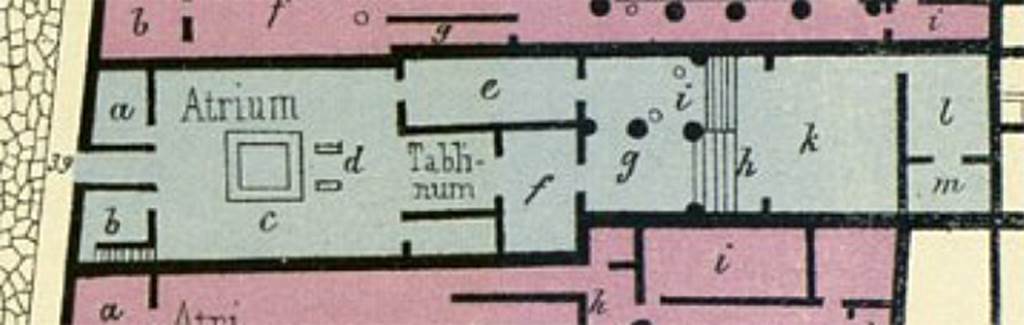
VI.14.39 Pompeii. Plan showing VI.14.39 by Emile Presuhn.
See Presuhn E., 1878. Pompeji: Les dernières fouilles de 1874 a 1878. Leipzig: Weigel, Abtheilung V, Taf. I.
![VI.14.39 Pompeii. Looking west across area on cork model in Naples Archaeological Museum. According to Mau, found in the atrium on 23 and 26 September, and 11 and 18 October 1876, were various vases and other bronze utensils, iron, glass bottles and plates. As a result of this he concurred that like any other room, the atrium served many uses. Most interesting of the objects was a bronze seal/signet (length 0.085), with the wording -
AXI . GVN
and on the ring – FE
Found in room “f” at the rear of the tablinum, on 2nd December 1876, as well as various bronze objects, were also a number of tools for a Turner, including amongst them 15 iron chisels for lathe work. According to Mau, he thought it likely that the room he called a triclinium because of its proportions, (room “f”), served in the last years of Pompeii as a workshop for the Turner.
See Mau in BdI, 1878, (p.96)
According to Della Corte, found here in December 1878 were 15 iron chisels for working at a lathe, and two tools for working the wood on the lathe.
He came to the conclusion that this was a workshop of wood turners (faber tornator), and that the upper floor would have been the dwelling.
He had two thoughts on the name of the person who lived here.
Firstly, a signet/seal was found here, of a citizen of an obscure family – it read
Axi(us) Gun…… (Tornator) [CIL X 8058, 7] (S.9, with Note 4 – Della Corte had not known of another Axi at Pompeii until this one).
Secondly, found to the left of the entrance doorway was an electoral recommendation, this time of a distinct Pompeian family, a Clodio, although not known of which family.
Clodi fac [CIL IV 3502] with Note 1: page 85).
The programme containing the name Clodi fac, was traced on the external wall, above the zoccolo that was at the height of 1.74m. Also found was -
Sei copo, probe fecisti quod sella(m) commodasti [CIL IV 3502] with Note 2).
See Della Corte, M., 1965. Case ed Abitanti di Pompei. Napoli: Fausto Fiorentino. (p.84 with notes 2 and 4)
According to Epigraphik-Datenbank Clauss/Slaby (See www.manfredclauss.de), these read as –
Axi Gun()
/
Fe() [CIL X 8058, 7]
[H]ol[c]o<n=R>ium Priscum aed(ilem) Clodi fac(iat)
/
sei copo probe fecisti
quod sella commodasti [CIL IV 3502]](6%2014%2039_files/image031.jpg)
VI.14.39 Pompeii. Looking west across area on cork model in Naples Archaeological Museum.
According to Mau, found in the atrium on 23 and 26 September, and 11 and 18 October 1876, were various vases and other bronze utensils, iron, glass bottles and plates. As a result of this he concurred that like any other room, the atrium served many uses.
Most interesting of the objects was a bronze seal/signet (length 0.085), with the wording -
AXI . GVN
and on the ring – FE
Found in room “f” at the rear of the tablinum, on 2nd December 1876, as well as various bronze objects, were also a number of tools for a Turner, including amongst them 15 iron chisels for lathe work. According to Mau, he thought it likely that the room he called a triclinium because of its proportions, (room “f”), served in the last years of Pompeii as a workshop for the Turner.
See Mau in Bullettino dell’Instituto di Corrispondenza
Archeologica (DAIR), 1878, (p.96)
According to Della Corte, found here in December 1878 were 15 iron chisels for working at a lathe, and two tools for working the wood on the lathe.
He came to the conclusion that this was a workshop of wood turners (faber tornator), and that the upper floor would have been the dwelling.
He had two thoughts on the name of the person who lived here.
Firstly, a signet/seal was found here, of a citizen of an obscure family – it read
Axi(us) Gun…… (Tornator) [CIL X 8058, 7] (S.9, with Note 4 – Della Corte had not known of another Axi at Pompeii until this one).
Secondly, found to the left of the entrance doorway was an electoral recommendation, this time of a distinct Pompeian family, a Clodio, although not known of which family.
Clodi fac [CIL IV 3502] with Note 1: page 85).
The programma containing the name Clodi fac, was traced on the external wall, above the zoccolo that was at the height of 1.74m. Also found was -
Sei copo, probe
fecisti quod sella(m) commodasti [CIL
IV 3502] with Note 2).
See Della Corte, M., 1965. Case ed Abitanti di Pompei. Napoli: Fausto Fiorentino. (p.84 with notes 2 and 4)
According to Epigraphik-Datenbank Clauss/Slaby (See www.manfredclauss.de), these read as –
Axi Gun()
/
Fe() [CIL X
8058, 7]
[H]ol[c]o<n=R>ium
Priscum aed(ilem) Clodi fac(iat)
/
sei copo probe
fecisti
quod sella
commodasti [CIL IV 3502]
For detailed room descriptions see the room plan Room Plan