VI.8.5 Pompeii. Casa del Poeta
Tragico or House of the Tragic Poet.
Excavated 1824. Linked to VI.8.3.
Part 5 Part 1 Part 2
Part 3 Part 4 VI.8.3 and VI.8.5 Room Plan
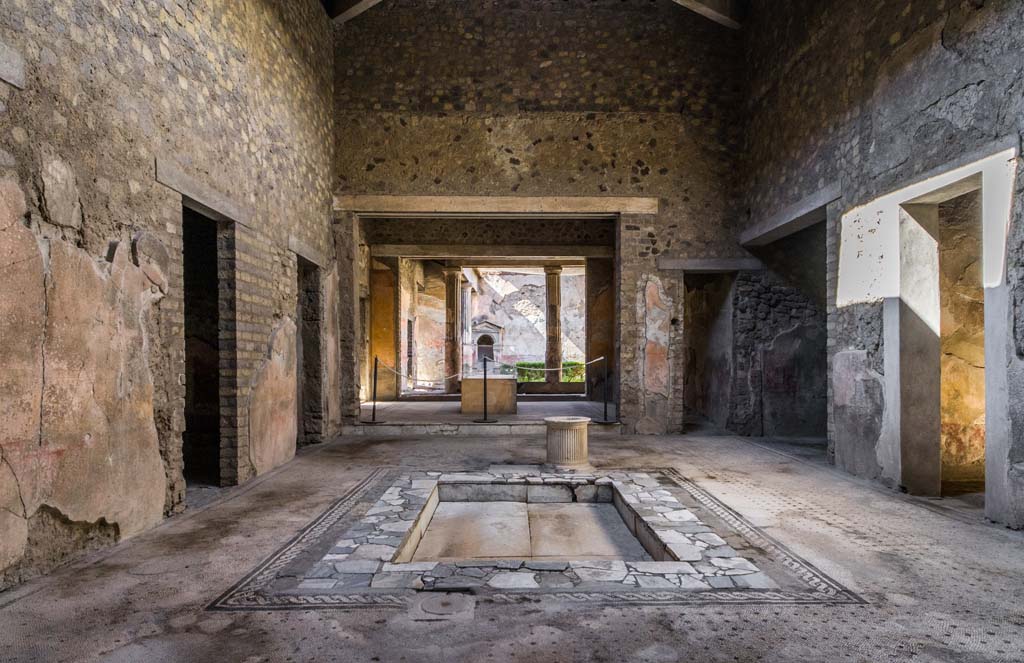
VI.8.3/5 Pompeii. April 2022.
Looking north across impluvium in atrium through tablinum towards
peristyle garden. Photo courtesy of Johannes Eber.
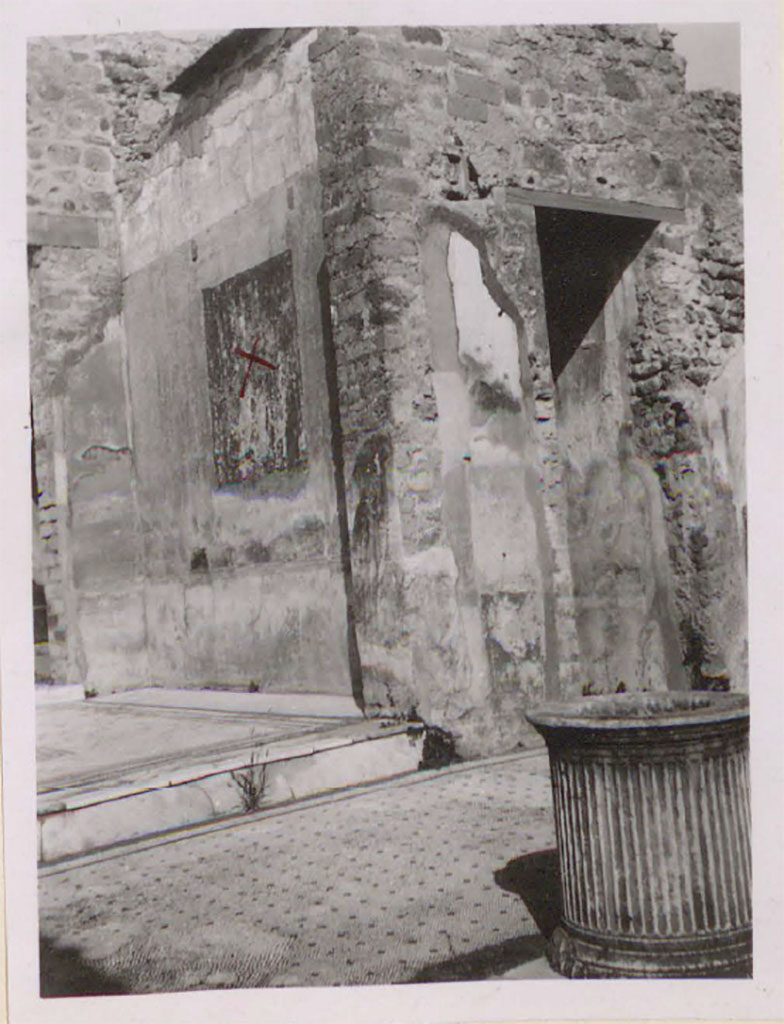
VI.8.5 Pompeii. Pre-1942. Room 6, looking north to east wall of tablinum, from atrium.
“X” marks the spot where the painting of Alcestis and Admetus was cut from the wall and transferred to the Museum.
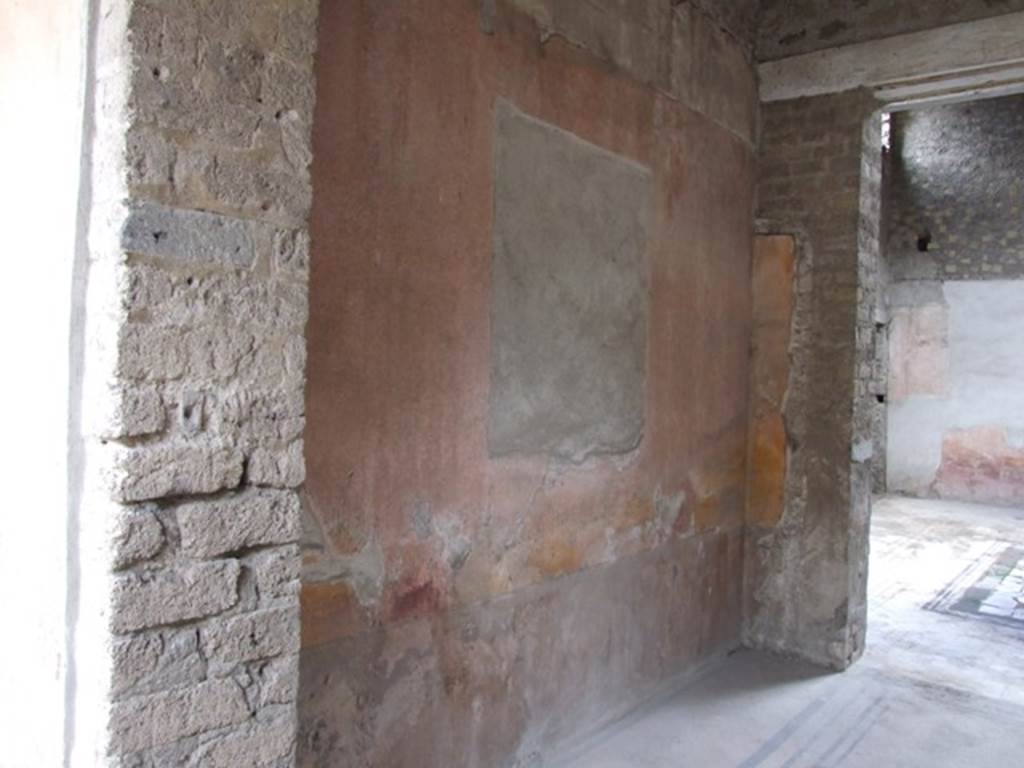
VI.8.5 Pompeii. March 2009. Room 6, looking south to east wall of tablinum.
Mau identified a painting, found in the tablinum, showing the delivery to Admetus of the oracle which declared that he must die unless someone should voluntarily meet death in his place. On one side sits Admetus, with his devoted queen Alcestis. Opposite them is the messenger who is reading the oracle from a roll of papyrus.
See Mau, A., 1907, translated by Kelsey F. W. Pompeii: Its Life and Art. New York: Macmillan. (p. 313-4).
According to Nappo the painting was from the east wall of the tablinum.
See Nappo, S., 1998. Pompeii: Guide to the lost City. London: Weidenfeld and Nicolson. (p. 143).
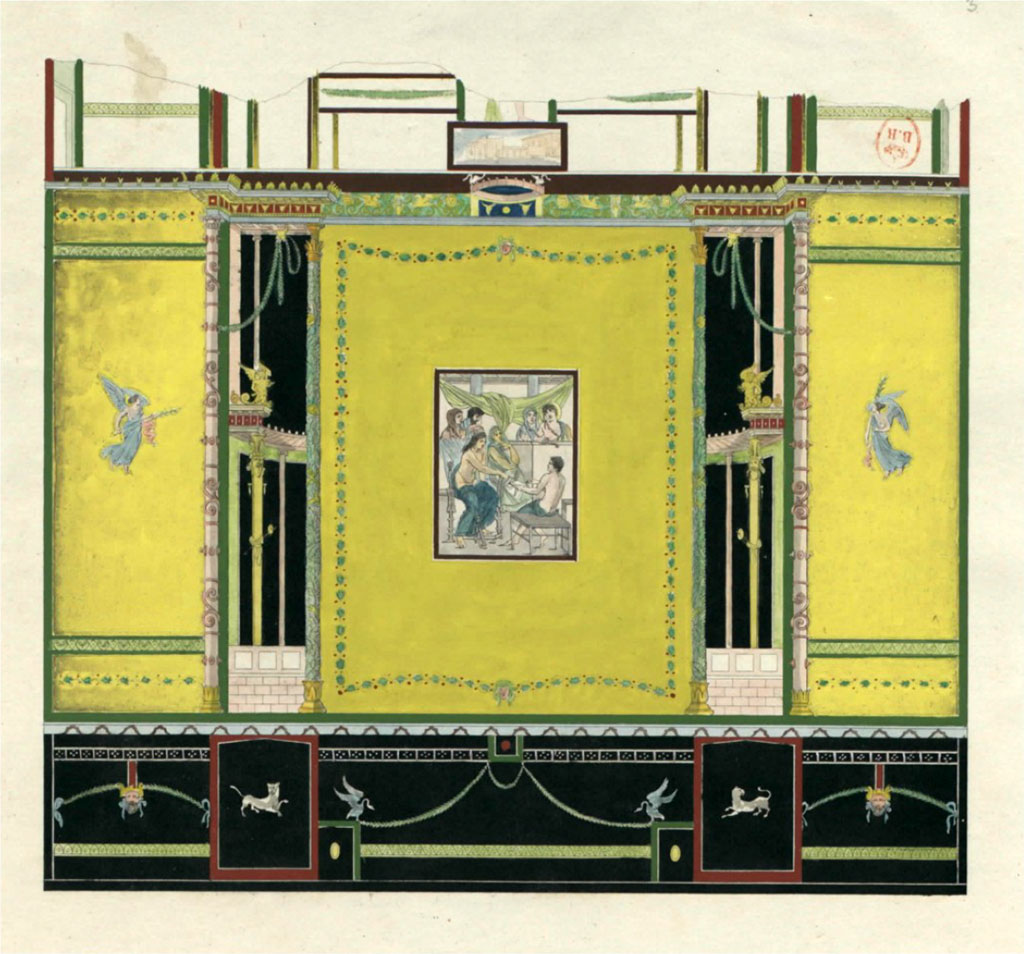
VI.8.5 Pompeii. c.1828. Room 6,
painting of east wall of tablinum.
See Raoul Rochette et
Bouchet J., 1828. Choix d'Edifices Inédits : Maison du Poète Tragique.
Paris, pl 3. (Described
as «Prothyrum»).
![VI.8.5 Pompeii. c.1828. Room 6, drawing by Zahn from north side of the central painting on the east wall of tablinum.
See Zahn W. Neu entdeckte Wandgemälde in Pompeji gezeichnet von W. Zahn [ca. 1828], taf. 14.](6%2008%2005%20p5_files/image007.jpg)
VI.8.5 Pompeii.
c.1828. Room 6, drawing by Zahn from north side of the central painting on the
east wall of tablinum.
See Zahn W. Neu entdeckte Wandgemälde in
Pompeji gezeichnet von W. Zahn [ca. 1828], taf. 14.
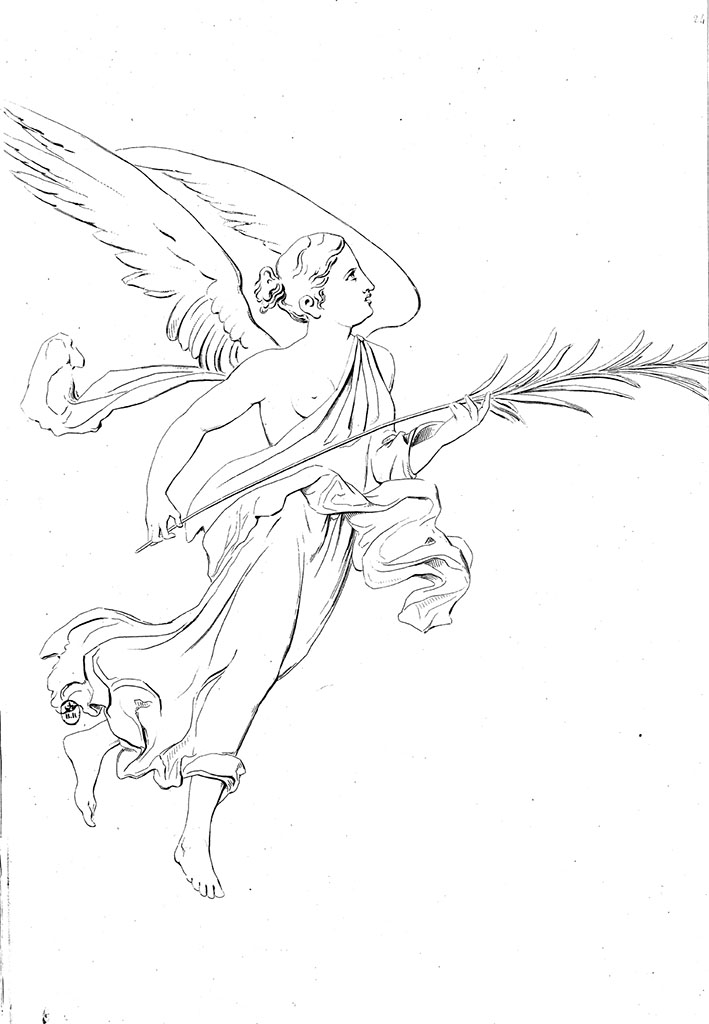
Room 6, painting from the north side of the
central painting on the east wall of tablinum.
See Raoul
Rochette et Bouchet J., 1828. Choix d'Edifices Inédits : Maison du Poète
Tragique. Paris, pl 24.
(Described as Calque
de la figure du panneau à gauche du tablinum.)
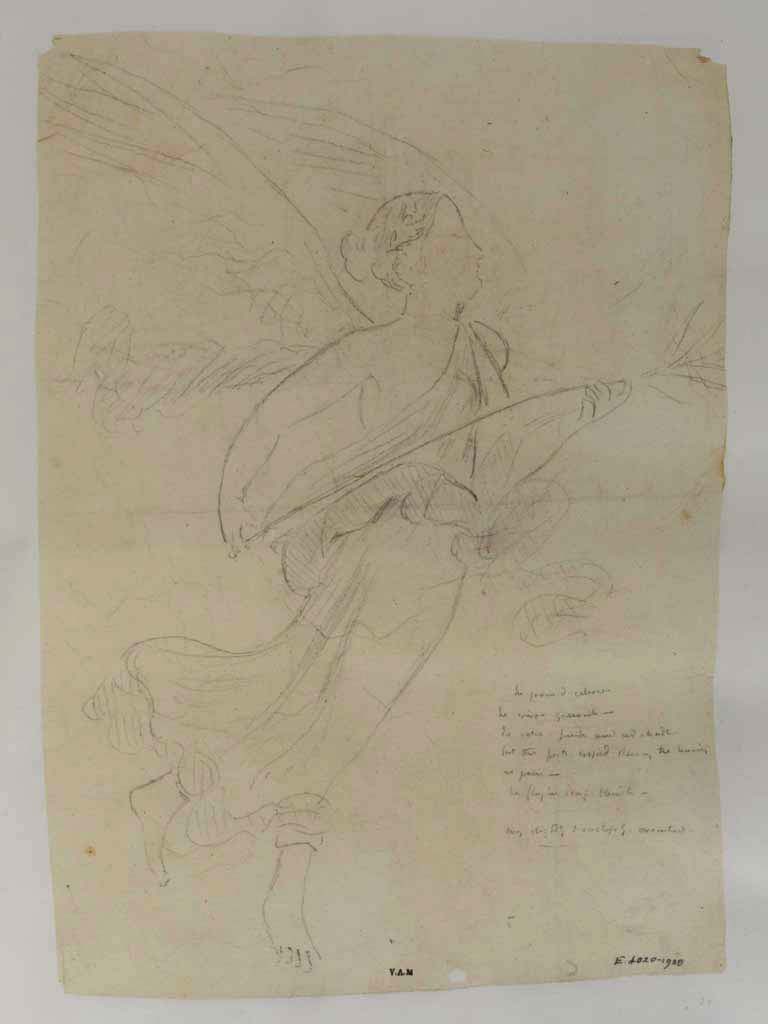
VI.8.5 Pompeii. c.1840. Drawing by
James William Wild of figure on east wall of tablinum, room 6.
Photo © Victoria and Albert
Museum, inventory number E.4020-1938.
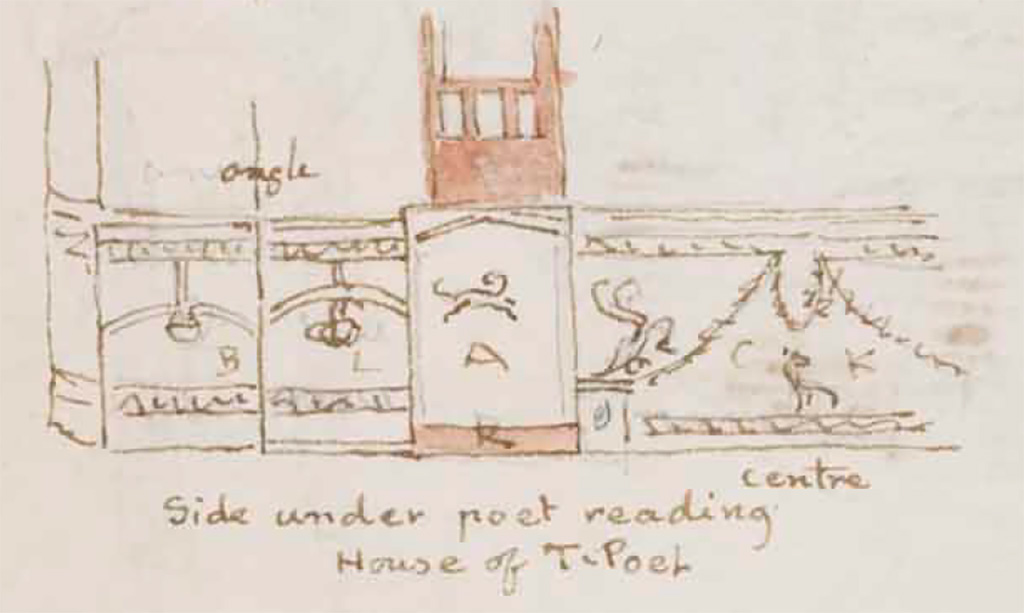
From a page "Notes on the Poets House" from William Gell's sketch book.
See Gell, W. Sketchbook of Pompeii, c.1830.
See book from Van Der Poel Campanian Collection on Getty
website http://hdl.handle.net/10020/2002m16b425
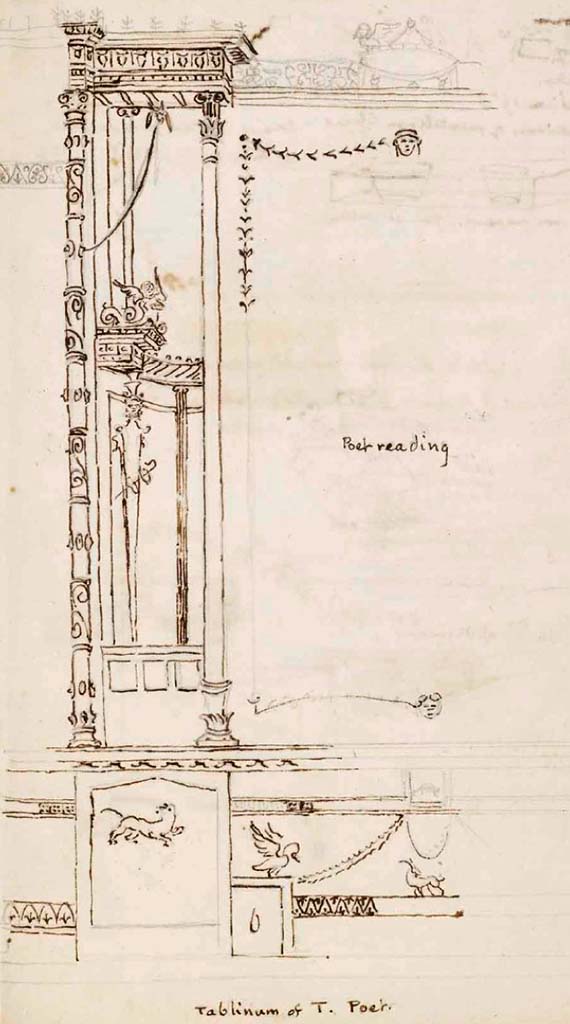
VI.8.5 Pompeii. c.1830. Drawing by Gell of east wall of tablinum on north side of central painting.
See Gell, W. Sketchbook of Pompeii, c.1830.
See book from Van Der Poel Campanian Collection on Getty
website http://hdl.handle.net/10020/2002m16b425
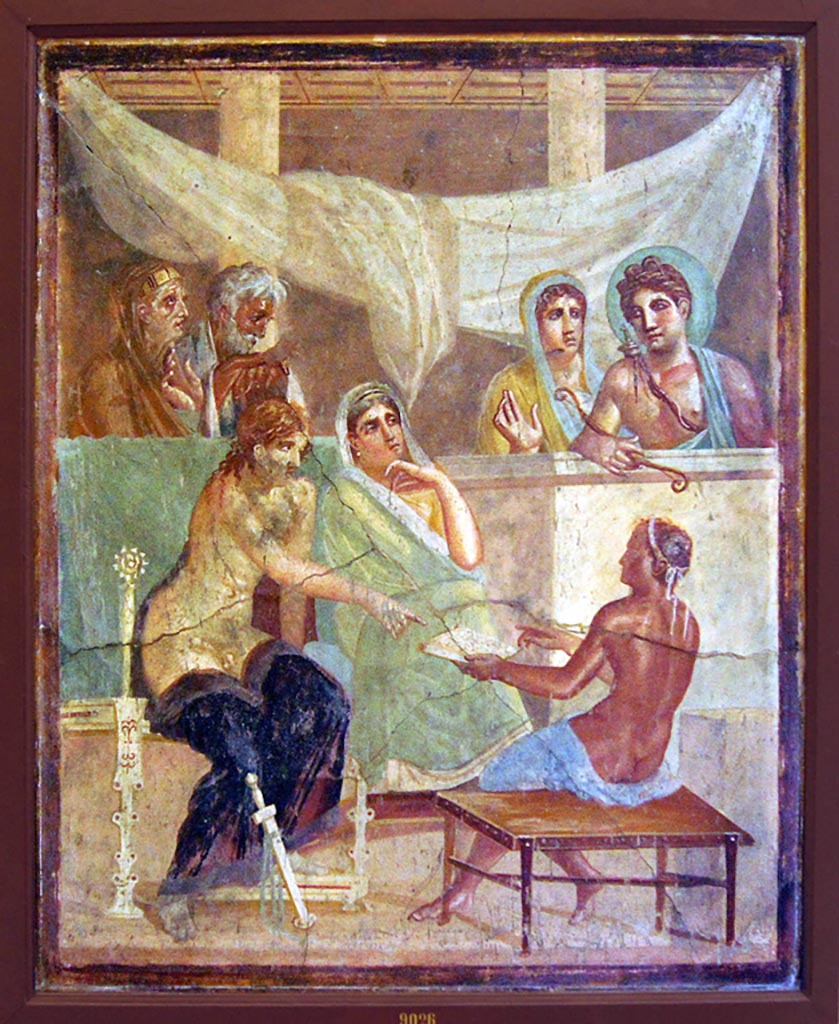
VI.8.5 Pompeii. December 2019. Found 22nd January 1825 in the tablinum. Wall painting of Alcestis and Admetus.
Now in Naples Archaeological Museum, inventory number 9026. Photo courtesy of Giuseppe Ciaramella.
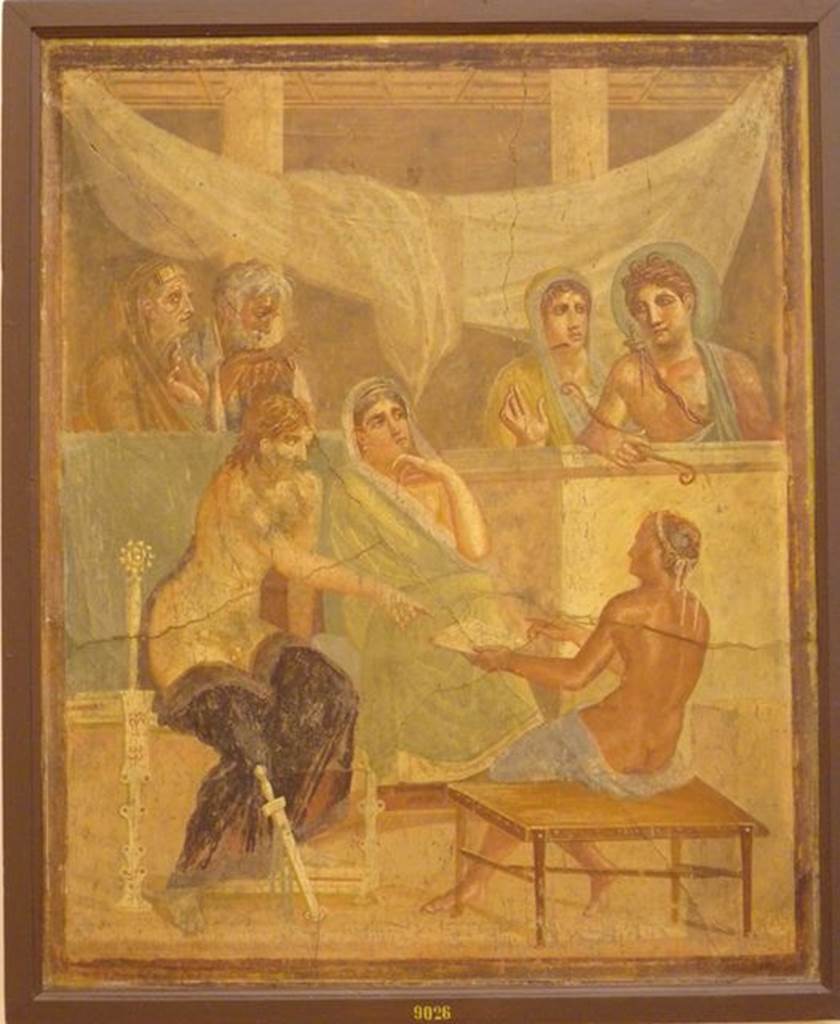
VI.8.5 Pompeii. Found 22nd January 1825 in the tablinum. Wall painting of Alcestis and Admetus.
Now in Naples Archaeological Museum. Inventory number 9026.
Helbig attributed this picture to the Casa del Poeta and described the picture.
Admetus has a dark robe over his knees with his sword resting on his leg, and he is pointing with his right hand.
Alcestis is dressed in a yellow chiton with bright green mantle.
Behind green drapery are the parents of Admetus.
Apollo, with his bow and quiver sits behind a wall or trellis with a muse.
See Helbig, W., 1868. Wandgemälde der vom Vesuv verschütteten Städte Campaniens. Leipzig: Breitkopf und Härtel. (1158, p. 240-1).
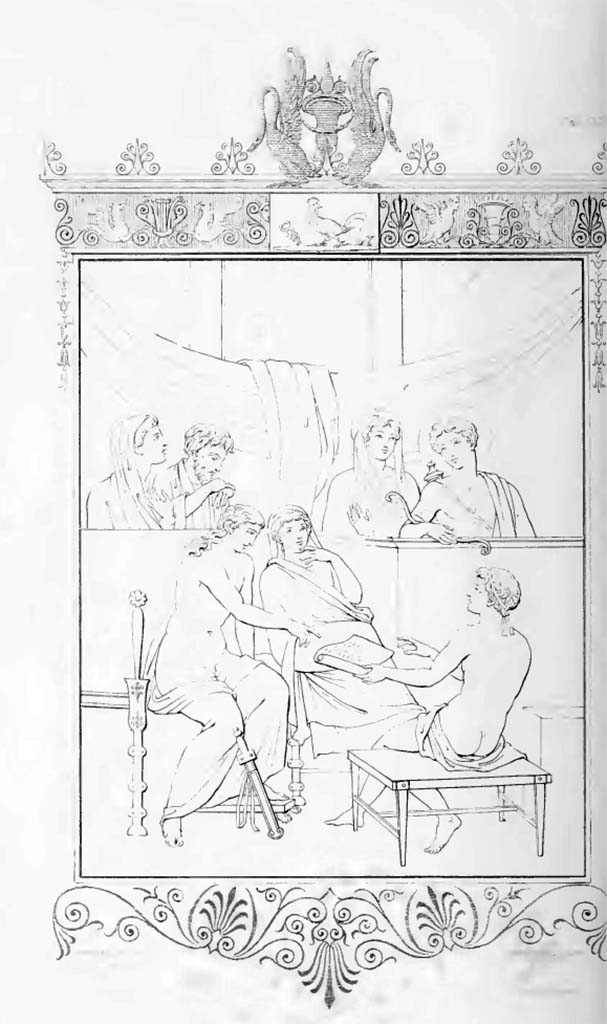
This is also the picture referred to by Gell in his book written only a few years after the house was excavated.
He attributed it to the tablinum of the House of the Tragic Poet but described it as the image of a poet reading that gave the house its name.
See Gell, W, 1837. Pompeiana. London: Lewis A. Lewis. (Ch. VIII, T. XLIV).
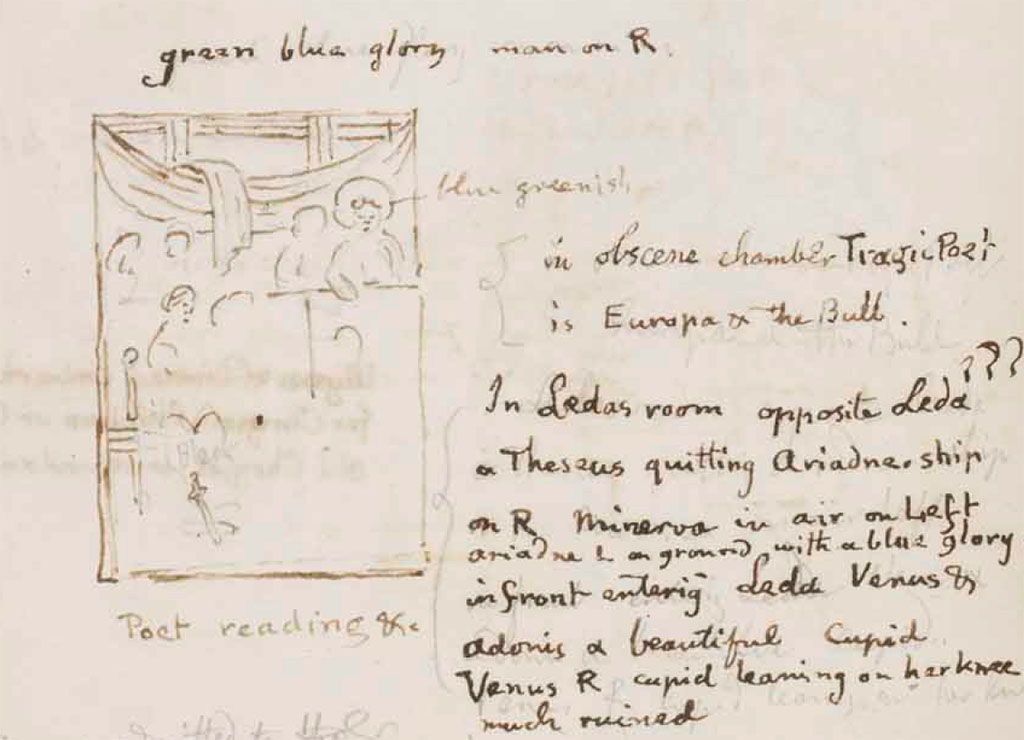
VI.8.5 Pompeii. c.1830. Notes on the Poets House from William Gell's sketch book.
Sketch by Gell of the central painting (poet reading) on the east wall of the tablinum.
The detail appears to correspond most closely with the fresco of Alcestis and Admetus in Naples Archaeological Museum, inventory number 9026.
See Gell, W. Sketchbook of Pompeii, c.1830.
See book from Van Der Poel Campanian Collection on Getty
website http://hdl.handle.net/10020/2002m16b425
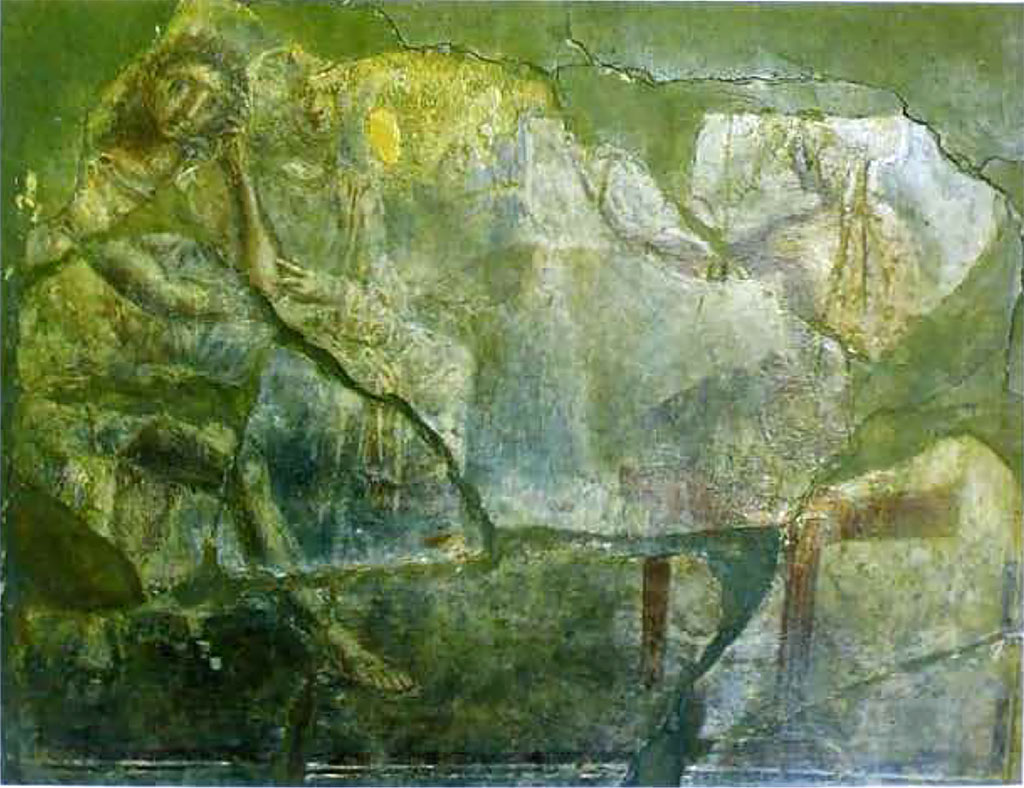
VI.8.5 Pompeii. Tablinum east wall. PPM shows this picture of Alcestis and Admetus.
According to PPM, Alcestis and Admetus appear seated while the oracle refers to the imminent death of Admetus; the parents of the young bride and a girl attend the scene, on the right the bust of Apollo.
Now in Naples Archaeological Museum. Inventory number 9025.
See Carratelli, G. P., 1990-2003. Pompei: Pitture e Mosaici: Vol. IV. Roma: Istituto della enciclopedia italiana, p. 546-7, n. 36.
According to Bragantini, in PPM, p. 547, the picture inv. 9025 is wrongly attributed to the House of the Tragic Poet and also by Schefold to the Masseria di Irace and she is not aware of its origin.
See Bragantini I., 2001. Quadri con la rappresentazione della storia di Admeto e Alcesti: MEFR. Antiquité, tome 113, n°2. 2001. Antiquité. p. 813 e nota 45.
Our thanks to Rachel Lowder for
helping with this.
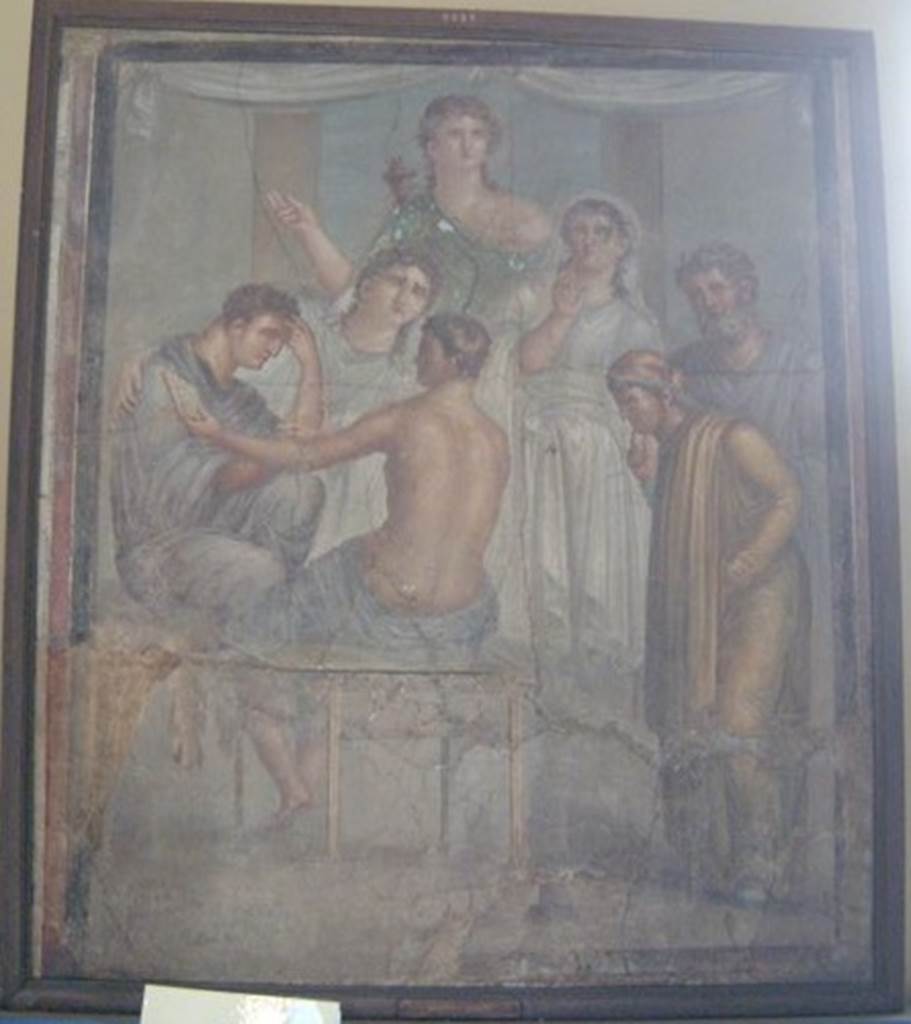
Wall painting of Alcestis and Admetus. Found in VI.8.3.
Now in Naples Archaeological Museum. Inventory number 9027.
Courtesy of Current Archaeology, 2001.
Some sources say the picture shown here is from VI.8.3 and some say it is from Herculaneum.
Richardson identified this as from the Basilica at Herculaneum.
Richardson, L., 2000. A Catalog of Identifiable Figure Painters of Ancient Pompeii, Herculaneum. Baltimore: John Hopkins. (p. 90).
De Carolis identified this with a question mark as “Casa del Poeta Tragico(?)”.
See de Carolis, E., 2001. Gods and Heroes in Pompeii. Los Angeles: Getty Museum. (p. 49).
Fiorelli only identified one picture of Alcestis and Admetus.
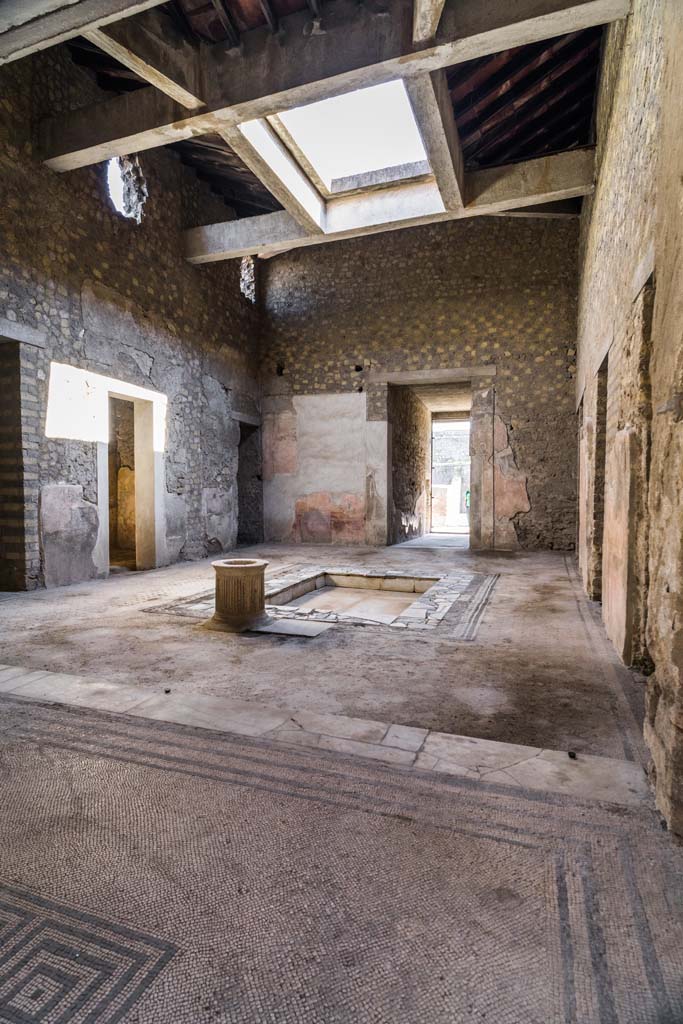
VI.8.3/5
Pompeii. April 2022.
Looking
south across atrium from tablinum. Photo courtesy of Johannes Eber.
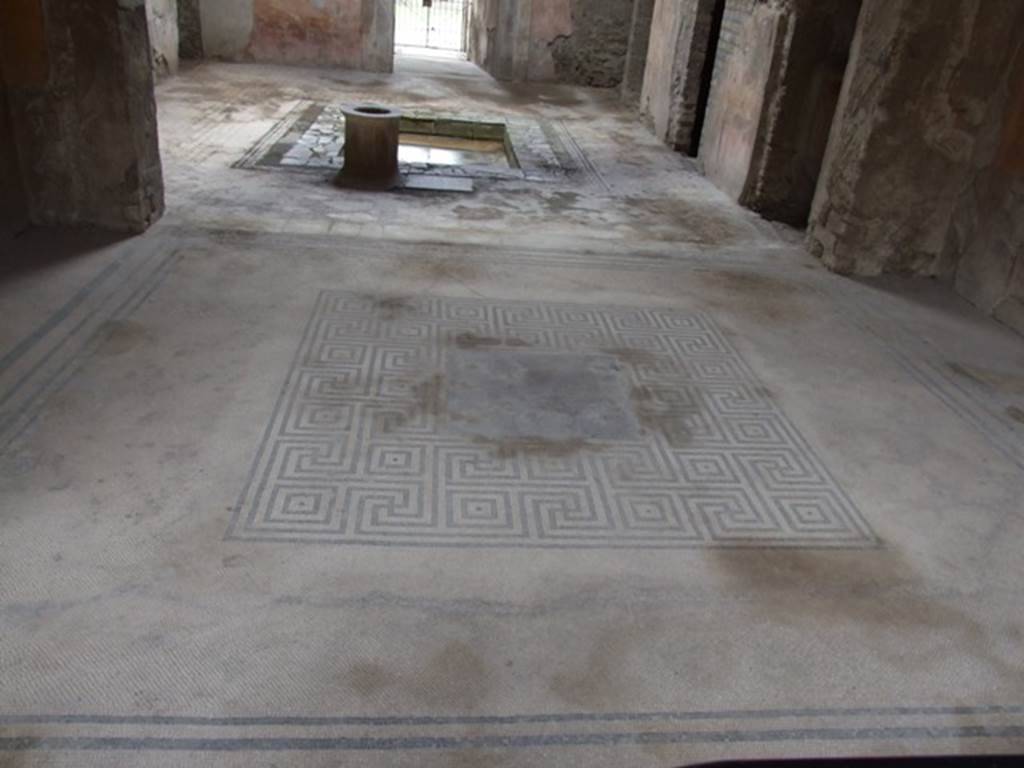
VI.8.5 Pompeii. March 2009. Room 6, mosaic floor in tablinum, looking south.
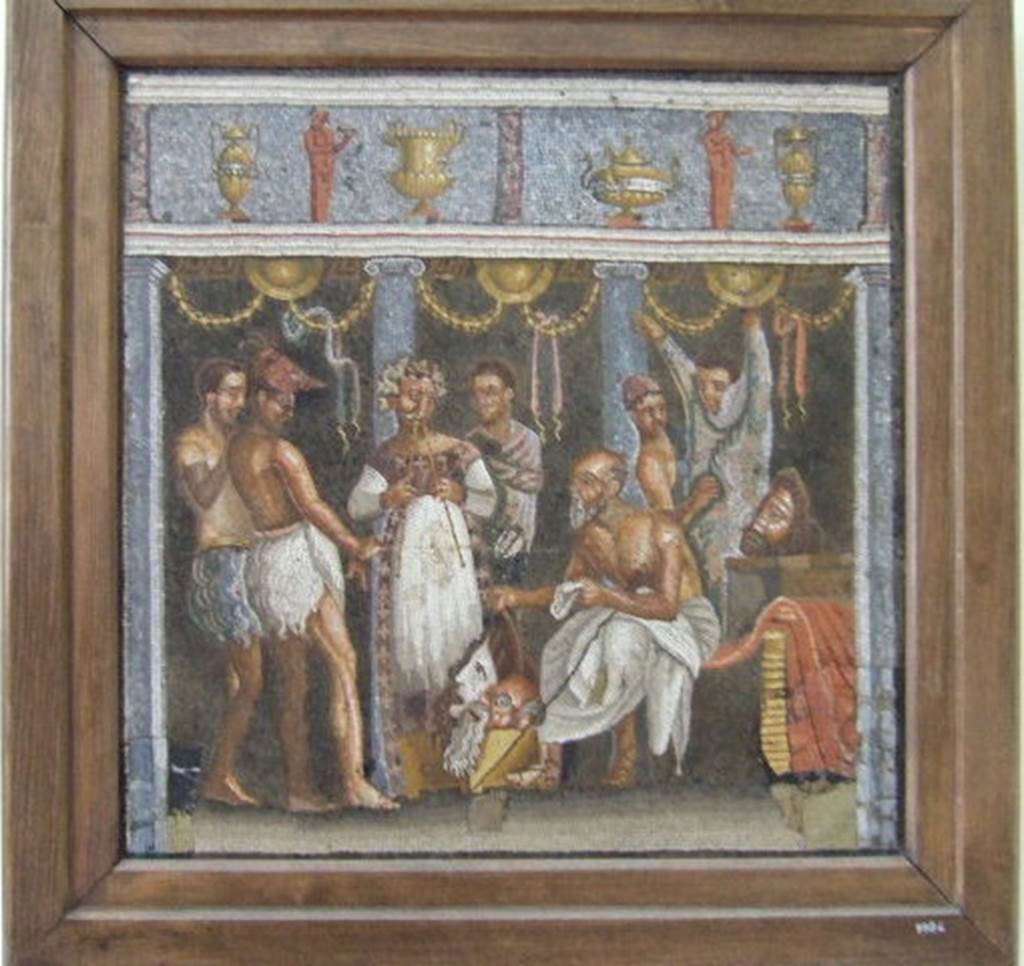
According to Mau this is a mosaic of an actor making preparations for the stage and was found in the floor of the tablinum.
The label in the museum says it was found in the tablinum of VI.8.3.
Now in Naples Archaeological Museum. Inventory number 9986.
See Mau, A., 1907, translated by Kelsey F. W. Pompeii: Its Life and Art. New York: Macmillan. (p. 314).
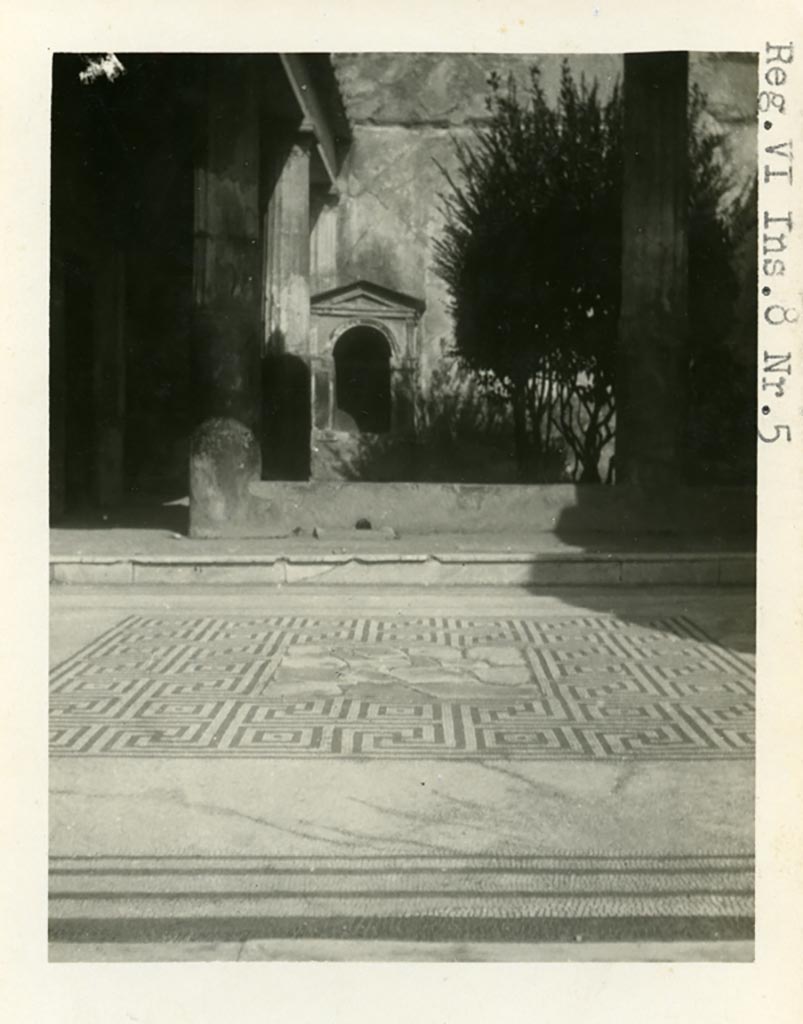
VI.8.5 Pompeii. Pre-1937-1939. Looking north across mosaic tablinum floor towards peristyle.
Photo courtesy of American Academy in Rome, Photographic Archive. Warsher collection no. 426.
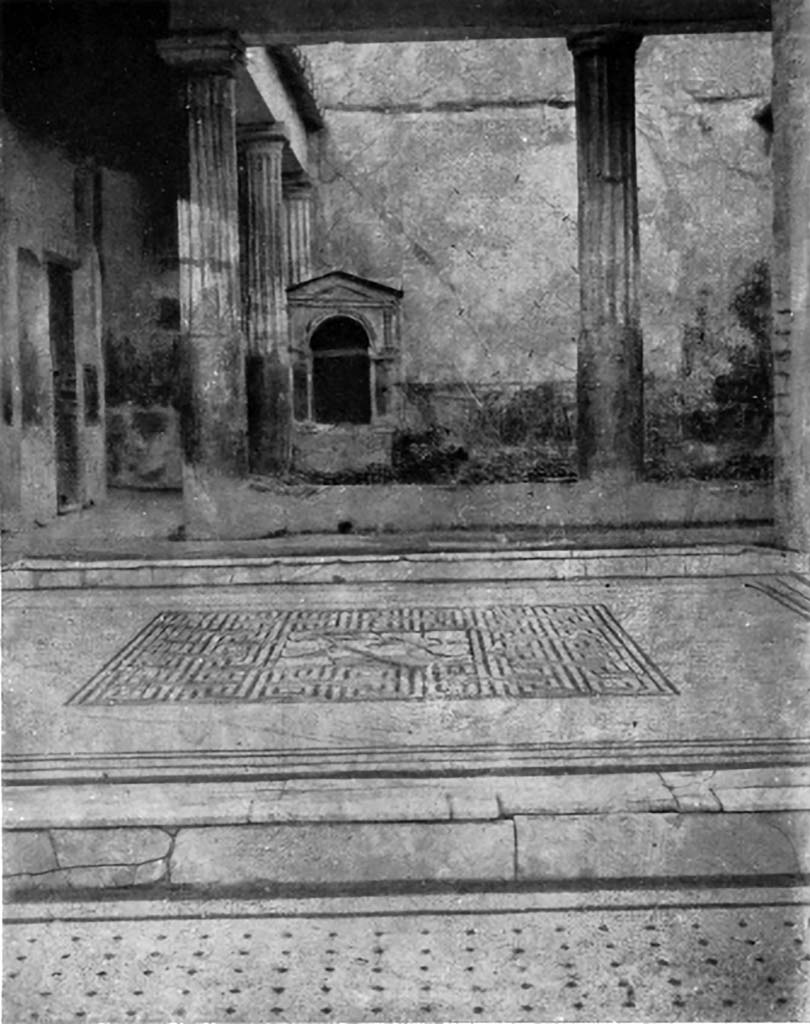
VI.8.5 Pompeii. c.1930. Looking north from atrium, across flooring in tablinum towards
peristyle.
See Blake, M., (1930). The pavements of the Roman Buildings of the Republic and Early Empire. Rome, MAAR, 8, (p.105, & Pl.30, tav.1).
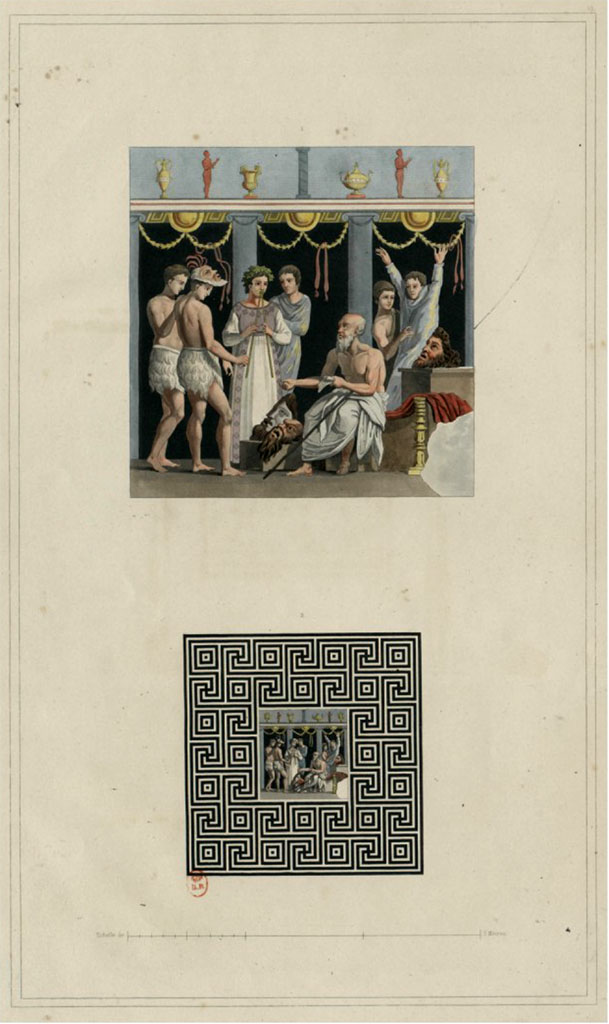
VI.8.5 Pompeii. c.1828. Room 6, tablinum. Painting of
central emblema and mosaic flooring.
See Raoul Rochette et
Bouchet J., 1828. Choix d'Edifices Inédits : Maison du Poète Tragique.
Paris, pl 19. (Mosaïque du tablinum marque 8 sur le plan.)
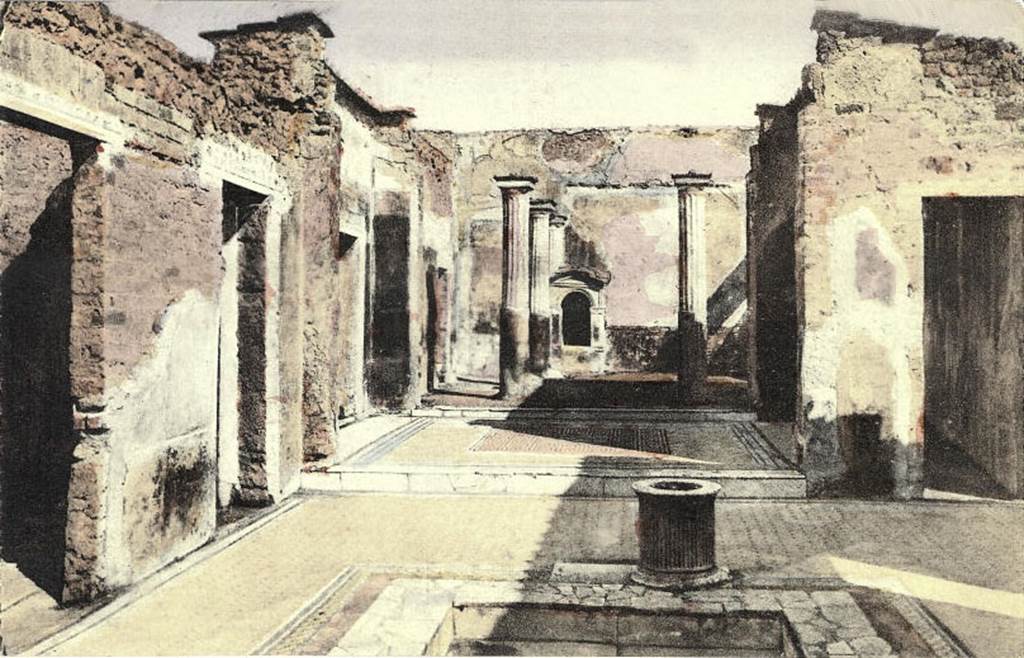
VI.8.5 Pompeii. Old postcard, date unknown. Looking across the tablinum to the peristyle. Photo courtesy of Rick Bauer.
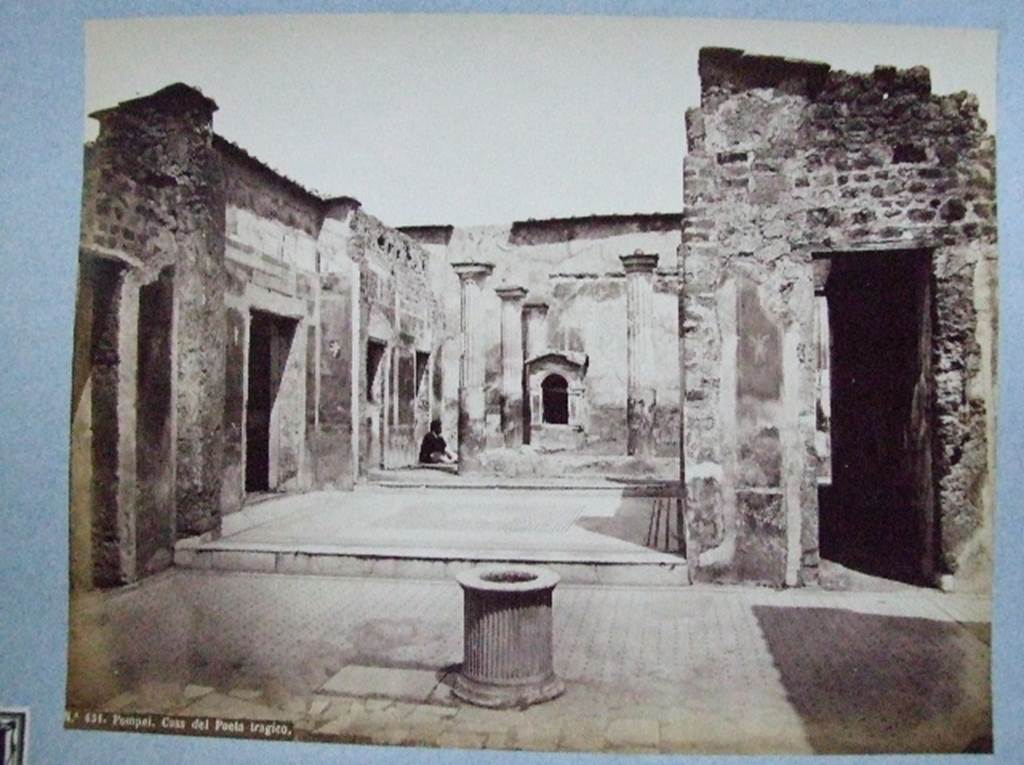
VI.8.5 Pompeii. House of the Tragic Poet. Tablinum and peristyle.
Old undated photograph courtesy of the Society of Antiquaries, Fox Collection.
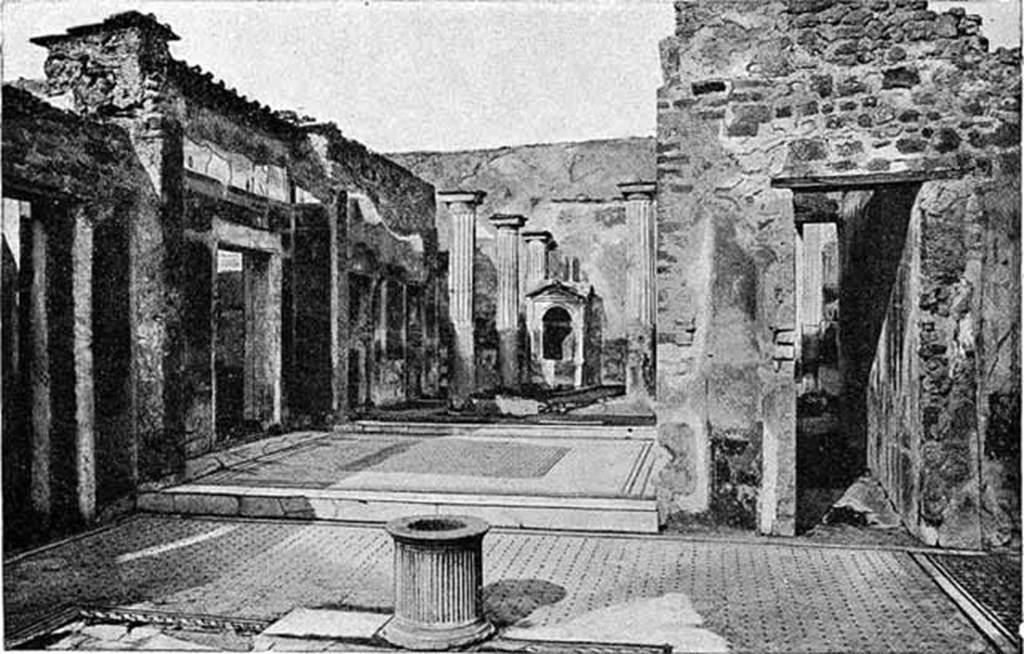
VI.8.5 Pompeii. 1892. Tablinum and corridor to peristyle. Photo courtesy of Rick Bauer.
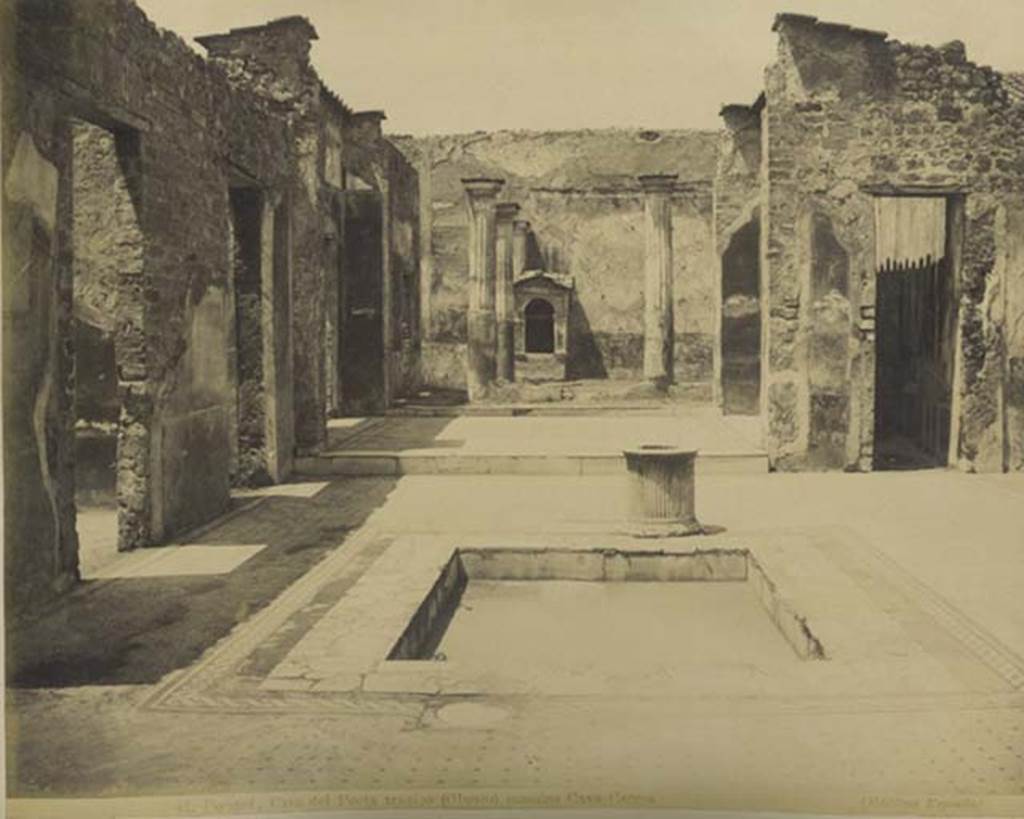
VI.8.5 Pompeii.
Mid 1890’s photograph by Esposito, no. 044.
Looking across the atrium to tablinum and the peristyle. Photo courtesy of Rick Bauer.
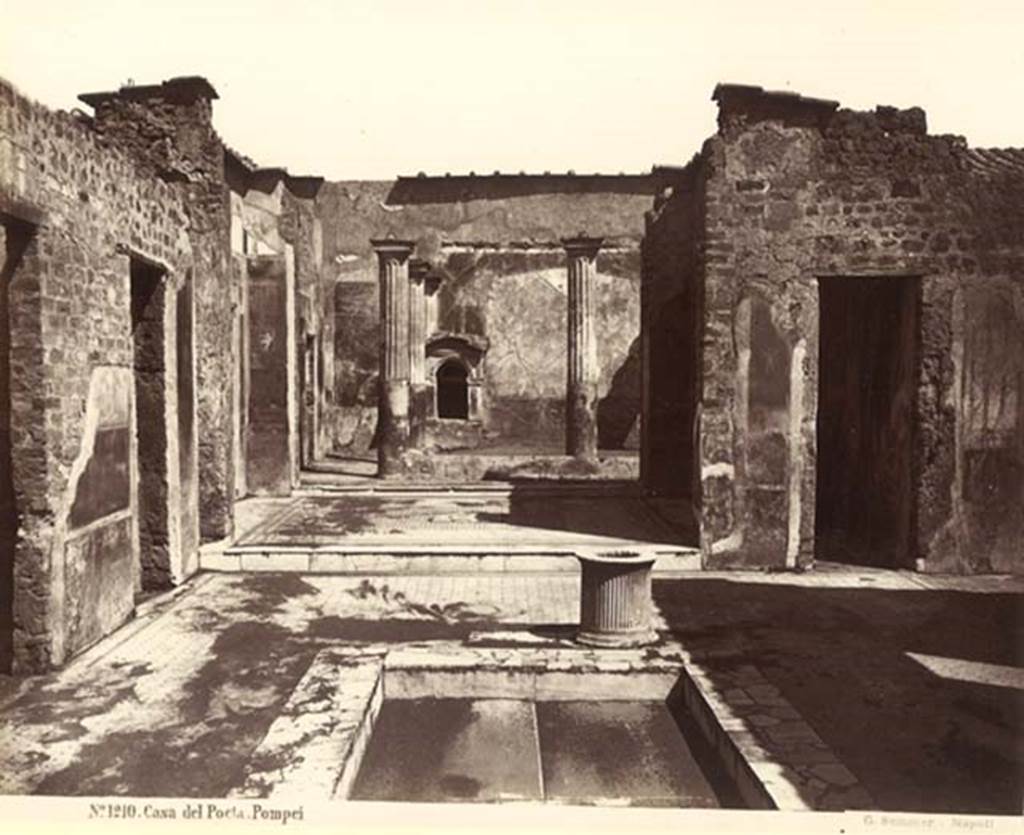
VI.8.5, Pompeii.
c.1880-1890. G. Sommer no. 1210.
Looking north across impluvium in atrium towards tablinum and peristyle, at rear. Photo courtesy of Rick Bauer.
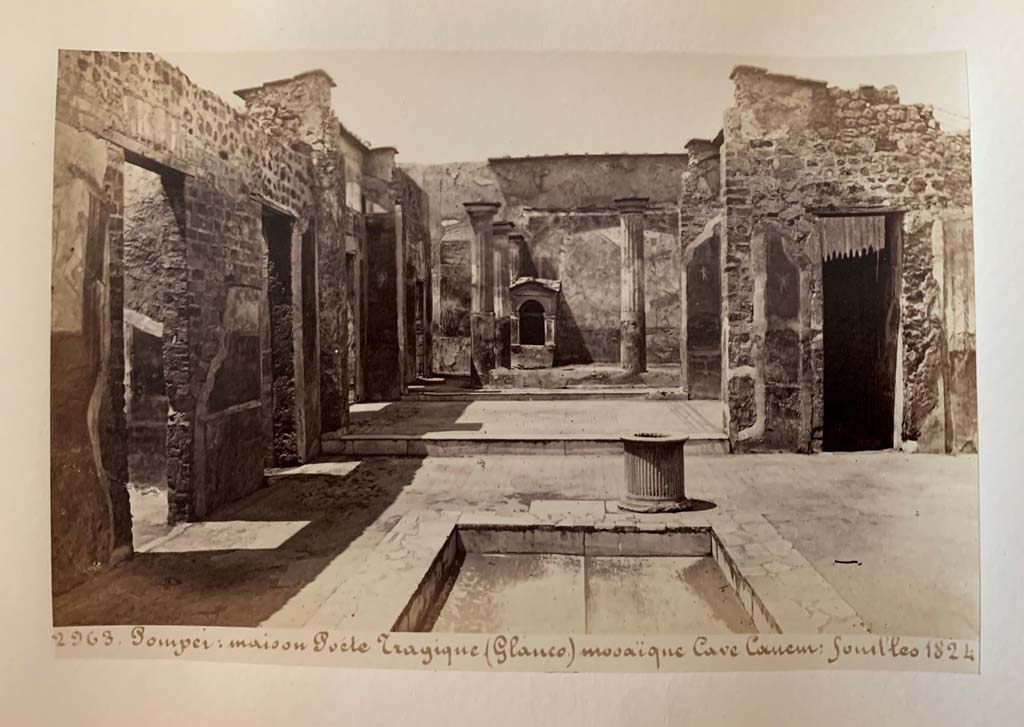
VI.8.5, Pompeii. Album by M. Amodio, c.1880,
entitled “Pompei, destroyed on 23 November 79, discovered in 1748”.
Looking north across impluvium in atrium. Photo
courtesy of Rick Bauer.
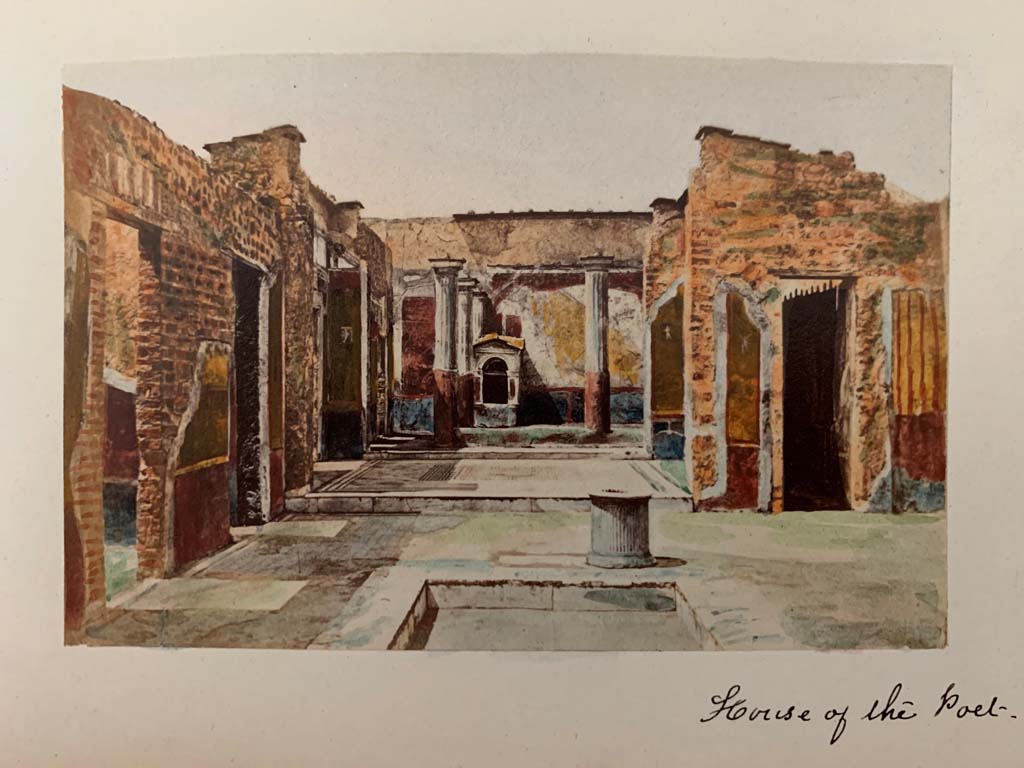
VI.8.5, Pompeii. From a coloured album by M.
Amodio, dated c.1880. Looking north. Photo courtesy of Rick Bauer.
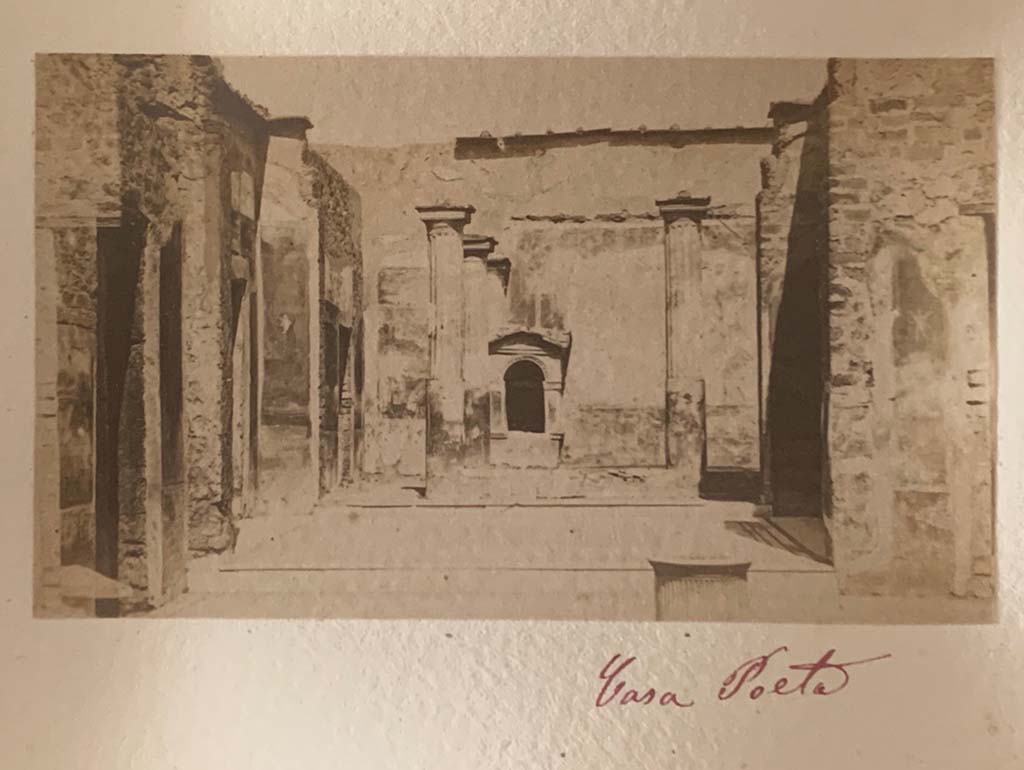
VI.8.5 Pompeii. From an Album c. 1875-1885. Looking
north to tablinum and peristyle. Photo courtesy of Rick Bauer.
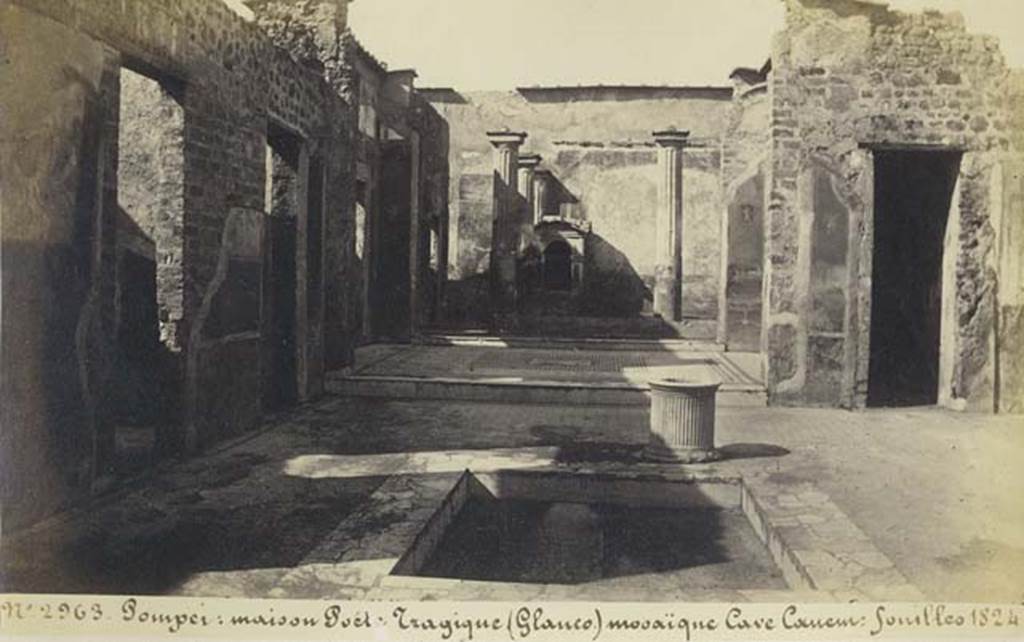
VI.8.5 Pompeii. Old undated photograph by Amodio no. 2963, album dated c.1873.
Looking across impluvium in atrium, across tablinum to peristyle. Photo courtesy of Rick Bauer.
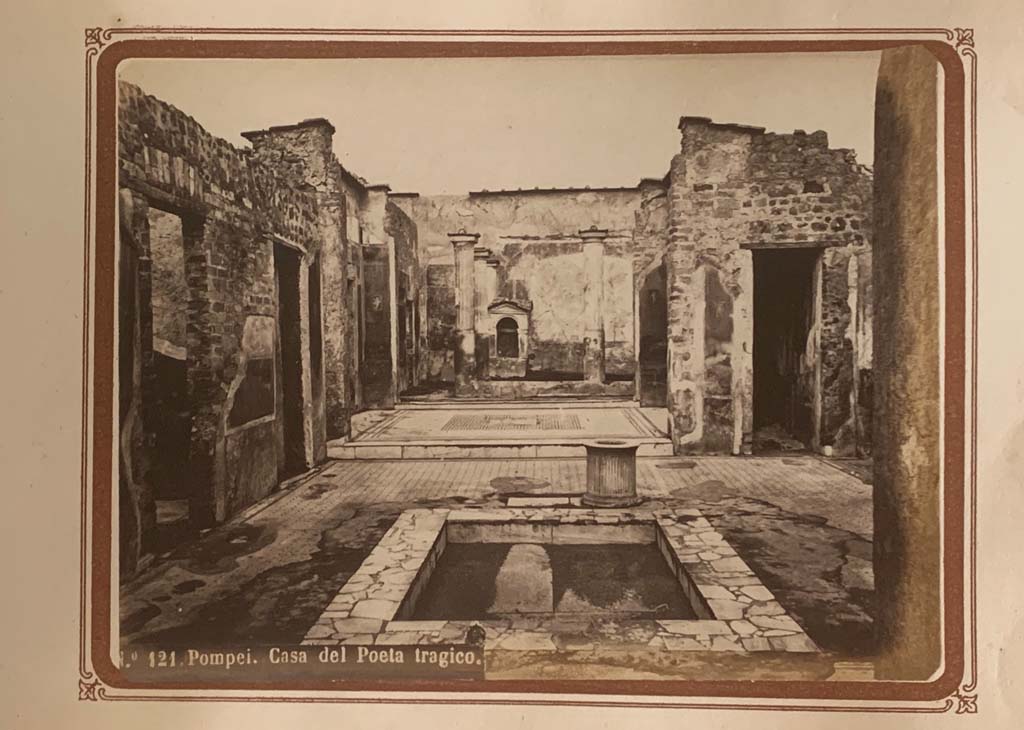
VI.8.5 Pompeii. Album by Roberto Rive dated 1868. Looking
north across impluvium in atrium. Photo courtesy of Rick Bauer.
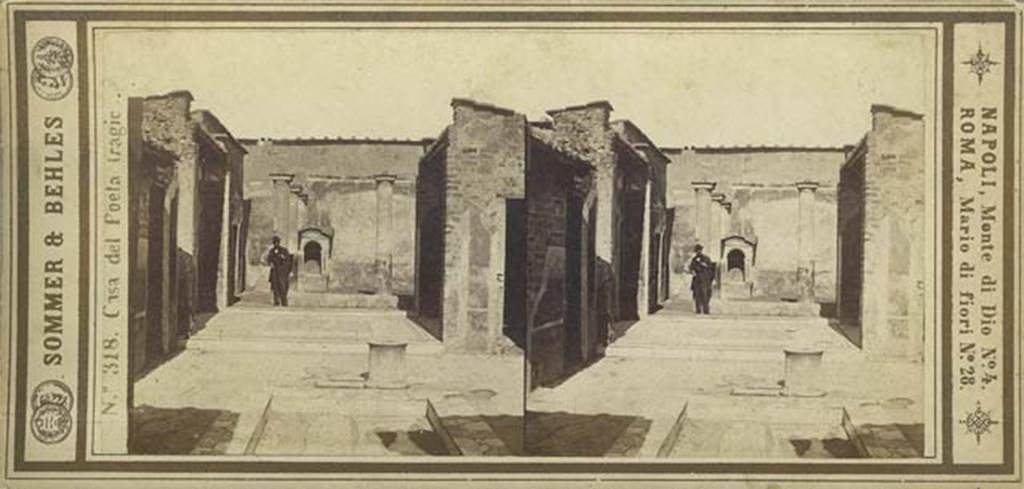
VI.8.5 Pompeii. Between 1867 and 1874.
Looking across impluvium to tablinum and peristyle. Stereoview by Sommer & Behles. Photo courtesy of Rick Bauer.
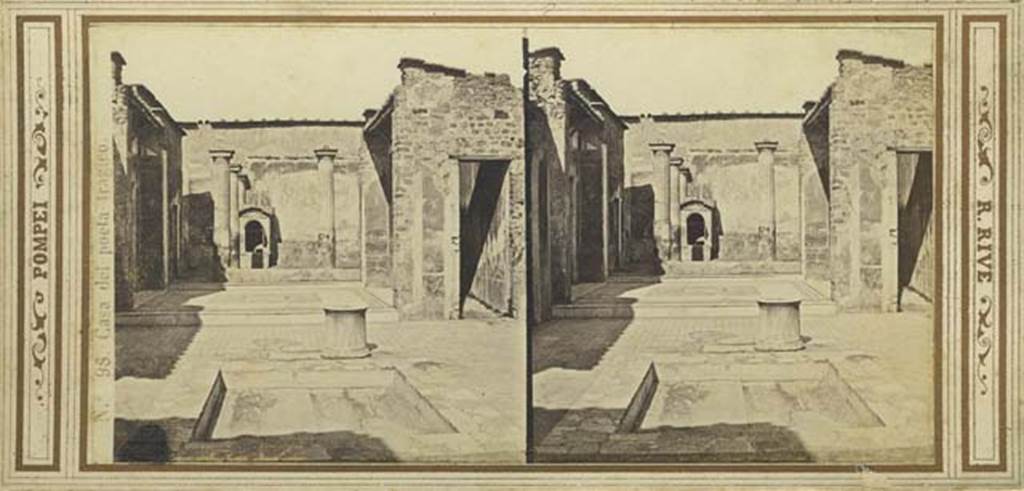
VI.8.5 Pompeii.
Looking across impluvium to tablinum and peristyle. Stereoview by R. Rive, 1860 - 1870s. Photo courtesy of Rick Bauer.
![VI.8.5 Pompeii. June 2017.
Slab of marble with inscription, from around 1AD, found in vicinity of Tablinum/Peristyle, 2nd March 1825.
Now in Naples Archaeological Museum, inv. no. 3779.
Detail from photo courtesy of Giuseppe Ciaramella.
According to the Epigraphic Database Roma this reads
L(ucius) Caecilius Felix,
Q(uintus) Lollius Felix,
Q(uintus) Arrius Hieroni,
minist(ri) August(i),
ex d(ecreto) d(ecurionum), iussu
M(arci) Pomponi Marcell(i),
Ḷ(uci) Valeri Flacci
d(uum)v(irorum) i(ure) d(icundo),
A(uli) Perenni Merulini,
L(uci) Obelli Lucretiani
d(uum)v(irorum) v(iis) a(edibus) s(acris) p(ublicis) p(rocurandis),
C(aio) Caesare, L(ucio) Paullo
co(n)s(ulibus) [CIL X 891]
According to the information card in the Museum –
Action taken by the Ministers of Augustus by decree of the decurions and by order of the duoviri and the aediles
“Lucius Caecilius Felix, Quintus Lollia Felix, Quintus Arrius Hieroni, ministers of Augustus by decree of the decurions and by order of the duoviri Marcus Pomponius Marcellus and Lucius Valerius Flaccus, duoviri with judicial powers, Lucius Obellius Lucretianus and Aulus Perennius Merulinus duoviri v.a.s.p.p. during the consulate of Gaius Caesar and Lucius Paullus”.
The inscription is dated to 1AD by its mention of the consuls in office in Rome.
The magistri of the aediles is indicated by the peculiar formula d(uoviri) v(iis) a(edficiis) s(acris) p(ublicis) p(rocurandis).
See Fiorelli G., 1864. Pompeianarum antiquitatum historia, Vol. 3: Naples, Addenda, p.59.](6%2008%2005%20p5_files/image048.jpg)
Slab
of marble with inscription, from around 1AD, found in vicinity of
Tablinum/Peristyle, 2nd March 1825.
Now
in Naples Archaeological Museum, inv. no. 3779.
Detail
from photo courtesy of Giuseppe Ciaramella.
According to the Epigraphic Database Roma this
reads
L(ucius) Caecilius Felix,
Q(uintus) Lollius Felix,
Q(uintus) Arrius Hieroni,
minist(ri) August(i),
ex d(ecreto) d(ecurionum), iussu
M(arci) Pomponi Marcell(i),
Ḷ(uci) Valeri Flacci
d(uum)v(irorum) i(ure) d(icundo),
A(uli) Perenni Merulini,
L(uci) Obelli Lucretiani
d(uum)v(irorum) v(iis) a(edibus) s(acris) p(ublicis) p(rocurandis),
C(aio) Caesare, L(ucio) Paullo
co(n)s(ulibus) [CIL X 891]
According
to the information card in the Museum –
Action
taken by the Ministers of Augustus by decree of the decurions and by order of
the duoviri and the aediles
“Lucius
Caecilius Felix, Quintus Lollia Felix, Quintus Arrius Hieroni, ministers of
Augustus by decree of the decurions and by order of the duoviri Marcus
Pomponius Marcellus and Lucius Valerius Flaccus, duoviri with judicial powers,
Lucius Obellius Lucretianus and Aulus Perennius Merulinus duoviri v.a.s.p.p.
during the consulate of Gaius Caesar and Lucius Paullus”.
The
inscription is dated to 1AD by its mention of the consuls in office in Rome.
The
magistri of the aediles is indicated by the peculiar formula d(uoviri)
v(iis) a(edficiis) s(acris) p(ublicis) p(rocurandis).
See Fiorelli G., 1864. Pompeianarum antiquitatum historia, Vol. 3: Naples, Addenda, p.59.
The watercolours below have also
been included in VI.8.3
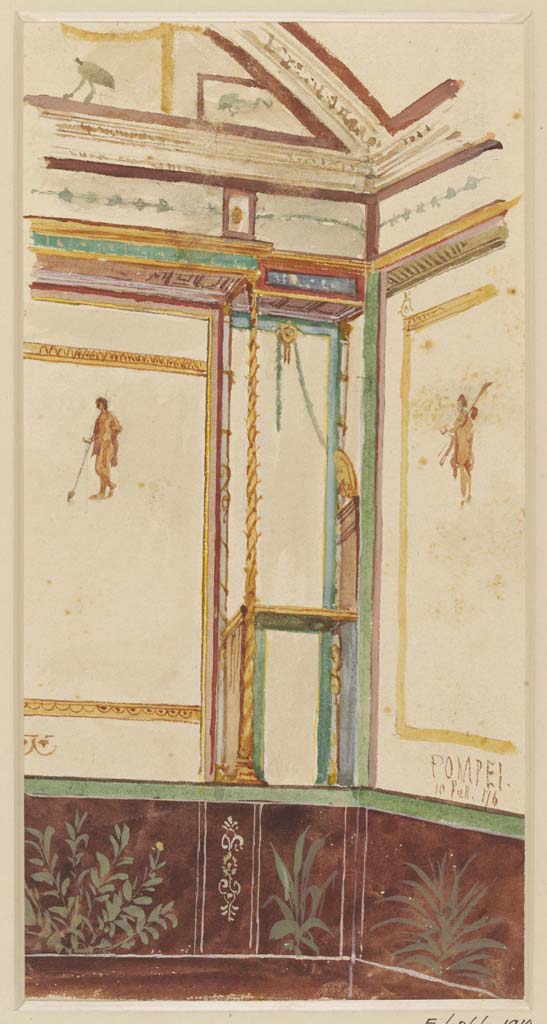
VI.8.3/5
Pompeii. 10th September (18)76.
Watercolour
by Luigi Bazzani, preliminary study of painted wall-decoration in the 'House
of the Tragic Poet' at
Pompeii.
Photo
© Victoria and Albert Museum. Inventory number 2034-1900.
(Note:
Although this painting is described as from this house, we have been unable to
locate a likely area.
According
to the cross-section below, the front of the house (VI.8.5) seemed to have red
zoccolos, the rear section (VI.8.3) appeared to have black ones).
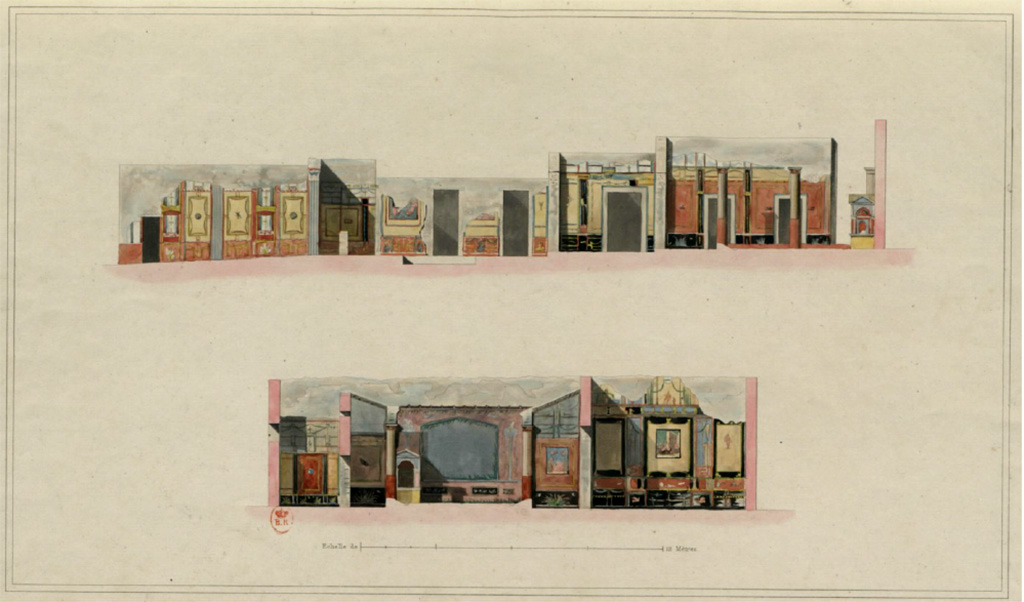
VI.8.3/5
Pompeii.c.1828.
Above
- Cross section from entrance fauces, on left, towards lararium against the
north wall, on right.
Below
– Cross section across the north wall.
See Raoul Rochette et Bouchet J., 1828. Choix
d'Edifices Inédits : Maison du Poète Tragique. Paris, pl 2.
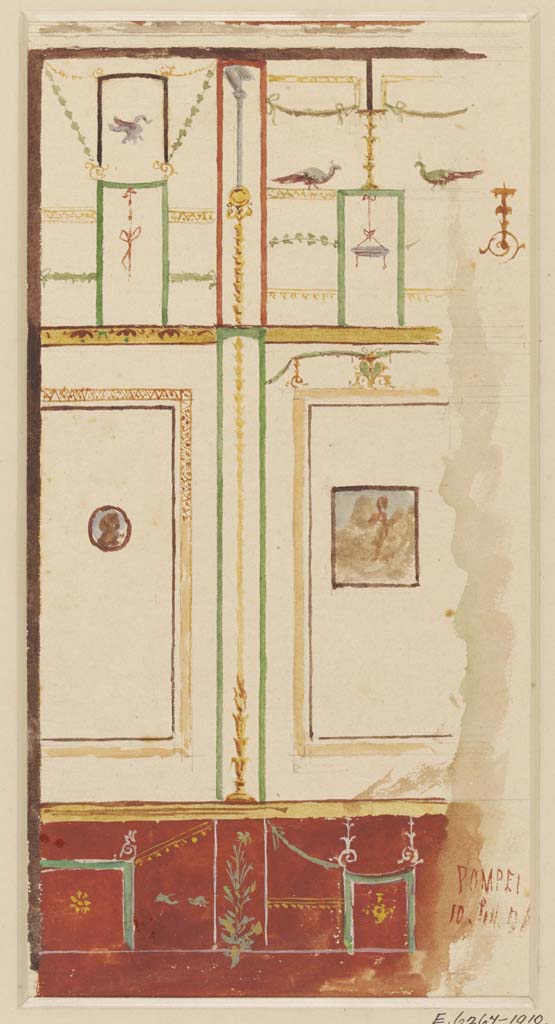
VI.8.3/5
Pompeii. 10th September (18)76.
Watercolour
by Luigi Bazzani, preliminary study of painted wall-decoration in the 'House
of the Tragic Poet' at
Pompeii.
Photo
© Victoria and Albert Museum. Inventory number 2034-1900.
(Note:
Although this painting is described as from this house, we have been unable to
locate a likely area.
It
may have been from “our” rooms 10, 8, or Ala 4
According
to the cross-section above, the front of the house (VI.8.5) seemed to have red
zoccolo, the rear section (VI.8.3) appeared to have black ones).
Part 1 Part 2 Part 3 Part 4 VI.8.3 and VI.8.5 Room Plan