I.2.29 Pompeii. Thermopolium of Polybius.
Excavated 1869. Linked to I.2.28. Bombed in 1943.

I.2.29 Pompeii. August
2023.
Looking north-west on Vicolo delle
Conciapelle towards entrance
doorway to I.2.29, centre right, with I.2.28 on right.
Photo courtesy of
Maribel Velasco.
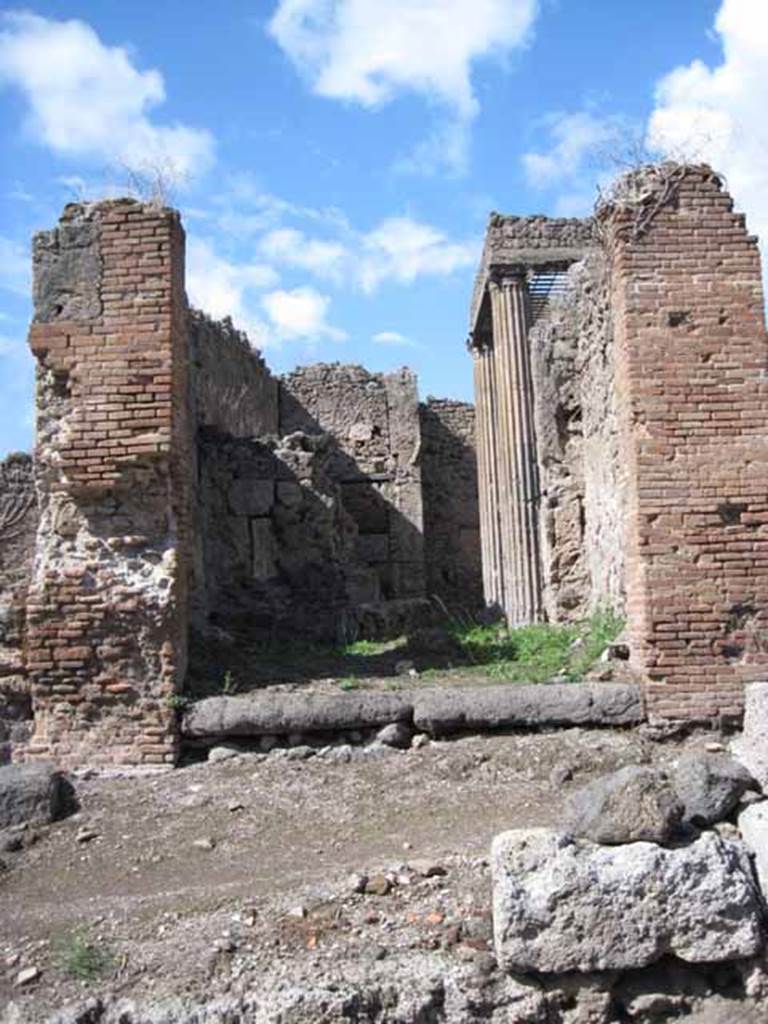
I.2.29 Pompeii, on left. October 2024.
Looking north-west on Vicolo del Conciapelle towards doorways to I.2.29, I.2.28 and I.2.27. Photo courtesy of Klaus Heese.

I.2.29 Pompeii. October 2024.
Looking north towards entrance doorway. Photo courtesy of Klaus Heese.
The north wall would have connected to the atrium of I.2.28 by a doorway.
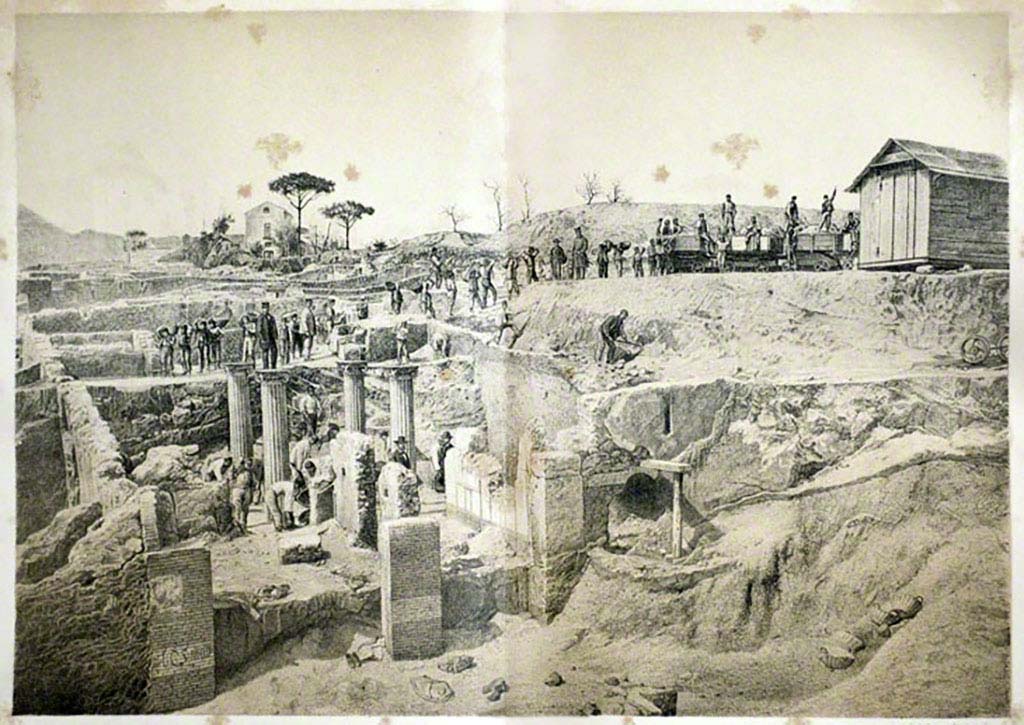
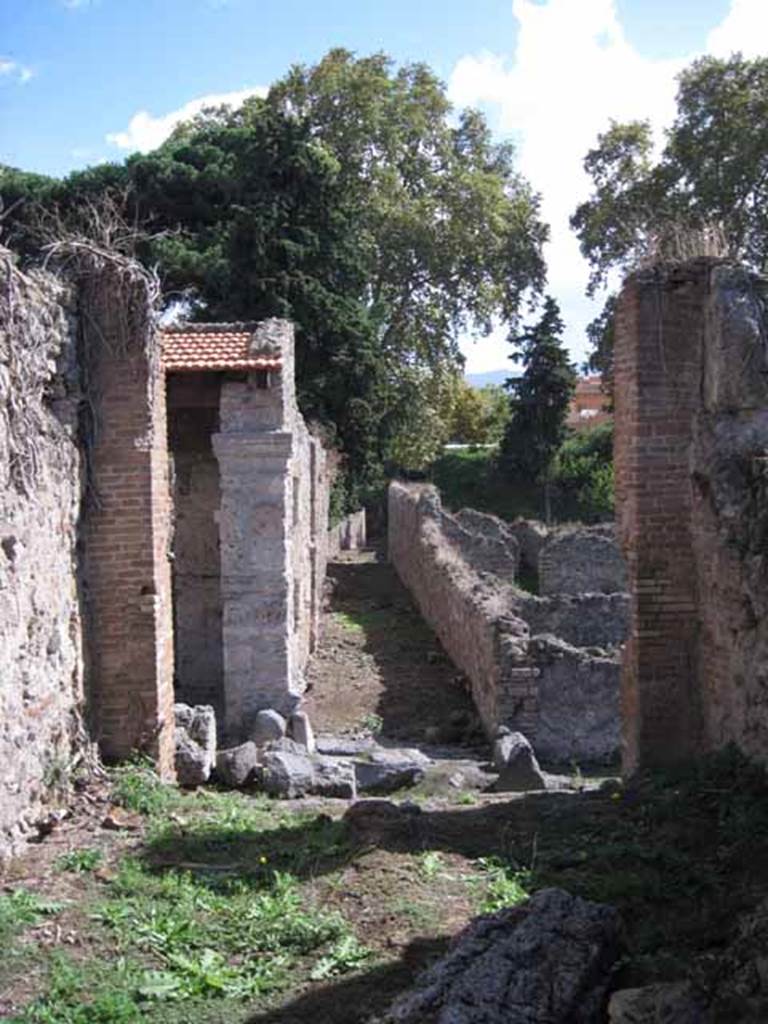
I.2.29 Pompeii. September 2010.
Looking north to entrance doorway from Vicolo del Conciapelle. Photo courtesy of Drew Baker.
According to CTP, originally before the 1943 bombing, this entrance had three steps leading up to it.
See Van der Poel, H. B., 1986. Corpus Topographicum Pompeianum, Part IIIA. Austin: University of Texas. (p.4)
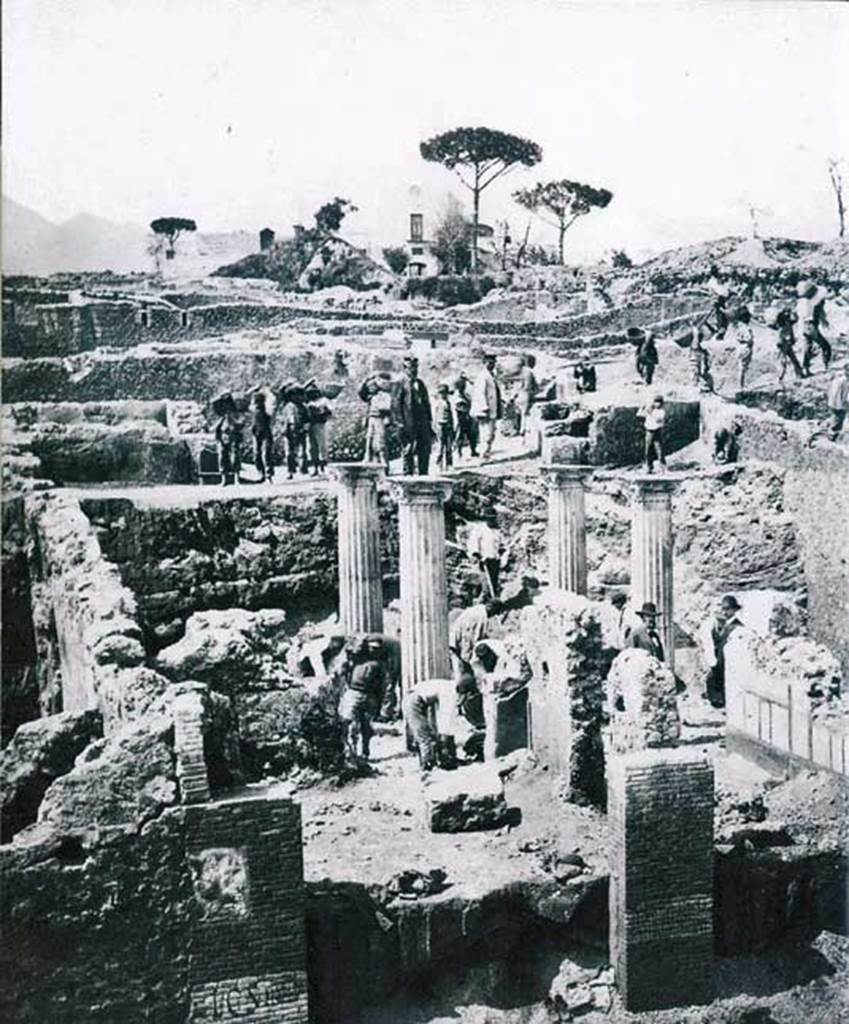
I.2.29 Pompeii. Riproduzione
di un vecchia fotografia.
Looking north to entrance doorways, 1.2.29 on the left, I.2.28 on the right.
See Warscher T., 1935. Codex Topographicus Pompeianus: Regio I.2. (no.48), Rome: DAIR, whose copyright it remains.

Vicolo del Conciapelle, north side, Pompeii. View of the excavations at Pompeii in May 1873.
Looking towards entrance doorways of I.2.29, on left, and I.2.28, in centre, and I.2.27 right with support during excavation.
See Overbeck J.,
1875. Pompeji in seinen Gebäuden, Alterthümen und Kunstwerken. Leipzig:
Engelmann, p. 34.
![I.2.29-28 Pompeii. May 1873. Detail from old photo showing thermopolium and house during excavation. Photo courtesy of Rick Bauer.
According to Fiorelli, on this doorway were two electoral recommendations.
One in honour of Lucium Ceium Secundum, acclaimed many times in other places:
L. C. S. II . VIR . I . D.
and
POPIDIVM AED . ROG
POLYBIVS
See Pappalardo, U., 2001. La Descrizione di Pompei per Giuseppe Fiorelli (1875). Napoli: Massa Editore. (p.38)
According to Della Corte, this bar was a dependence of the neighbouring house at I.2.28.
He could not speculate who it belonged to.
He thought it was lived in by a certain Polybius, as proved by the recommendation found to the east (right) of the entrance:
Polybius rog(at) [CIL IV 3379]
See Della Corte, M., 1965. Case ed Abitanti di Pompei. Napoli: Fausto Fiorentino. (p.275)
According to Epigraphik-Datenbank Clauss/Slaby (See www.manfredclauss.de) these read –
Popidium
/
aed(ilem) rog(at)
Polybius [CIL IV 3379]
L(ucium) C(eium) S(ecundum) IIv(irum) i(ure) d(icundo) [CIL IV 3380]](1%2002%2029_files/image011.jpg)
I.2.29-28 Pompeii. May 1873.
Detail from old photo showing thermopolium and house during excavation. Photo courtesy of Rick Bauer.
According to Fiorelli, on this doorway were two electoral recommendations.
One in honour of Lucium Ceium Secundum, acclaimed many times in other places:
L. C. S.
II . VIR . I . D.
and
POPIDIVM AED .
ROG
POLYBIVS
See Pappalardo, U., 2001. La Descrizione di Pompei per Giuseppe Fiorelli (1875). Napoli: Massa Editore. (p.38)
According to Della Corte, this bar was a dependence of the neighbouring house at I.2.28.
He could not speculate who it belonged to.
He thought it was lived in by a certain Polybius, as proved by the recommendation found to the east (right) of the entrance:
Polybius
rog(at) [CIL IV 3379]
See Della Corte, M., 1965. Case ed Abitanti di Pompei. Napoli: Fausto Fiorentino. (p.275)
According to Epigraphik-Datenbank Clauss/Slaby (See www.manfredclauss.de) these read –
Popidium
/
aed(ilem) rog(at)
Polybius [CIL IV 3379]
L(ucium) C(eium)
S(ecundum) IIv(irum) i(ure) d(icundo)
[CIL IV 3380]
![I.2.29 Pompeii. September 2005. Entrance. The missing bricks on the left of the doorway, is where the recommendation for Secundum would have been. Polybius [CIL IV 3379]
L(ucium) C(eium) S(ecundum) IIv(irum) i(ure) d(icundo) [CIL IV 3380]](1%2002%2029_files/image013.jpg)
I.2.29 Pompeii. September 2005. Entrance.
The missing bricks on the left of the doorway, is where the recommendation for Secundum would have been.

I.2.29 Pompeii. September 2010. West wall. Photo courtesy of Drew Baker.

I.2.29 Pompeii. December 2006. West side with the site of the remains of the counter and hearth.

I.2.29 Pompeii. September 2010.
Looking north from entrance doorway towards north wall that had a doorway into the atrium of I.2.28.
Photo courtesy of Drew Baker
The decorative serving table, counter or podium would have been on the left and centre of the photo.
According to Garcia y Garcia, this bar was destroyed completely by a bomb.
The perimeter walls have been reconstructed, but the three steps to the entrance, the sales counter and the electoral inscriptions have been lost forever.
See Garcia y
Garcia, L., 2006. Danni di guerra a Pompei. Rome: L’Erma di Bretschneider. (p.37).
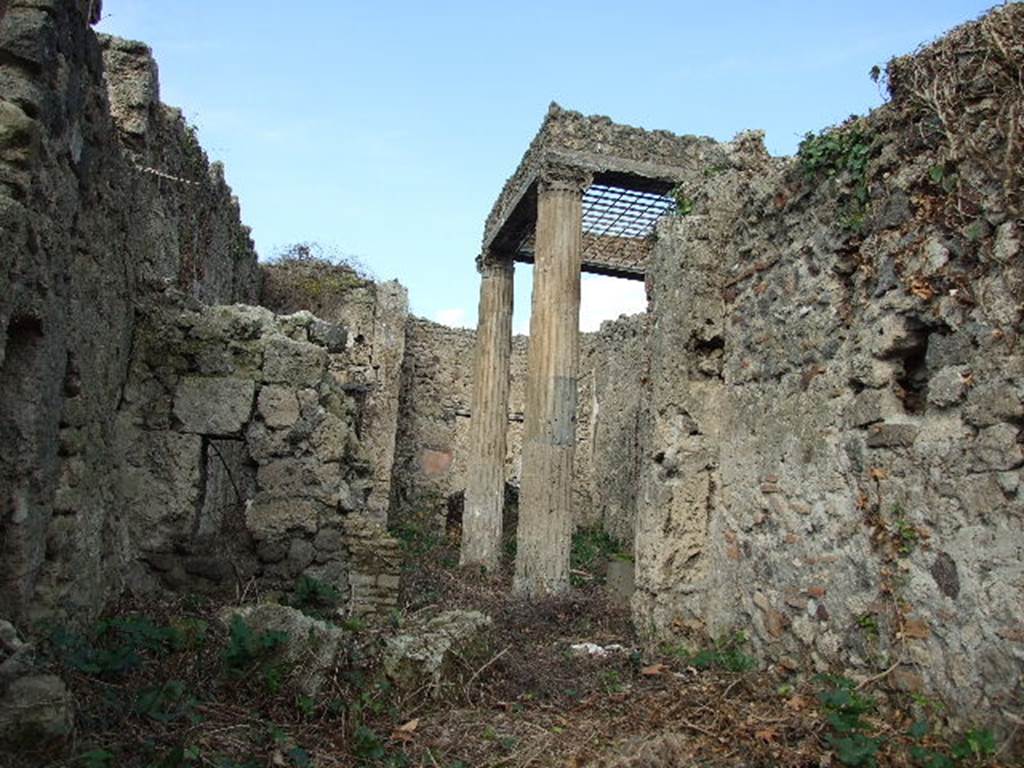
I.2.29 Pompeii. October 2024.
Site of doorway in north wall, at its rear was the atrium of I.2.28. Photo courtesy of Klaus Heese.
I.2.29 Pompeii. December 2006. Looking through site of doorway in north wall, to atrium of I.2.28.
I.2.29 Pompeii. December 2006. Site of doorway in north wall, leading through to atrium of I.2.28.
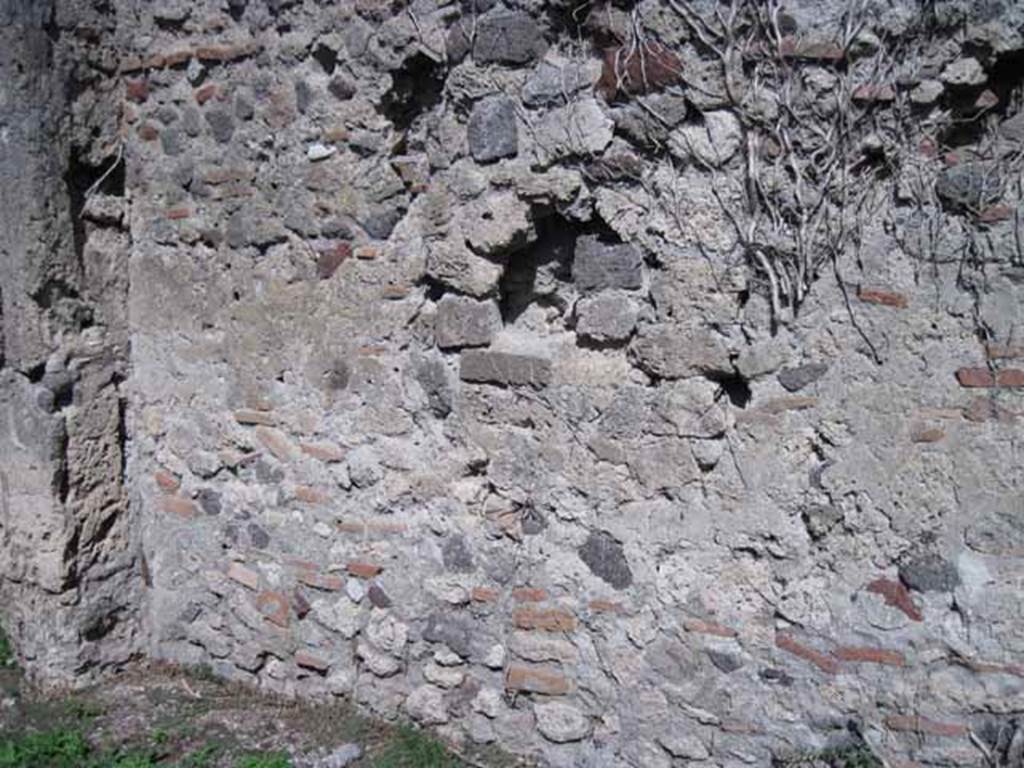
I.2.29 Pompeii. September 2010. East wall. Photo courtesy of Drew Baker.

I.2.29 Pompeii. September 2010. Looking south from rear of bar-room, towards Vicolo del Conciapelle.
The unnamed vicolo between I.1 and I.5 can be seen directly across the roadway. Photo courtesy of Drew Baker.

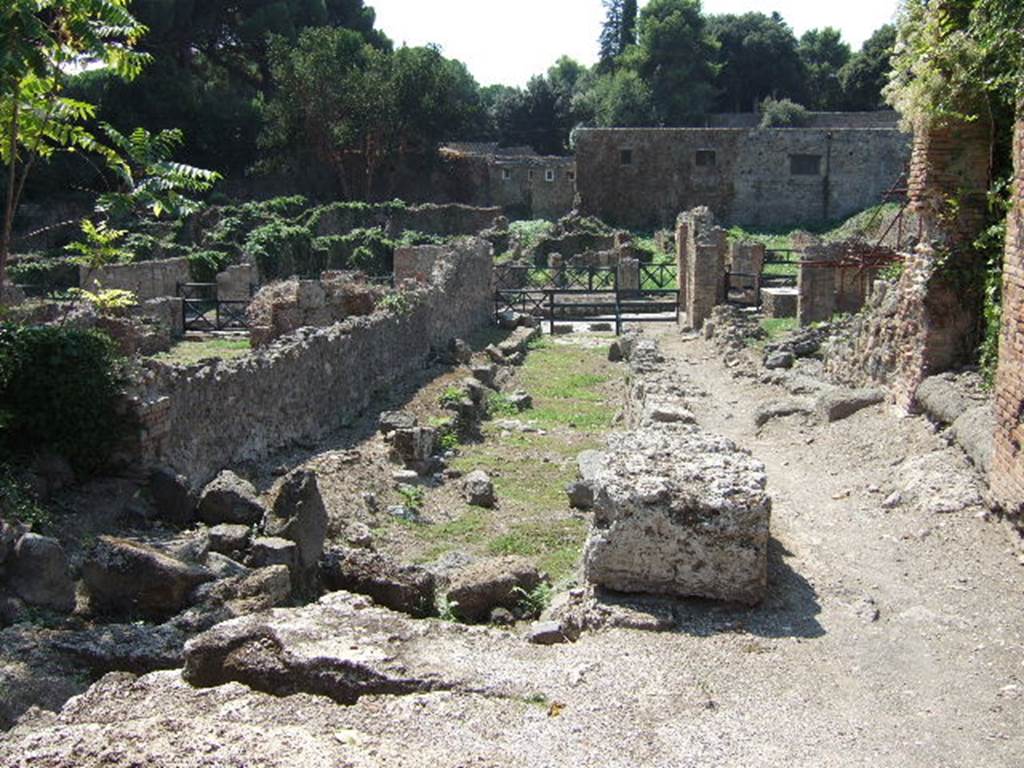
I.1 Pompeii, on left. September 2005. Vicolo del Conciapelle, looking west. (I.2.29 with remains of steps, on right.)
In Codex Topographicus Pompeianus: Regio I.2, (the copy at DAIR), Warscher included Viola’s description of the insula, from
Gli scavi di Pompei dal 1873 al 1878, p.10 (Pompei e la regione sotterrata dal
Vesuvio nell’anno 1879, Seconda parte).
This is included at the end in all parts of I.2 on the website.
“Nel dicembre
del 1873 incomminciò lo scavo di questa isola – quale dovette essere abitata da
moltissime persone. Infatti non si vede grande lusso
di abitazioni, nè grandi locali, ove i ricchi pompeiani passavano la vita
nell’ozio e nel piacere; si può invece osservare grand’economia di spazio, case
piccole miste a botteghe e ad officine, onde non è difficile argomentare che
quivi abitarono persone del ceto medio, le quali benchè agiate non godevano
certamente della più splendide posizione.
È questa
un’isola dove avennero frequentissime trasformazioni, per cui riesce
difficillissimo intravvedere qual’era la sua forma primiera; non mancano però
degli avanzi di costruzioni primitive, insieme ad altri di epoca posteriore,
come si osserva in molti luoghi di Pompei.
La sua area è
di mq.2948, ed è limitata da occidente dal cardo, a settentrione dalla via
secunda, ad oriente dal vico parallelo al cardo e a mezzogiorno dalla via
tertia che la separa dalle isole 1 e 5; il margine che la fiancheggia da tre
lati escluso l’orientale e sulla via tertia di fronte al vano No.28 si vede un
piccolo ponte, formato da massi posti a contrasto, il quale serve per unire i
due margine (vedi la fotografia no.42c)”.
(Note: this photo can also be seen at I.5.1, I.2.28 and
in the “streets” section under Vicolo del Conciapelle).
See Warscher T., 1935. Codex Topographicus Pompeianus: Regio I.2. Rome: DAIR.
(translation: "In December of 1873 the excavation of this insula began – which would have been inhabited by many people. In fact you don't see great luxury homes, nor large rooms, where rich Pompeian passed life in idleness and pleasure; if you instead look at the great economy of space, small homes and shops mixed with workshops, it's not difficult to argue that here lived people in the middle class, which however well-to-do they certainly did not enjoy the most splendid position.
This was an insula where there were frequent transformations for which it is difficult to glimpse what was the original form; it does not lack however, the remains of primitive constructions, alongside others of a later date, as can be seen in many places in Pompeii.
Its area was 2948 sq. m., and was bounded on the west by the “cardo”, on the north by via secunda, and east by a parallel vicolo to the “cardo” and in the south by the via tertia, that separated it from Insula’s 1 and 5: the border that flanked it by three sides excluding the east and on via tertia opposite No. 28, you will see a small bridge, formed by a boulder placed to serve to unite the two edges, (see photo No. 42 c)."