I.2.3 Pompeii. Casa con colonna etrusca. Linked to I.2.2 and I.2.4.
Excavated 1872. Bombed 1943.

I.2.3 Pompeii. October 2024. Looking north-east on
Via Stabiana towards doorway, on right. Photo
courtesy of Klaus Heese.

I.2.3 Pompeii.
September 2005. Entrance (in centre) on Via Stabiana.
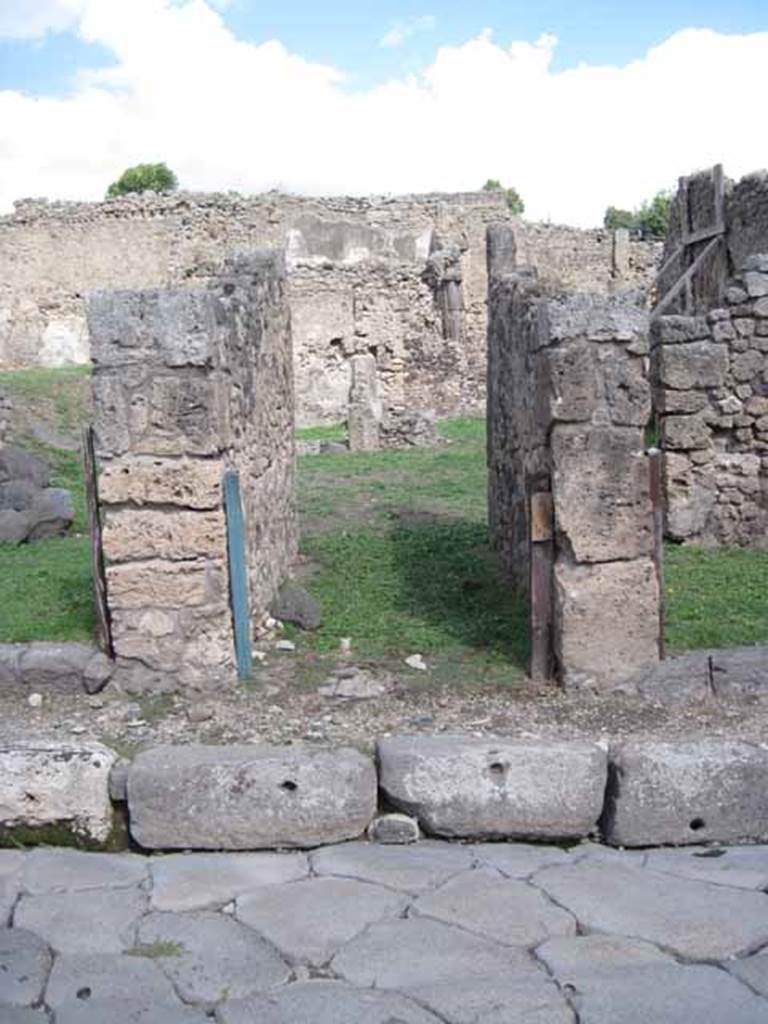
Looking towards north wall of entrance corridor. Photo courtesy of Klaus Heese.

I.2.3 Pompeii. October 2024.
Entrance corridor, looking east towards atrium. Photo courtesy of Klaus Heese.

1.2.3 Pompeii. September 2010.
Entrance doorway, looking east from Via Stabiana. Photo courtesy of Drew Baker.

1.2.3 Pompeii. September 2010.
Looking east from entrance corridor into atrium area. Photo courtesy of Drew Baker.

1.2.3 Pompeii. September 2010.
Looking west along entrance fauces towards Via Stabiana. Photo courtesy of Drew Baker.

I.2.3 Pompeii. September 2005. Looking east from fauces across the atrium to the tablinum.

I.2.3 Pompeii. Showing house as it was before it was bombed in 1943.
According to Garcia y Garcia, this area was bombed in September 1943.
The impluvium was destroyed, and the three rooms to the north of the atrium, together with the north wall separating the two houses were demolished.
See Van der Poel,
H. B., 1986. Corpus Topographicum
Pompeianum, Part IIIA. Austin: University of Texas. (p.4).
See Garcia y
Garcia, L., 2006. Danni di guerra a
Pompei. Rome: L’Erma di Bretschneider. (p.37-38).
(Viewed from rear (east) towards the front (west)). From model in Naples Archaeological Museum.
At the top, in the left-hand corner is the bar at I.2.1.

1.2.3 Pompeii. September 2010. Looking north towards remains of north wall (left or north-western corner of atrium).
The shop at I.2.4 is on the left behind the wall. The north wall of house at I.2.6 can be seen at the rear. Photo courtesy of Drew Baker.
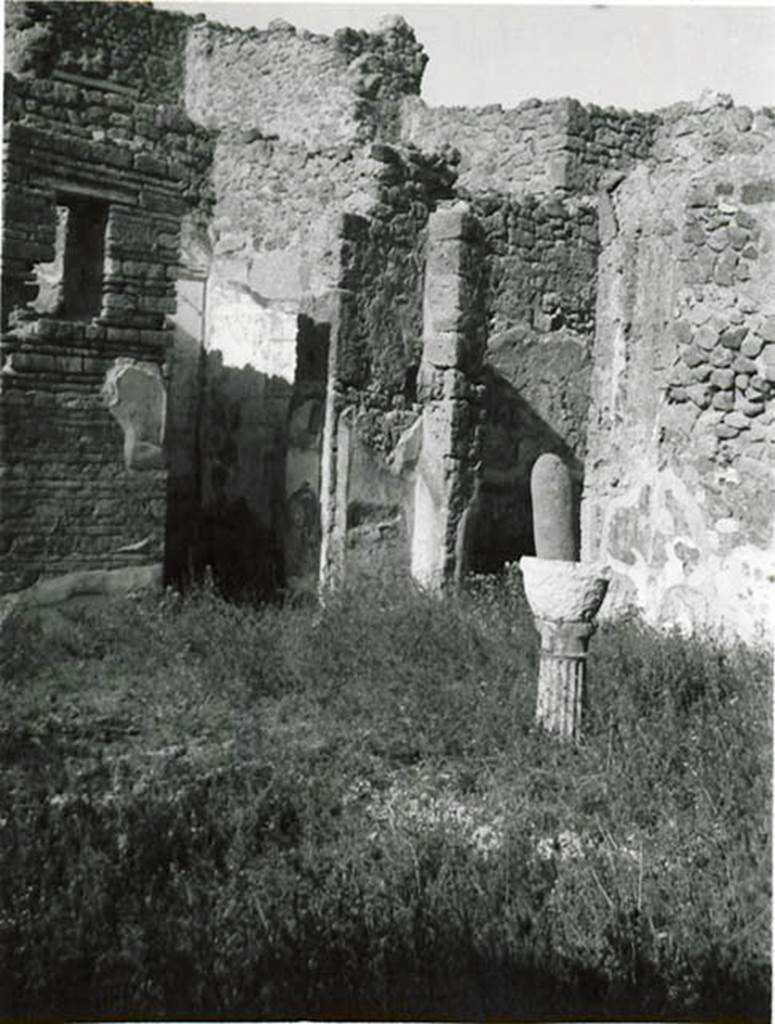
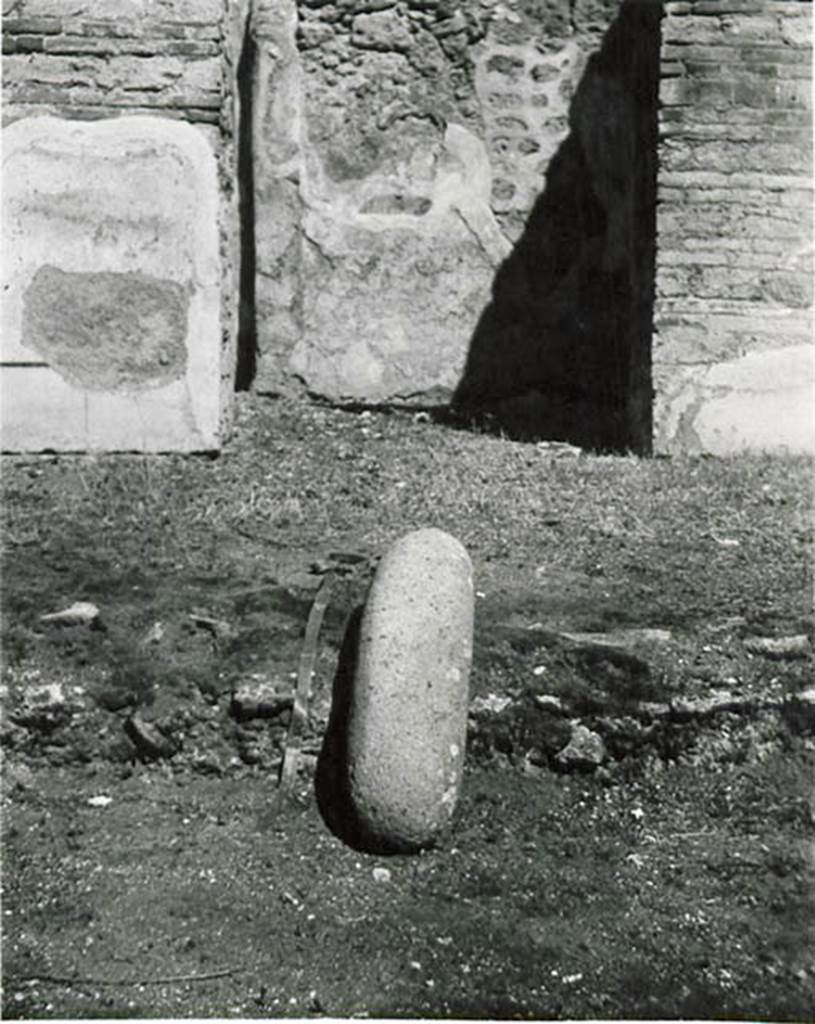
1.2.3 Pompeii. September 2010.
Looking north towards remains of middle part of north wall of atrium. The north wall of house at I.2.6 is visible at the rear.
Photo courtesy of Drew Baker.
In this area (bombed in 1943) would have been the site of the two cubicula mentioned by Fiorelli.
In one of them, he said, was antique decoration under the more recent restoration.
The other contained two paintings, Polyphemus and Galatea and Ariadne abandoned by Theseus.
According to Fiorelli, there was a third painting which had been destroyed.
Included on the walls were painted medallions enclosed in circles of wreaths of leaves, which were still visible.
In one were Mars and Venus, in another Meleager and Atalanta, and in third was the head of a Bacchante.
On the wall to the right was a small hollow covered internally with marble, probably to hold a lantern.
See Pappalardo,
U., 2001. La Descrizione di Pompei per
Giuseppe Fiorelli (1875). Napoli: Massa Editore. (p.34)
See Garcia y Garcia, L., 2006. Danni di guerra a Pompei. Rome: L’Erma di Bretschneider. (p.38, no.21 for photo of wall with Polyphemus and Galatea).
According to Warscher’s list from Prof. Sogliano, the paintings listed were all from the third cubiculum to the left of the atrium.
Head of Bacchante, no. 199 on p.45,
Polyphemus and Galatea, no. 474 on page 78,
Heads of Atalanta and Meleager, no. 507 on page 89,
Ariadne abandoned by Theseus, no.534 on page 97,
Heads of Mars and Venus, no 605; and a female head (this one nearly all destroyed) no.606, on page 124).
See Warscher T., 1935. Codex Topographicus Pompeianus: Regio I.2. Rome: DAIR (after photo no.12).
See Sogliano, A., 1879. Le pitture murali campane scoverte negli anni 1867-79. Napoli: (p. 45, 78, 89, 97, 124).
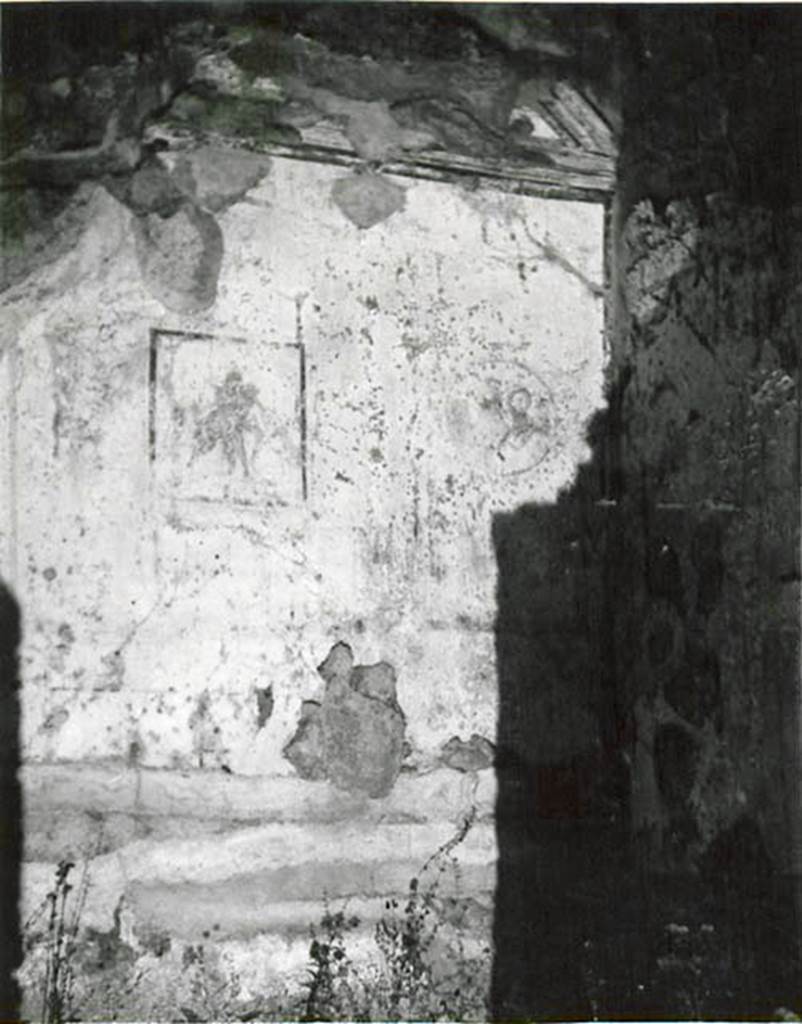
I.2.3 Pompeii. 1935 photo by Tatiana Warscher. The north-east corner of the atrium.
The doorway to the triclinium (room d, on the right) and the doorway to the ala (room c, on the left) can be seen.
See Warscher T., 1935. Codex Topographicus Pompeianus: Regio I.2. (no.4), Rome: DAIR, whose copyright it remains.
Note: although Warscher described room “c” as an ala, Fiorelli and Sogliano described it as a cubiculum.

I.2.3 Pompeii. 1935 photo by Tatiana Warscher.
Looking north across atrium, towards doorway to the tablinum (room e). A long projectile had been found in this house.
See Warscher T., 1935. Codex Topographicus Pompeianus: Regio I.2. (no.5), Rome: DAIR, whose copyright it remains.

I.2.3 Pompeii. 1935 photo by Tatiana Warscher.
Looking towards north wall of cubiculum, with central painting of Polyphemus and Galatea.
Warscher described this as, by quoting Sogliano -
“I.2.3 Nel
cubicolo (a destra?) erano tre quadretti; ne abbiamo solamente uno con Polifemo
e Galatea.
L’Arianna
abbandonata è distrutta. Si vedono ancora le traccie dei medaglioni, uno coi
busti di Marte e Venere.
She also quoted Mau, from Bull. Inst. 1874, p.202-3 –
“Le tre pareti di
detta camera sono divise ciascuna in tre scompartimenti, ne’quali in mezzo a
ciascuna parete vi è un piccolo quadro, sui due lati medaglioni con figure
visibili sino al petto, circondati da ghirlande.
In mezzo al muro
di fondo abbiamo un quadro compagno di quello descritto dall’Helbig (no.1052) e
spiegato per Polifemo e Galatea.
Qui Polifemo,
nudo sta seduto, tenendo sulla coscia Galatea: si guardano affettuosamente
negli occhi. Accante sta un ariete.
Nel medaglione a
sinistra una donna con capelli biondi e svolazzanti, armata di elmo e lancia,
si rivolge a destra verso un uomo imberbe, che come pare le parla
nell’orecchio. Nel medaglione a destra
vediamo una donna con capello, turcasso e due lancie; sopra la sua spalla
destra è visibile la testa d’un uomo imberbe e armato d’una lancia, che la
guarda attentamente e sembra parlare; ella invece guarda dalla parte opposta
con aria scontenta, se non m’inganna l’esecuzione trascurata. A sinistra si
scorge come un vaso sopra una base.
In mezzo alla
parete destra nel primo piano sta sdraiata Arianna, appoggiandosi sul braccio
destro; nel fondo si scorge la nave.
Nel medaglione a
sinistra vi è una testa di baccante, e a destra di essa un vaso ed un tirso
sopra un base.
In quello a
destra si vede una testa muliebre ed un’altra testa più piccola, di cui non si
distinguono i dettagli.
See Warscher T., 1935. Codex Topographicus Pompeianus: Regio I.2. (no.6), Rome: DAIR, whose copyright it remains.
(translation: from Sogliano - “I.2.3 In the cubiculum (on
the right?) were three paintings; of them we have only the one with Polyphemus
and Galatea.
The abandoned Ariadne was destroyed. You could still see
the traces of medallions, one with the busts of Mars and Venus”.
from Mau – “The three walls of the room are each divided
into three compartments, in the middle of which on each wall was a small
picture, on either side of which were medallions with figures, surrounded by
garlands.
In the middle of the rear wall we have a companion
painting of that described by Helbig (no.1052) and explained as Polyphemus and
Galatea.
Here was nude Polyphemus, sitting holding onto the thigh
of Galatea, looking lovingly into each others eyes.
Nearby was a ram.
In the medallion on the left, we could see a flying
figure of a woman with blonde hair, armed with helmet and spear, turning to the
right towards a beardless man, who seemed to be speaking into her ear. In the
medallion on the right, we could see a woman with hair, a quiver and two
lances: visible above her right shoulder was the head of a beardless man also
armed with a lance, looking attentively at her and seeming to speak; she
instead looked towards the opposite side with an unhappy air, if the neglected
execution does not deceive us. On the left, one could see a pot on a base.
In the middle of the right wall in the foreground was
Ariadne, lying down leaning on her right arm; in the background you could see
the ship.
In the medallion on the left there was the head of a
bacchante, and to the right of it a vase and a thyrsus on a base.
On the right you could see a head of a woman and another
smaller head, but of these one couldn’t distinguish the details.”)
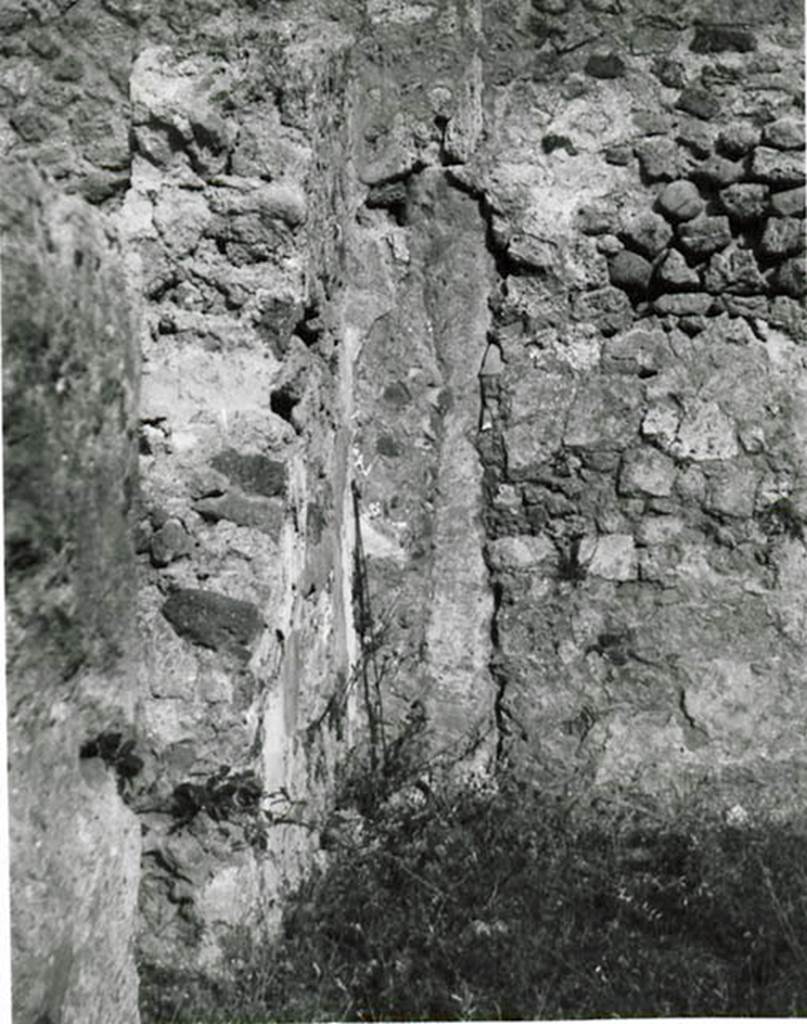
1.2.3 Pompeii. c.1900. Drawing by Pierre Gusman, medallion enclosed in circles of wreaths of leaves, showing a Bacchante with a vase on a base.
Probably from the third cubiculum on the left of the atrium,
(north side).
See Gusman P., 1900. Pompeii: The City, Its Life & Art. London: Heinemann, p. 370.
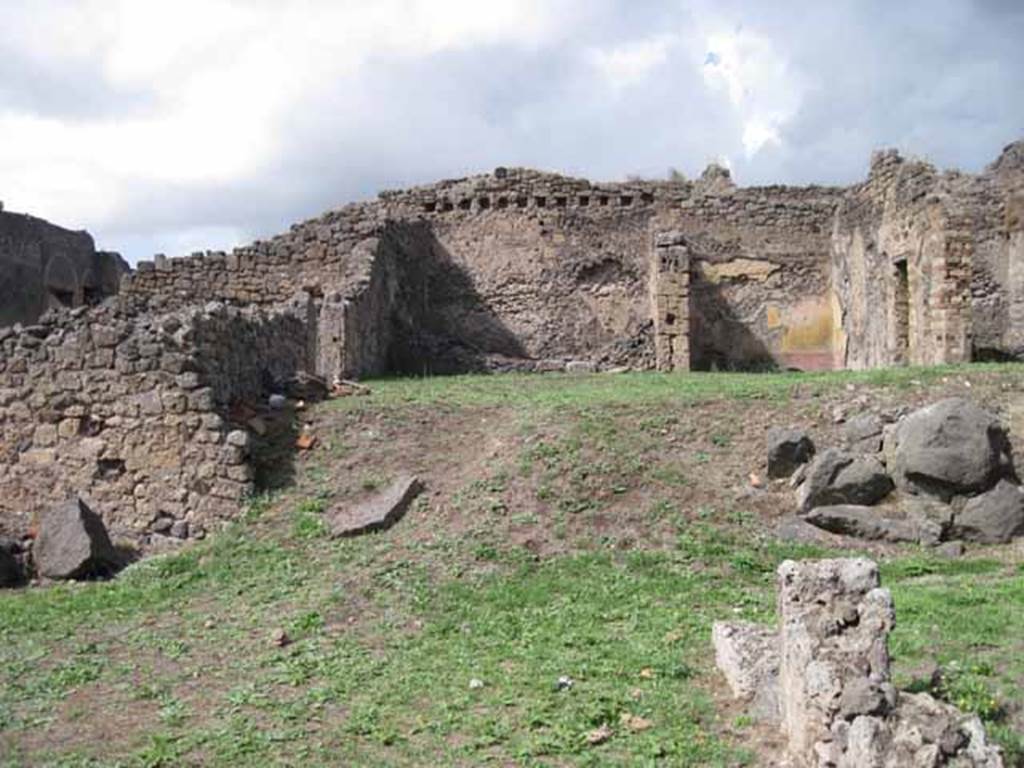
I.2.3 Pompeii. 1935 photo taken by Tatiana Warscher. Warscher described this photo as –
“I.2.3, nel
cubicolo (b) vi è un piccolo incavo rivestito interamente di marmo destinato a
contenere una lucerna.”
She also quoted Bull. Inst. 1874, p.203 as saying:
“Di sopra ed
interrompendo il quadro stesso v’è una piccola nicchia rivestita di marmo, per
mettervi un lume”.
See Warscher T., 1935. Codex Topographicus Pompeianus: Regio I.2. (no.7), Rome: DAIR, whose copyright it remains.
(translation: “I.2.3, in cubiculum (b) there was a small recess entirely clad in marble and intended to contain a lantern”.
She also quoted Bull. Inst. 1874, p. 203 as saying:
"above and interrupting the same painting there was a small marble-clad niche, for putting a light”.)
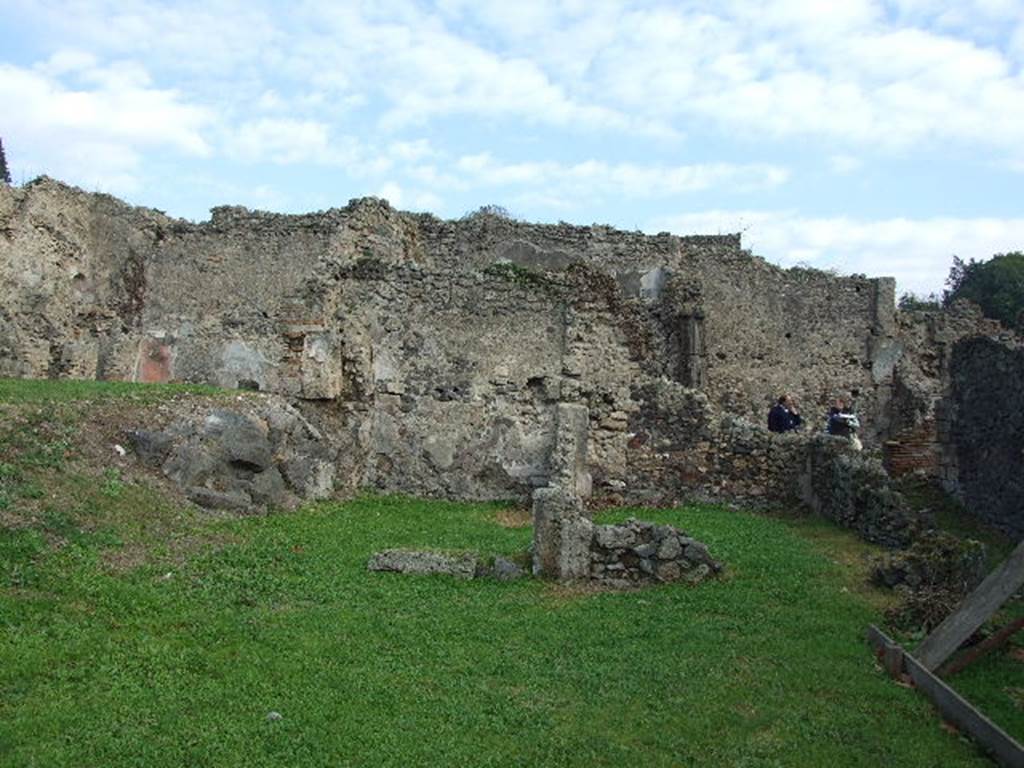
I.2.3 Pompeii. 1935 photo taken by Tatiana Warscher. Warscher described this photo as –
“I.2.3, nella
camera (b) a sinistra dell’atrio (nord) è degno di speciale attenzione il muro
nord:
vi è una
colonna di tufo molto rassomigliante a quella di Mau o cosidetta colonna
“etrusca” (VI.5.17).
Fino que non
faranno gli scavi sotto la colonna – noi dobbiamo astenerci da ogni
conclusione.
Ma in caso che
questa colonna è usata solamente come un pezzo di materiale, noi abbiamo tutto
il diritto di dire che hanno troppo parlato intorno alla colonna Mau.
See Warscher T., 1935. Codex Topographicus Pompeianus: Regio I.2. (no.8), Rome: DAIR, whose copyright it remains.
(translation: "I. 2.3, in room (b) to the left of the north side of the atrium, the north wall was worthy of special attention:
there was a tufa column very much resembling to that of Mau’s, the so-called "Etruscan" column (VI. 5.17).
Until there will be an excavation under the column – we must abstain from any conclusion.
But in case that this column was used only as a piece of material, we have every right to say that too much has been spoken about the Mau column.”)
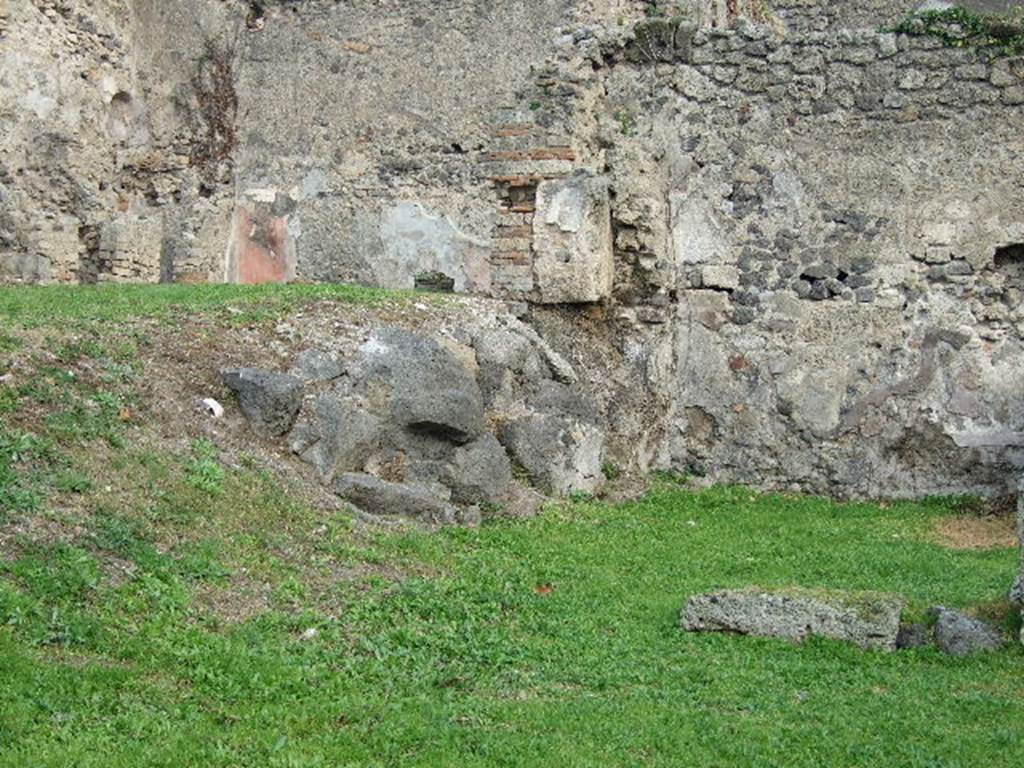
1.2.3 Pompeii. September 2010. Looking north towards remains of north wall (right or north-eastern corner of atrium).
The north wall of house at I.2.6 is visible at the rear. Photo courtesy of Drew Baker.

I.2.3 Pompeii. October 2024. Looking east across atrium. Photo courtesy of Klaus Heese.

I.2.3 Pompeii. December 2006. Looking east across atrium.
The triclinium, left, contained a large block of Vesuvian lava from pre-historic times.
The tablinum and the corridor to the garden are on the right-hand side of the picture.

I.2.3 Pompeii. December 2006. North and east side of triclinium on lower level, with a large block of Vesuvian lava from pre-historic times.
To the north on the higher level are the remains of house number I.2.6. This area was bombed in September 1943.
The impluvium was destroyed, and the three rooms to the north of the atrium, together with the north wall separating the two houses were demolished.
See Van der Poel,
H. B., 1986. Corpus Topographicum Pompeianum, Part IIIA.
Austin: University of Texas. (p.4).
See Garcia y
Garcia, L., 2006. Danni di guerra a
Pompei. Rome: L’Erma di Bretschneider. (p.37-38).