Pompeii. Painted street shrine to twelve gods at VIII.3.11.
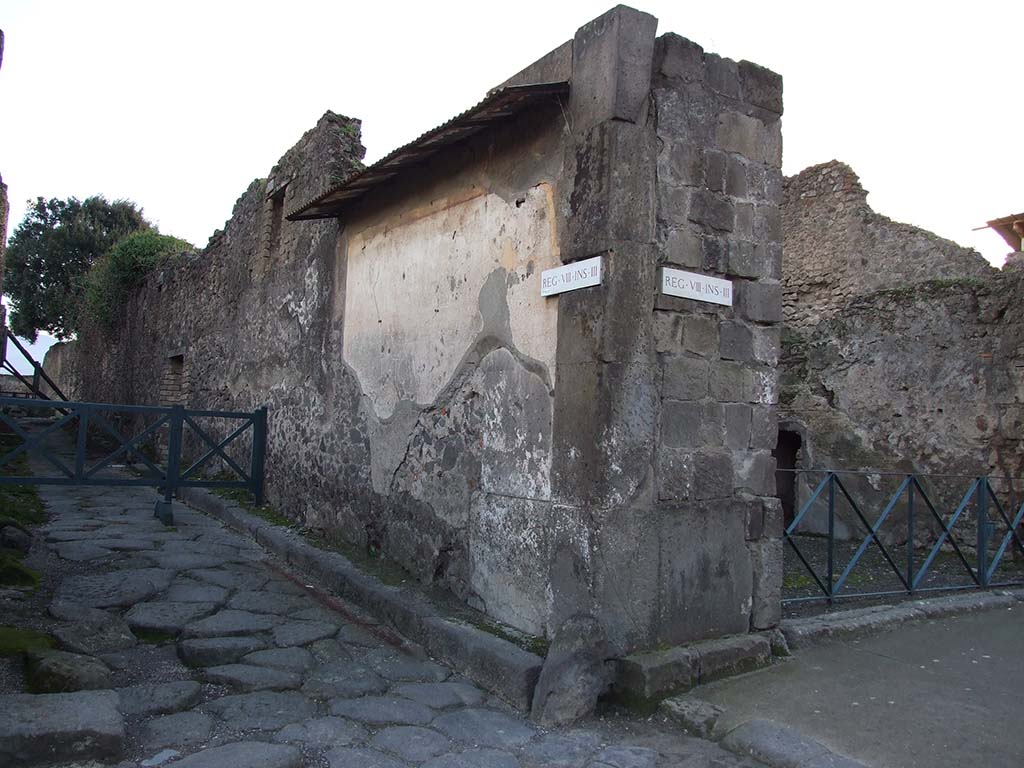
Looking south along painted street shrine to twelve gods.
On corner of Vicolo
dei 12 Dei and Via dell’ Abbondanza at VIII.3.11 in December 2006.
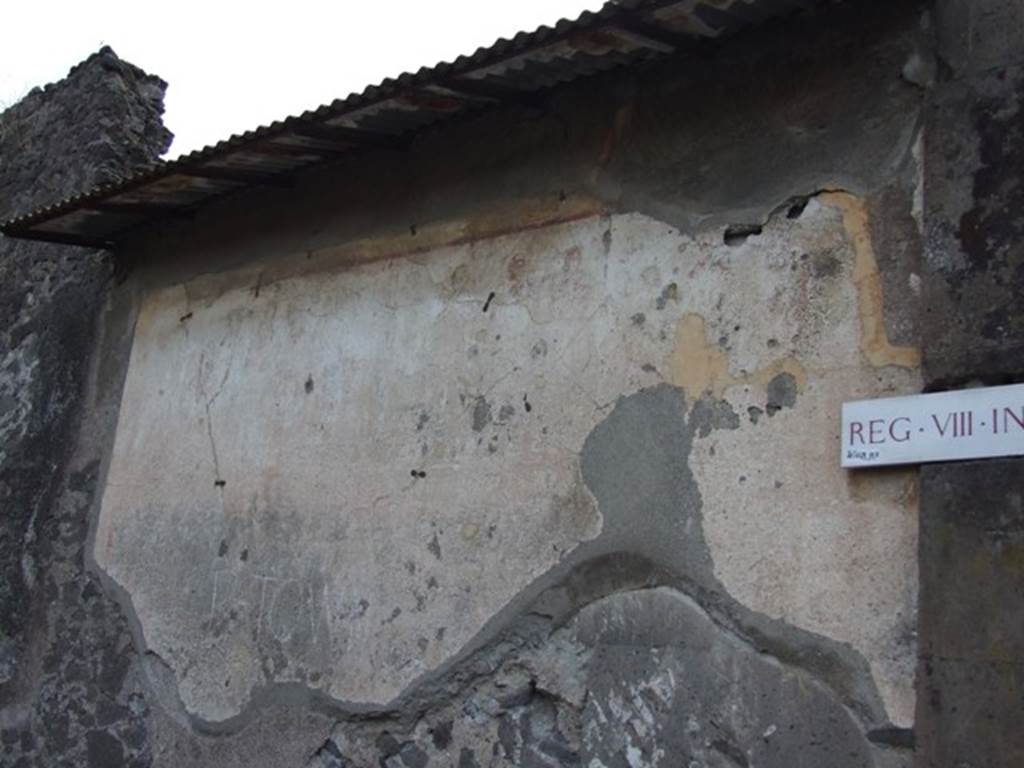
Painted street shrine to twelve gods on corner of insula at VIII.3.11 in December 2007.
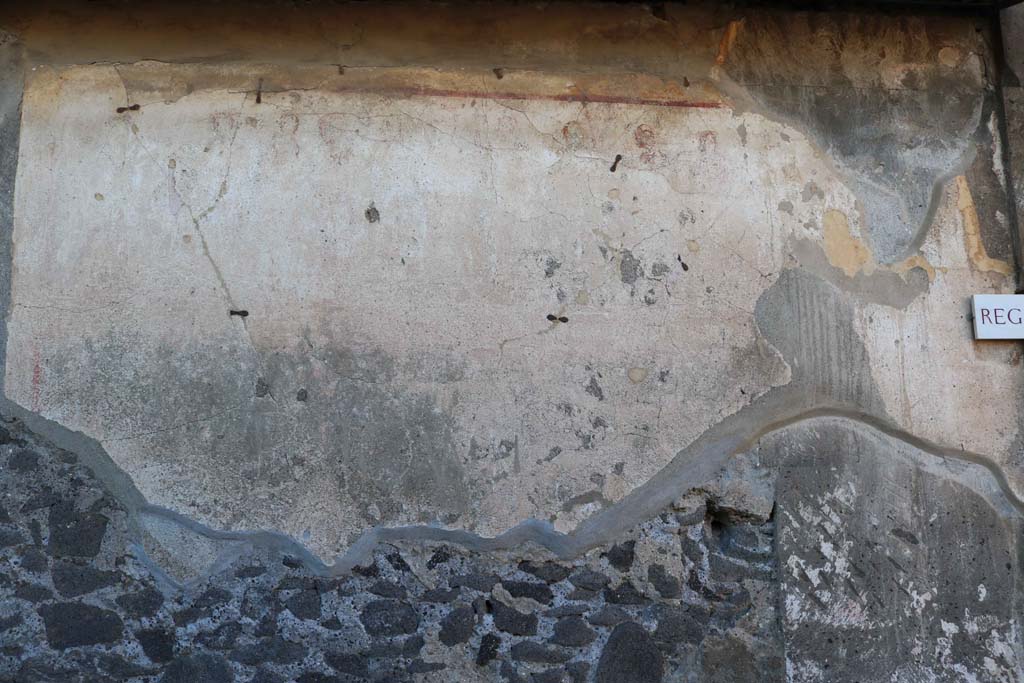
Painted street shrine of the Twelve Gods on
corner of insula at VIII.3.11, in Vicolo dei Dodici
Dei. December 2018.
Photo courtesy of Aude Durand.
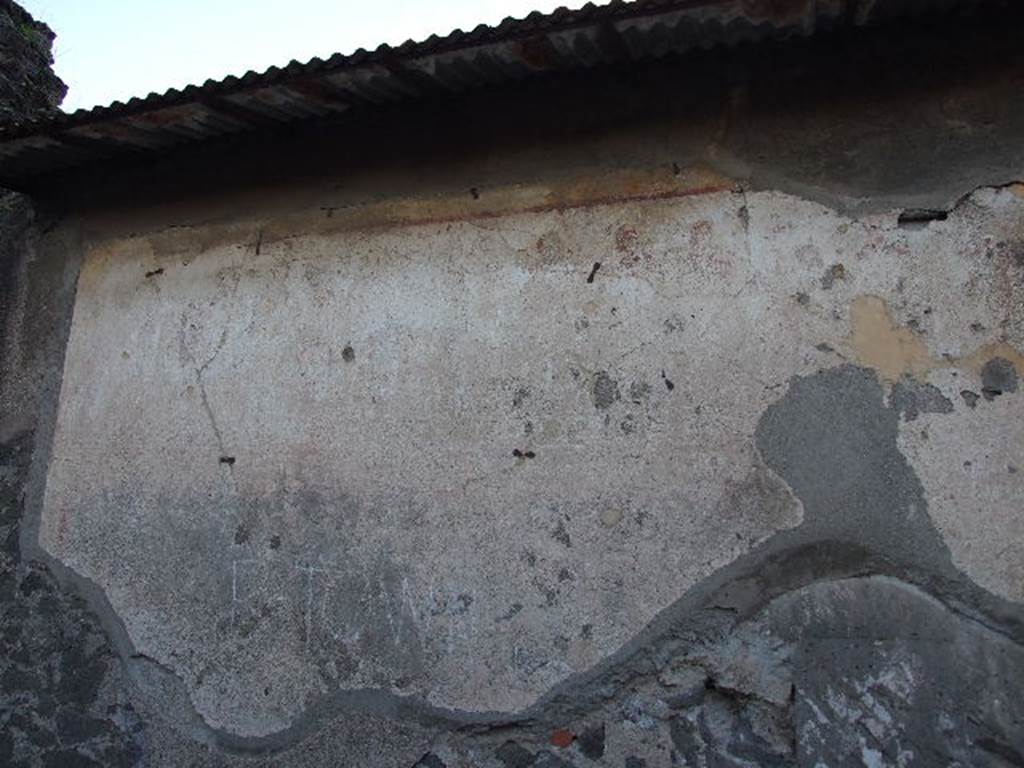
Painted street shrine to twelve gods on corner of insula at VIII.3.11 in December 2006.
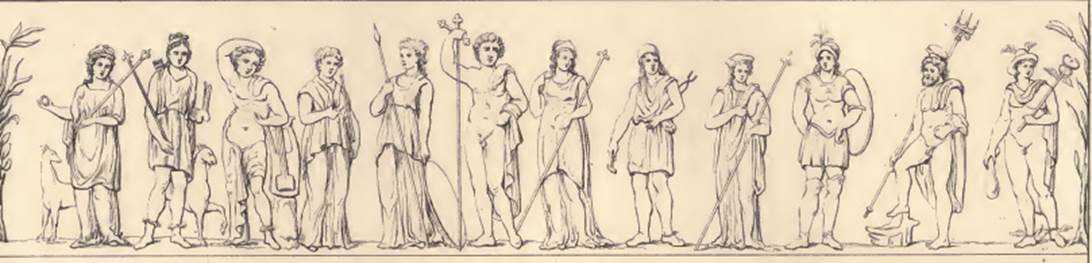
Painted street shrine to twelve gods on corner of insula at VIII.3.11. Pre-1840 drawing of the Twelve Gods. Discovered in 1818.
Roux describes this painting as executed in a correct but curious way in that it shows the twelve main gods with their attributes.
Roux names them from the left as Venus, Diana, Apollo, Vesta, Minerva, Jupiter, Juno, Vulcan, Cérès, Mars, Neptune and Mercury.
Beneath this painting were painted two serpents.
See Roux, H.,
1840. Herculanem et Pompei recueil général
des Peintures, Bronzes, Mosaïques : Tome 5. Paris: Didot. (Planche
11).
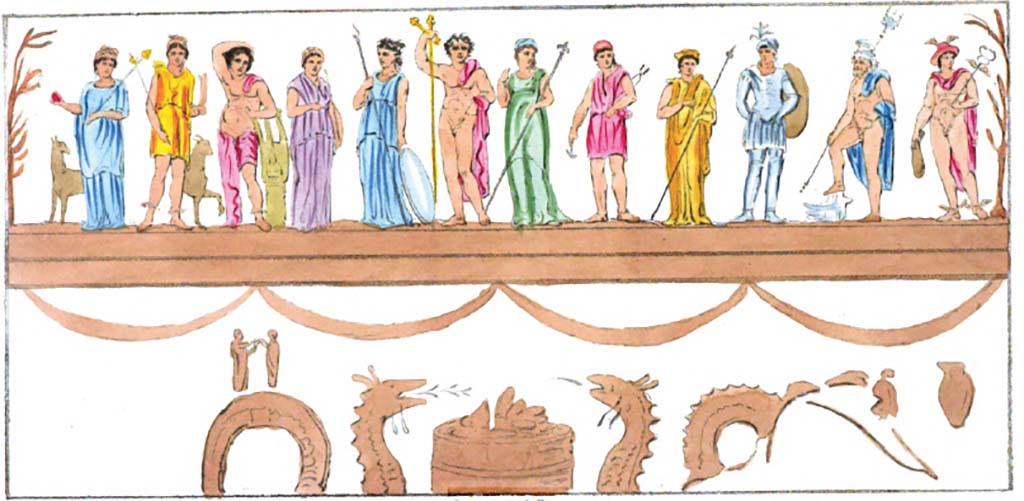
Painted street shrine to twelve gods on corner of insula at VIII.3.11. 1852 painting of twelve gods from Pompeiana by Gell and Gandy.
Gell names them from the left as Juno, Diana, Apollo, Vesta, Minerva, Jupiter, Venus, Vulcan, Cérès, Mars, Neptune and Mercury.
He states, “Juno has the pomegranate and the blue robe” and “The hair of Venus is different from the rest and her greenish robe more transparent”.
The naming of these two goddesses is the opposite of that put forward by Roux.
Gell identifies the two small figures underneath as “the genii loci”
See Gell, W. and Gandy, J., 1852. Pompeiana: Third Edition. London: Bohn. (p. 198-9, T:77)
Helbig refers to this as very misrepresented and better by A d J 1850.
See Helbig, W., 1868. Wandgemälde der vom Vesuv verschütteten Städte Campaniens. Leipzig: Breitkopf und Härtel. (7)
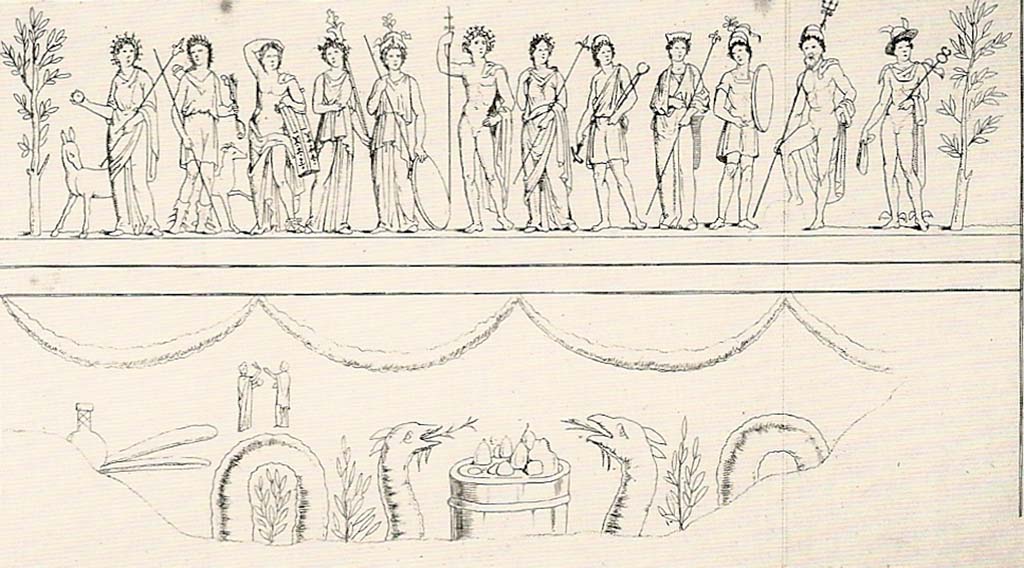
Painted street shrine to twelve gods on corner of insula at VIII.3.11. Drawing of about 1850 of the Twelve Gods.
Fröhlich echoes Helbig’s viewpoint and prefers this drawing of the twelve gods after Gerhard.
Fröhlich names them from the left as Vesta, Diana, Apollo, Ceres, Minerva, Jupiter, Juno, Vulcan, Venus Pompeiana, Mars, Neptune and Mercury.
This again differs from the names given by Roux and Gell.
Fröhlich identifies the two small figures as possibly priests.
See Fröhlich, T., 1991. Lararien und Fassadenbilder in den Vesuvstädten. Mainz: von Zabern. (p.330, F60, T:60,3).
![Altar VIII.3.11 Pompeii. c.1819, sketch by W. Gell of the painting of the 12 Gods, with part of the painting of the two serpents.
Here Gell names them from the left as Ceres, Diana, Apollo, Themis, Minerva, Jupiter, Venus, Vulcan, Vesta, Mars, Neptune and Mercury.
See Gell W & Gandy, J.P: Pompeii published 1819 [Dessins publiés dans l'ouvrage de Sir William Gell et John P. Gandy, Pompeiana: the topography, edifices and ornaments of Pompei, 1817-1819], pl. 54.
See book in Bibliothèque de l'Institut National d'Histoire de l'Art [France], collections Jacques Doucet Gell Dessins 1817-1819
Use Etalab Open Licence ou Etalab Licence Ouverte](Altar%2080311_files/image012.jpg)
Altar VIII.3.11 Pompeii. c.1819, sketch by W. Gell of the painting of the 12 Gods, with part of the painting of the two serpents.
Here Gell names them from the left as Ceres, Diana, Apollo, Themis, Minerva, Jupiter, Venus, Vulcan, Vesta, Mars, Neptune and Mercury.
See Gell W & Gandy, J.P: Pompeii published 1819 [Dessins publiés dans l'ouvrage de Sir William Gell et John P. Gandy, Pompeiana: the topography, edifices and ornaments of Pompei, 1817-1819], pl. 54.
See book in Bibliothèque de l'Institut National
d'Histoire de l'Art [France], collections Jacques Doucet Gell
Dessins 1817-1819
Use Etalab Open Licence ou
Etalab Licence Ouverte
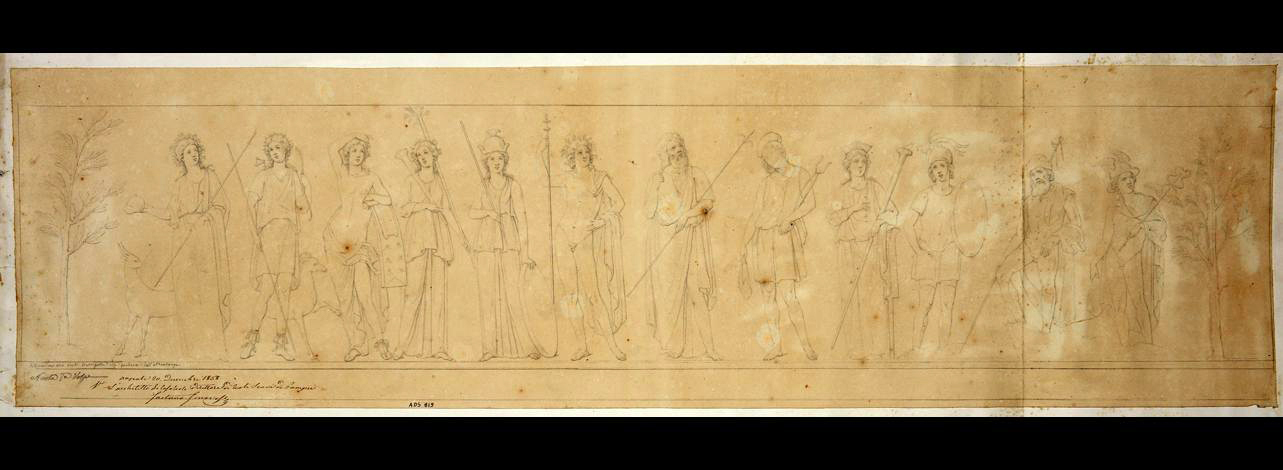
Painted street
shrine to twelve gods on corner of insula at VIII.3.11. 1858 drawing of gods by
N. La Volpe.
Now in Naples Archaeological Museum. Inventory number ADS 819.
La scheda ICCD descriva:
Il disegno raffigura la teoria dei dodici dei,
delimitata da due alberelli; partendo da sinistra si hanno
Vesta, dietro cui si scorge un asinello.
Diana, abbigliata da cacciatrice, con arco, asta e
faretra, nei cui pressi è una cerva.
Apollo a torso nudo, appoggiato alla cetra.
Cerere coronata di spighe, con la lunga fiaccola.
Minerva elmata, con scudo e lancia.
Giove, giovane, nudo, appoggiato al lungo scettro.
Un personaggio barbato che dovrebbe invece essere
Giunone con lo scettro.
Vulcano sbarbato, pileo sul capo, martello nella
destra e tenaglie nella sinistra.
Venere Pompeiana con lunga fiaccola e corona
turrita.
Marte senza barba, con elmo e scudo.
Nettuno, barbato, coronato, con copricapo e tridente
nella destra.
Mercurio con calzari alati, petaso, caduceo e marsupio.
Photo © ICCD. https://www.catalogo.beniculturali.it
Utilizzabili alle condizioni della licenza Attribuzione
- Non commerciale - Condividi allo stesso modo 2.5 Italia (CC BY-NC-SA 2.5 IT)
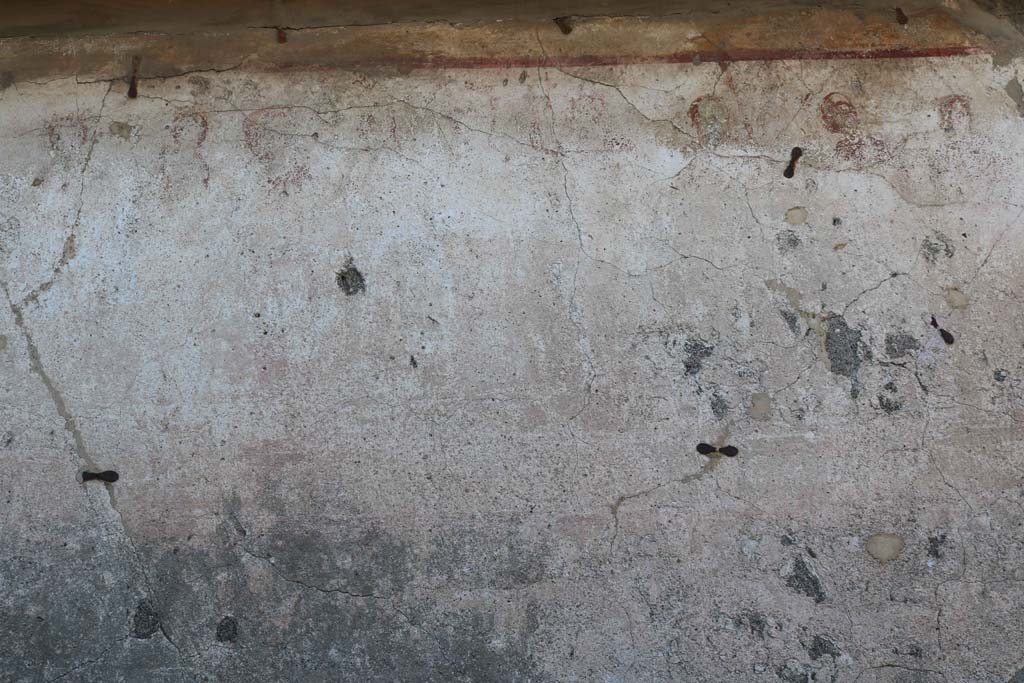
Painted street
shrine to twelve gods on corner of insula at VIII.3.11 in December 2018. Photo
courtesy of Aude Durand.
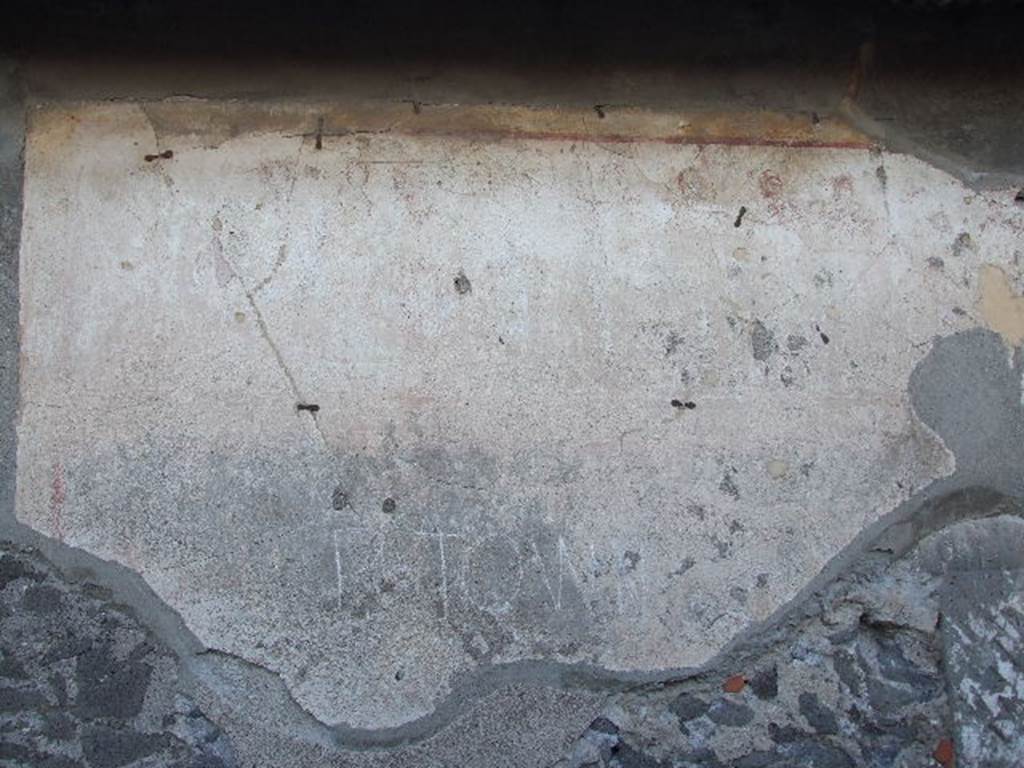
Painted street shrine to twelve gods on corner of insula at VIII.3.11 in December 2006. At south end.
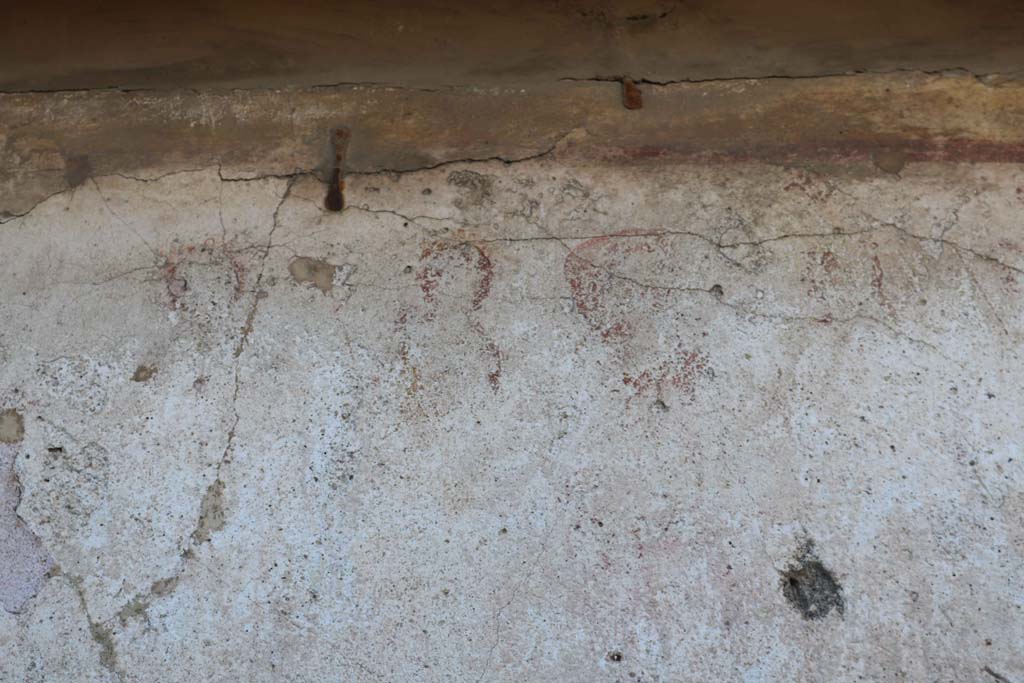
Detail of painted street shrine to twelve gods on corner of insula at VIII.3.11 in December 2018.
South end. Photo
courtesy of Aude Durand.
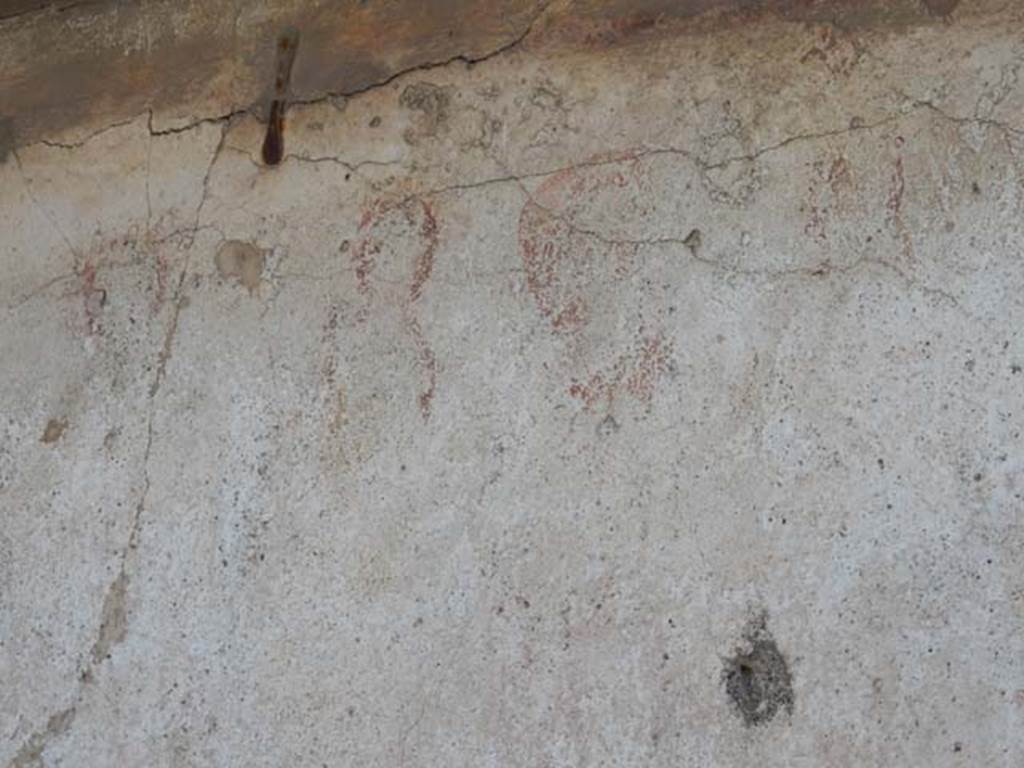
Painted street shrine to twelve gods on corner of insula at VIII.3.11 in May 2015.
Remains from upper south end of centre. Photo courtesy of Buzz Ferebee.
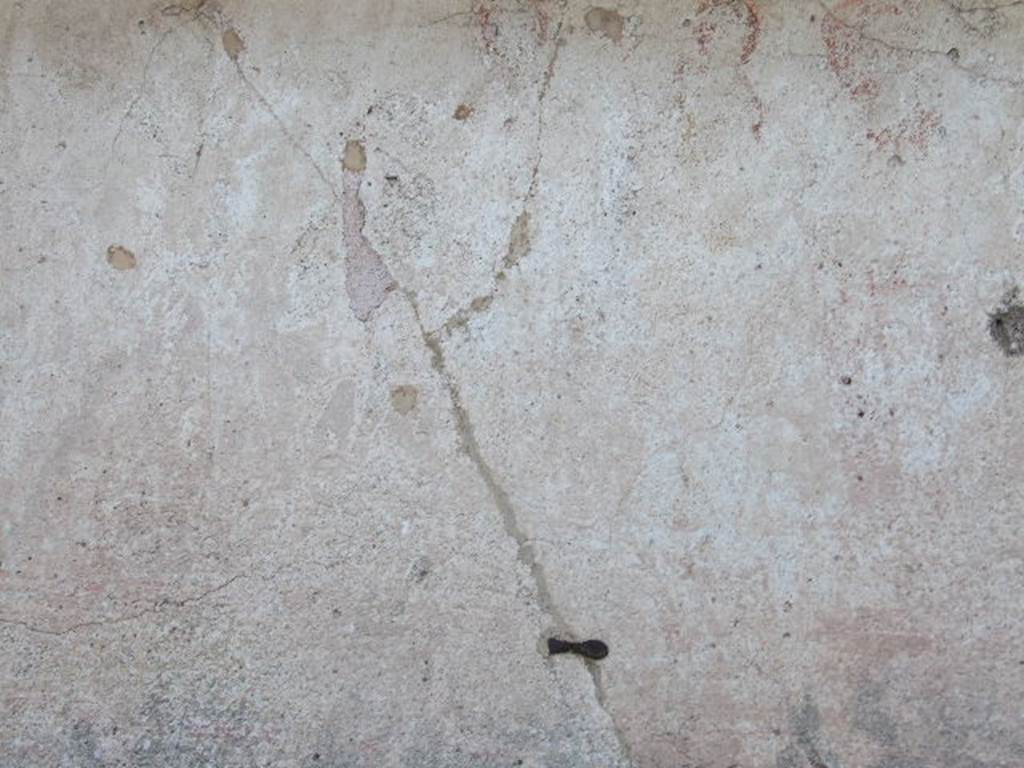
Painted street shrine to twelve gods on corner of insula at VIII.3.11 in December 2006. South end.
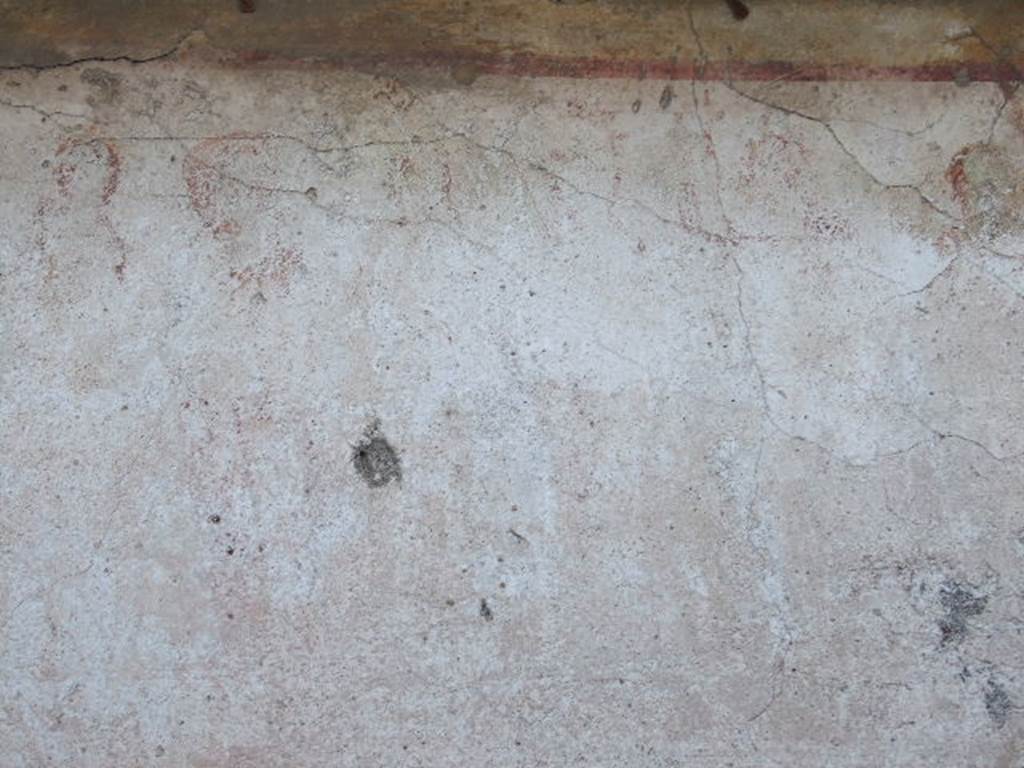
Painted street shrine to twelve gods on corner of insula at VIII.3.11 in December 2006. South end of centre.
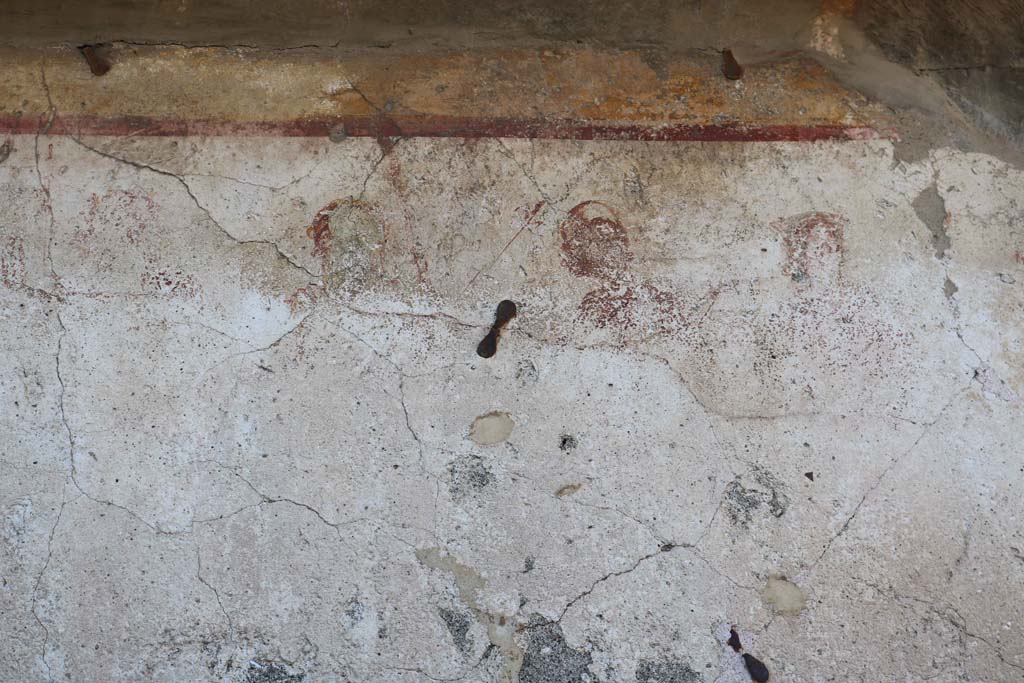
Painted street shrine to twelve gods on corner of insula at VIII.3.11 in December 2018.
Detail from north
end of centre. Photo courtesy of Aude Durand.
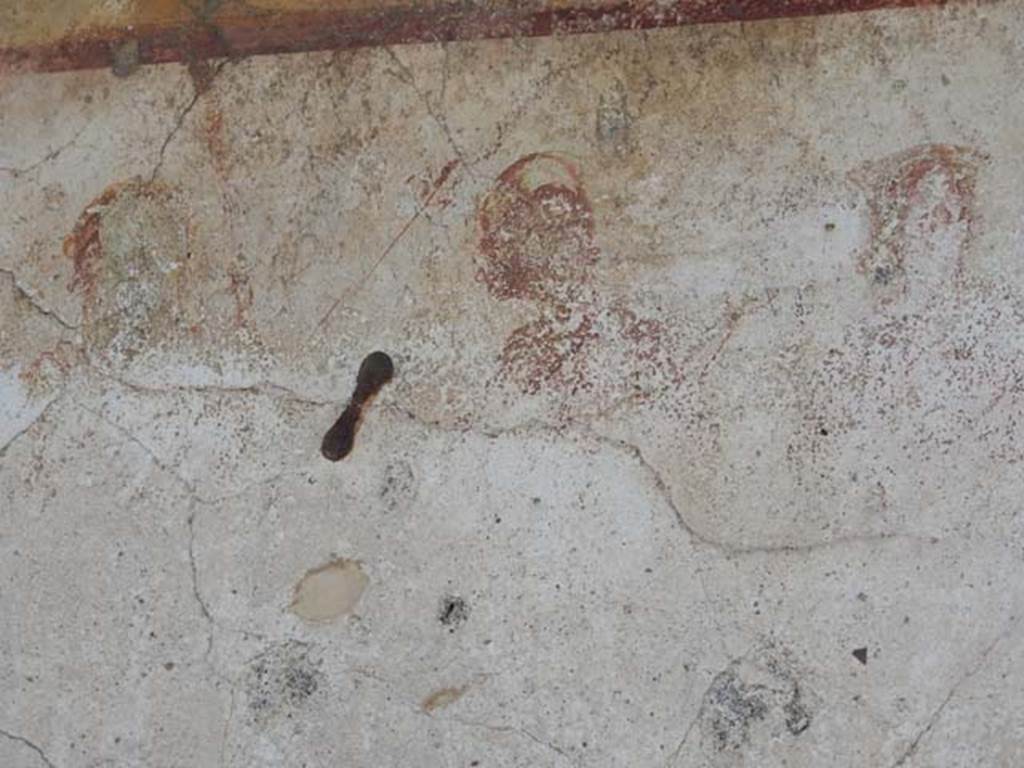
Painted street shrine to twelve gods on corner of insula at VIII.3.11 in May 2015.
Detail from north end of centre. Photo courtesy of Buzz Ferebee.
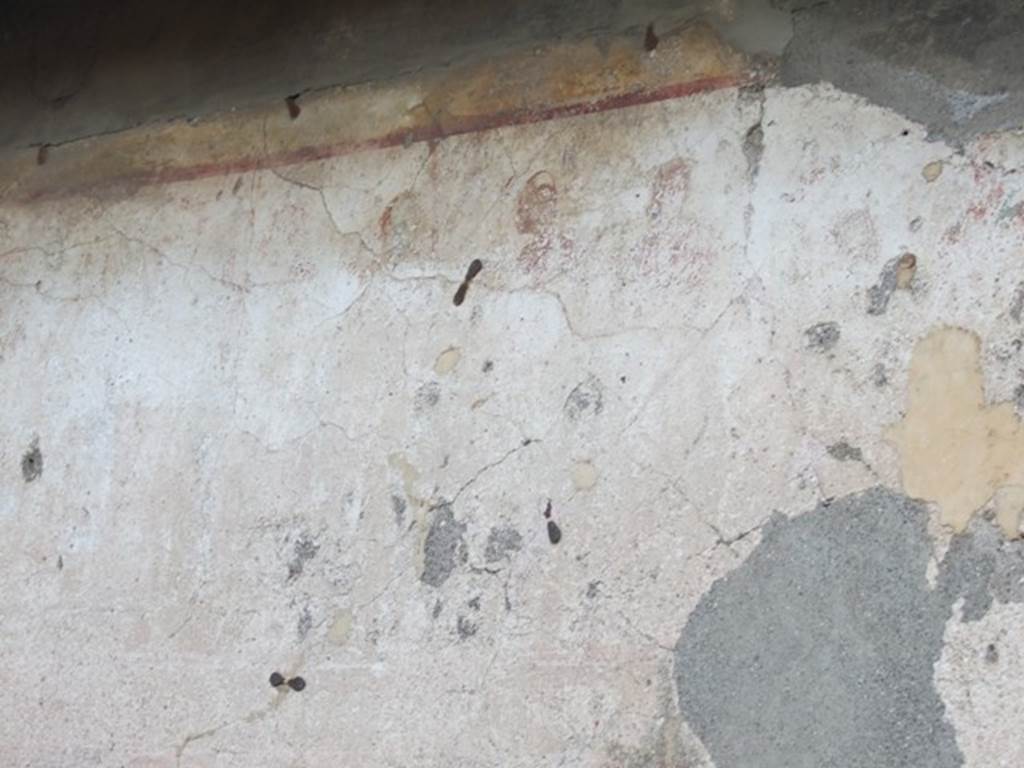
Painted street shrine to twelve gods on corner of insula at VIII.3.11 in December 2007. North end of centre.
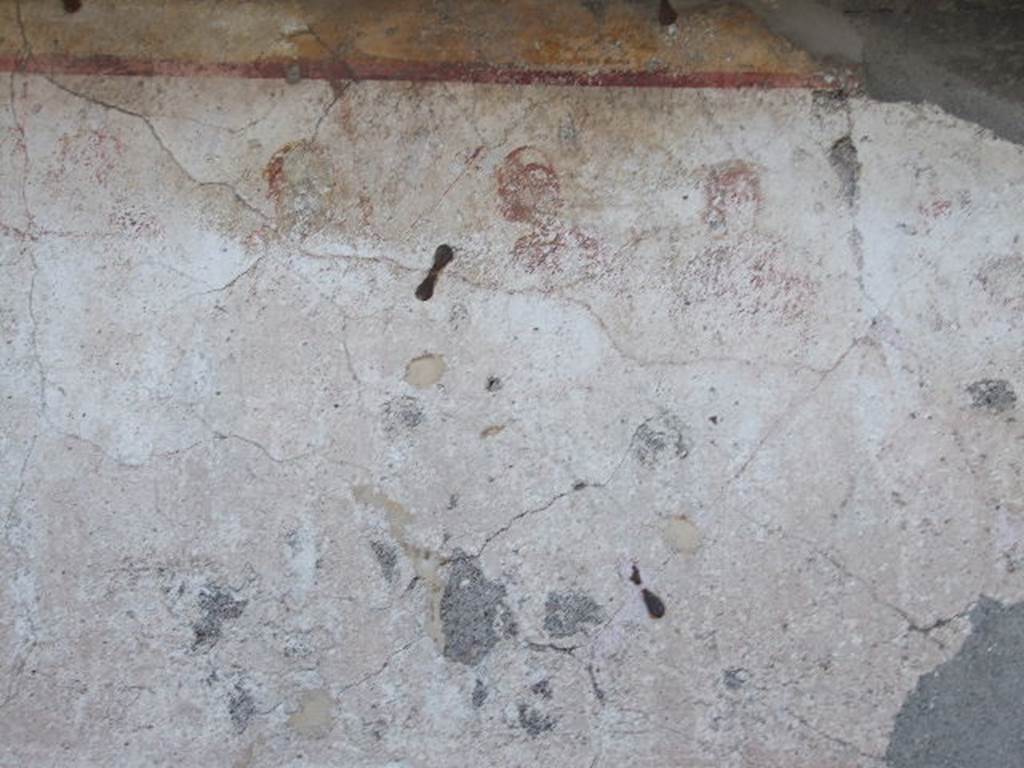
Painted street shrine to twelve gods on corner of insula at VIII.3.11 in December 2006. North end of centre,
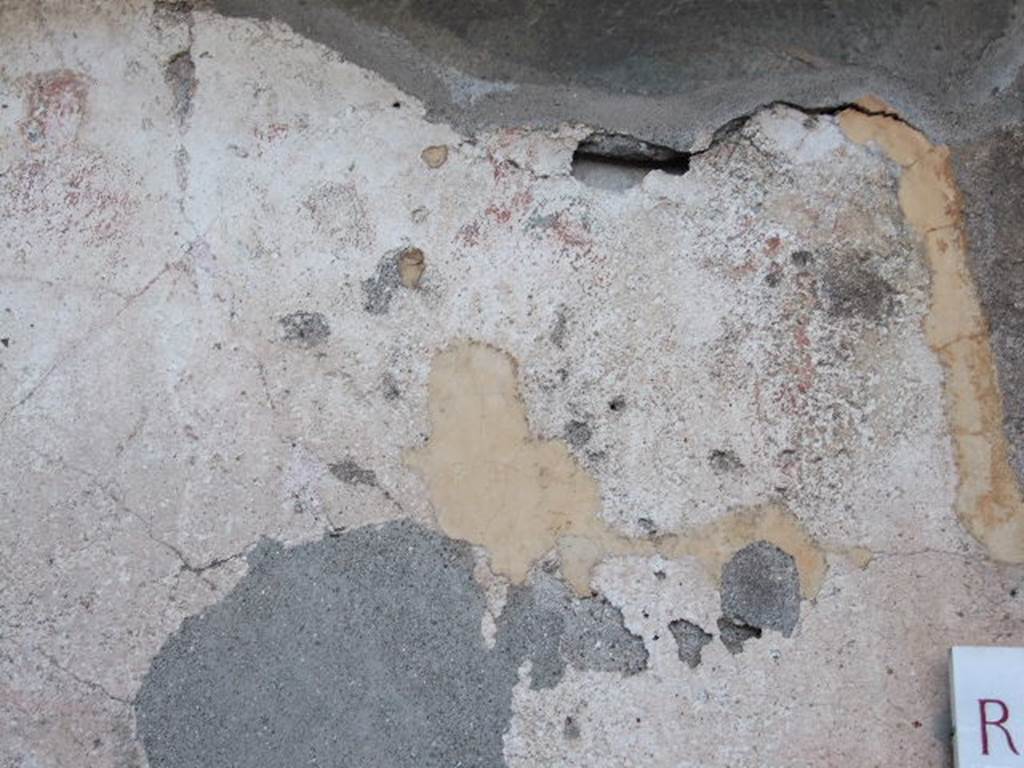
Painted street shrine to twelve gods on corner of insula at VIII.3.11 in December 2006. North end.
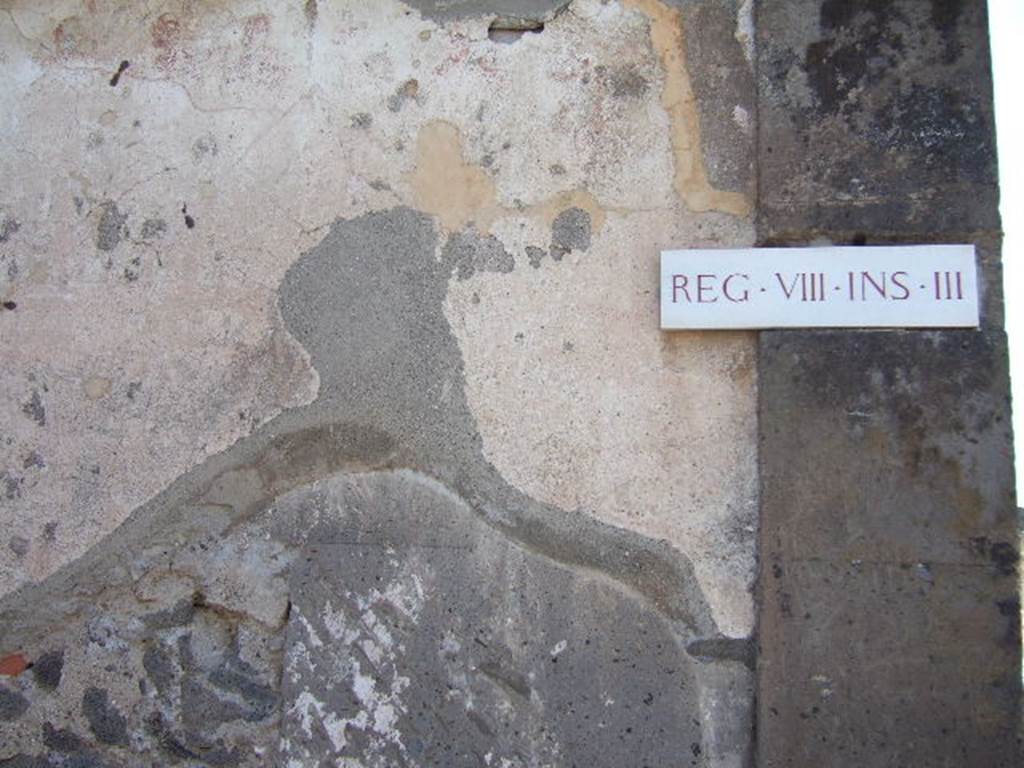
Painted street shrine on corner of insula at VIII.3.11 September 2005. North end.